
Author: HairWeavings Editorial Team
Why the Cycle of Overeating Is a Game-Changer When We’re Losing after 50

I told myself, this time will be different. And it was, but only because I was different.
Here’s the scoop.
Like so many of us, I’d lost weight before – from kid-hood into my mid-30s – only to find the pounds pile on once again.
However, this time would bedifferent because while – of course – I wanted to lose, my primary mission was to figure out the habits needed to preserve my hard-won loss.
I was done losing weight only to go back to square one.
My new plan was to train my brain to embed healthier eating habits. And as I did, it became glaring to me that while we’re constantly admonished to “eat this, not that,” the so-called experts know little about how our powerful brains affect overeating itself; that whatever we put into our mouth is merely the end result of a sophisticated cognitive process.
I started to have a sneaking suspicion that changing our thoughts might change our results.
My Favorite Thinking Tool
Of the many thinking tools I used while losing, my hands-down favorite was what I ended up calling the Cycle of Overeating.
Using the cycle meant that when I was having an intense craving, I could pinpoint where I was on the cycle at any given moment, and thereby make a positive intervention and – with practice – change the final outcome.
One caveat: I’m talking about the kind of overeating sessions that can see us wipe out a box of Ding Dongs or drink too much wine and chow down a medium-sized pizza. Enjoying a slice of cheesecake is fine. Eating the entire cheesecake because we’ve been triggered is the type of overeating I’m addressing here.
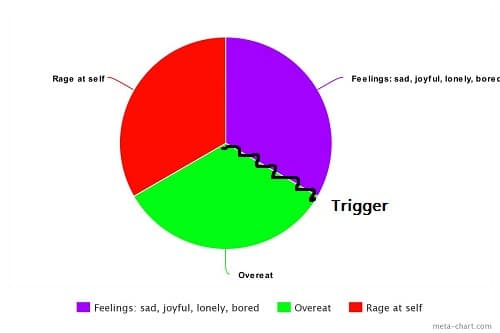
Take a look and then I’ll explain the ins and outs.
Cycle of Overeating
The Purple Slice
In learning the cycle, let’s begin with the purple slice that represents our feelings (e.g., we’re thrilled, angry, content, disgusted and so forth). Some might have one feeling only – say, sadness – that triggers overeating, while others can experience a bevy of strong feelings and head straight for the Easter candy (me).
As an example, let’s say that our trigger-feeling is jubilance. When we’re in the purple slice, here’s how our internal self-talk might go, I may have landed the job!! If I did, I deserve to party!!
We’re at the squiggly-trigger line when we receive the call saying, “You’re hired!!”
It’s Not Easy Being Green
At that, we bounce into the green where we overeat because we “deserve” it: we might party alone in front of Hulu with a towering bowl of ice cream, or go out with friends and faceplant into a massive margarita and entree at our favorite Mexican restaurant.
It’s important to note that overeating isn’t just an “at home in secret, alone” activity. We can also overeat at parties, restaurants, with the gang at lunch, at the movie theater and so on.
And Finally: Rude-Red
After satiating a craving, we’re then hurled into the red slice where our powerful pre-frontal brains – finally awake – growl, What have you done?! We were doing so well on our healthy eating plan, and you go and ruin it. Don’t even look at me. I’m so fed up.
A very rude pre-frontal.
In response to our brain’s anger, we either clamp down hard on ourselves, expecting nothing less than perfection as we attempt to make zero mistakes on our eating plan, or we utterly give up (I’m done trying. Women over 50 just can’t drop weight. Wendy probably had Lipo anyway.).
When we go the “perfection” route, we eventually give up anyhow. We might eat “perfectly” for five or six days, but when real life intrudes, we’re back to “messing up” again.
Days, weeks, months or even years later we again try a new eating plan only to hop back onto The Cycle of Overeating once more.
And on it goes.
Stepping Off the Cycle
Leaving the cycle in your dust isn’t a “one and done” thing (I wish). It’s more the work of a lifetime: when we’re besieged by cravings, here’s how to use the cycle:
- Become crystal clear about which emotions trigger you (if they all trigger you, that’s important to know too).
- Learn to identify where you are on the cycle so you can step in and create a new experience for yourself. (I’m super sad; I haven’t been triggered yet, but I’m getting close.)
- Establish new responses for your trigger emotions (it was life-altering when I realized that taking a page-turner to bed was more fun than inhaling Oreos in the evening).
- Developing reliable ways to stay clear of the red slice. When we beat-up on ourselves for being in the green slice (overeating), it’s like screaming and yelling, and expecting perfection from your fur-kids. You wouldn’t be awful to your fur-child, so don’t be awful to yourself.
- I’ve said it a gazillion times: if being cruel to ourselves worked, we’d all be a size 4. When I have a green experience I’m extra kind to myself. I might buy flowers for my desk, do my nails or brush my kitty. Being good to ourselves will catapult us out of rude-red.
If it’s seemed to you as if losing weight is super hard, that’s because losing weight is super hard.
But here’s the kicker: it’s okay to tell ourselves that this time will be different because it absolutely can be. For decades, we’ve been encouraged to look for answers to keeping our weight down in the wrong place (e.g., what we put into our mouths) when – all along – we had the glittering treasure that is our mind with us the entire time.
Let’s Have a Conversation:
Do you think losing weight is super hard? What do you think about the Cycle of Overeating? Which slice affects you the most?
Read More
4 Qualities That Help You to Embrace Aging

Aging. It’s happening and it’s weird. Some days I am relaxed in the process of it. Other days I am Don Friggin’ Quixote, battling the windmills with Pilates classes, hiking, and an overabundance of green salads and coconut water.
I’ve read all those inspirational articles about embracing and celebrating your 60s and your 70s. Hell, I’ve even written some of those articles! But I have to say, whether you embrace your age or not, it’s still weird.
It really does seem like 27 was last week and that 47 was just yesterday. The thing about aging is that you have to arm yourself with dignity and grace because that, and a sense of humor, is what it’s going to take.
Embrace Aging with Dignity
Recently, I attended a charity yoga event whose proceeds fight sex trafficking. After 20 minutes of sitting on the floor, my scoliotic back was screaming mad. And I muttered to myself, “Never again.”
Scoliosis, arthritis, brittle connective tissue – those things can make you alter how you do certain activities. After the event, I went to the director and suggested that next year there be a section for chair yoga.
I can do the same breathing and arm motions sitting on a chair without hurting my back. The chairs would have yoga mats in front of them for those who can still do some yoga positions on a mat.
I felt a sense of dignity that I had found a solution that would allow my full participation. That’s what dignity means to me – taking care of yourself, spiritually, emotionally and physically to the very best of your ability. Living well is not given. It must be claimed.
Grace
Grace is gratitude in action. No one likes being around a complainer, though I’m not saying that aging doesn’t have a list of legitimate complaints.
You don’t have to look too far to find aching knees, blurred vision or bad backs, not to mention sagging skin. Note to self: smiling will make your face look less saggy, if you find reasons to do it.
Too tired to take a walk? I hear ya. But if you push yourself to do that walk, achy knees and all, you are going to feel better when you’re done. That’s the grace of it.
Grace is the result of an attitude of gratitude. One of the things that helps me is to keep a gratitude journal. Or, you can create a daily list in your head.
Set aside five minutes and speak aloud all of the things about life that you are grateful for. Once you start listing what you’re thankful for, you’ll see that your gratitude outnumbers the complaints.
Humor
Keep your sense of humor close at hand. Do you catch yourself groaning as you get up from a chair? Make sure to laugh at yourself when you do.
Does it sometimes look like only 12-year-olds have driver’s licenses, and they’re all in your lane? That’s worth a chuckle. Do you talk about different kinds of fiber as if you are discussing fine wine? That’s pretty funny, too.
The insults of aging can be fodder for laughing your way toward the finish line. Life is going to have its way with you, so you might as well develop a sense of humor about it.
Be the Crone
Some women bristle at the word crone, but it’s a word that deserves to be reclaimed by us. Crone means crown. It is the crowning glory of your wise age. It is the mark of being an elder.
Let’s face it, you know stuff. You know more stuff now about what it means to fully be a human being than ever before. You’ve experienced loss, grief, failure and pain and you are still standing. You know how to hold life’s suffering and life’s joy side by side.
That’s why this is such a good time to mentor or volunteer. At the very least, use your crone years to write out the things you’ve learned about living this long. Claim your voice. Stand in the light of your truth.
Ageing is a strange new journey, a time of humbling and a time to laugh, a time to be wise and a time to remember child-like wonder. As a Zen master once said, “This being so, how shall I proceed?”
Proceed with caution. Proceed at your own risk. Proceed with laughter, love, grace and dignity. Say “thank you” as if it were the prayer of your life.
Let’s Have a Conversation:
What qualities enhance and help you in your process of ageing? What does it mean to embrace aging to you? Please share them with me in the comment section.
Read More
