
Author: HairWeavings Editorial Team

Olivia Rodrigo Just Revealed An Unreleased Glossier Product & I’m Drooling

There’s nothing better than a new Vogue Beauty Secrets video. We get to see inside a celebrity’s makeup or skincare routine for better or for worse. (Looking at you, Gwyneth). On Thursday, Vogue released our girl Olivia Rodrigo’s makeup routine and there are some gems inside the video. She reveals dermatitis she’s been dealing with, as well as where the 18-year-old gets breakouts. It’s sponsored by Glossier so of course, there are Glossier products strewn throughout—including an unreleased, top-secret lipstick launch.

Our mission at STYLECASTER is to bring style to the people, and we only feature products we think you’ll love as much as we do. Please note that if you purchase something by clicking on a link within this story, we may receive a small commission of the sale.

First, she pops Olly Multivitamin Gummys ($12.42 at Amazon), which she says taste as good as they make her hair look. The first step of her pre-makeup routine is washing her face with Epionce Milky Lotion Cleanser ($34 at Dermstore). “I had the worst case of dermatitis, where I just broke out all around my mouth and it was awful,” she says. “I think it was wearing masks a lot and also using a bunch of products that irritated my skin.” Now she’s all about a less-is-more approach.

She follows up her cleanser with a serum from The Ordinary, though we can’t tell exactly which one it is. Then she does a little relaxing Gua Sha. “I love alone time. I am very much an introvert,” she says. “And so doing stuff like that really helps energize me for whatever I’m doing in my work, or in my life. Next comes a little lip scrub and then the First Aid Beauty Ultra Repair Tinted Moisturizer SPF 30 ($28 at Ulta).

Rodrigo then applies Glossier Stretch Concealer ($18 at Glossier), which she loves for its buttery feel and buildable coverage. Next comes a little blush and bronzer (we can’t tell what she’s using), followed by winged eyeliner with Glossier Pro Tip
brush point liquid eyeliner ($16 at Glossier). She fills in her brows with a pencil and then uses Glossier Boy Brow ($16 at Glossier) to set them. Next, she curls her lashes and applies what looks like the Milk Makeup Kush High Volumizing Mascara ($25 at Sephora).

Finally, here comes the top-secret, unreleased Glossier Ultralip Gloss.

glossier ultra lip

YouTube.

“So the Ultralip has hyaluronic acid in it also which is great ’cause it keeps your lips moisturized which is very important for me,” she says. “I love how it’s buildable. I love the natural color of my lips. This just sort of accentuates that, it doesn’t try to cover it up or put a new color on top of it. It just emphasizes what you got.” She’s wearing the shade Ember.

We hear that the Ultralip is coming soon. It’s a lip tint with the sheen of a gloss and the moisture of a balm. Yes, we want it, too. We’ll update you as soon as it’s available.

STYLECASTER | Ashley Benson Interview


Read More

4 Powerful Ways to Succeed When Aging Alone

aging alone

I recently had the pleasure of speaking with Carol Marak on the issue of aging alone.

Carol earned a Fundamentals of Gerontology Certificate from the USC Davis School of Gerontology and advocates on behalf of older adults and family caregivers. She simplifies elder care research into doable know-how and steps for family caregivers.

The statistics is staggering – some 15 million people in the U.S. are what Carol calls elder orphans. It struck her particularly after her parents passed and she realized she was one of those orphans, with no partner and no children to take care of her.

“Certainly, there must be others out there,” she thought. Indeed, 19 percent of women between ages 40 and 45 have no children, and 27 percent of the 65+ population live alone in the U.S. Here are some ways Carol started preparing to age alone.

Get Your Legal T’s Crossed and I’s Dotted

Before you go any further, make sure you are legally protected as you age. Do you have a will, an estate plan, a trust, a medical and financial power of attorney, an advance directive? No? Then you had better get busy. Evaluate and update these documents every few years. Things change.

Evaluate Your Circumstances

Are you in the best health you can be? Evaluate your eating habits. Are you a couch potato? Look at your exercise routine. Staying healthy is the key to aging in place, in your home – a thing most people want to do and financially have to do, in many cases.

Do you have an active social network? Carol says you need to surround yourself with people. In essence, this is like forming a ‘family’ to substitute for a spouse and children. Create a lifestyle that does not isolate you as isolation leads to depression.

Consider a Move

Carol lived in a suburban area where she needed a car to get around. She deliberately thought about it and decided to move to an urban area.

She loves to walk and can walk to all nearby locations. In turn, she is keeping fit by walking. And, she avoids the conversation of “what happens when I can’t drive anymore?”

You might consider a move even if you already live in an urban area. If your home isn’t suited for aging in place, you might need to find a place that will serve you better.

For example, Carol chose a flat in a high-rise condominium. It minimizes the steps she needs to take and has the potential of growing old with her. She advocates for more universal design that accounts for the needs of an aging population.

Be Mentally Active by Being Socially Active

Aging alone can lead to mental decline unless you consciously work on it. Even people in assisted living communities can be technically living alone if they do not get out and mentally stimulate themselves.

If you are engaged, that’s great, but perhaps you know someone in your community, high-rise or senior living, that is isolated. Engage them even just for brief conversations. “You would be surprised how helpful that is to people,” Carol says.

Join the Elder Orphan Facebook Group

Carol has created a Facebook group that people can join for mutual support. But she has taken that further and formed her own local group that physically meets in her community. Take that cue and do the same.

Her group has more than 7,000 members. Consider joining. She has some criteria by which she screens candidates so answer the few questions she poses. It will help her know you are a good fit for the group.

Being alone is not exclusive to older people. Carol believes that it really does take a community to help solve the issue.

Are you aging alone? If so, what are your plans for avoiding social isolation? How can you work to relieve the isolation of people in your community? Please share your thoughts and ideas below.

Read More

3 Good Reasons Why NOT Everyone Over 60 Needs to Do Kegels

kegel exercises for women over 60

Are you diligently doing Kegels and finding it’s not helping your pelvic health at all? Perhaps you are experiencing involuntary loss of urine or urgent messages to find the bathroom (urge incontinence)? The very symptoms Kegels are meant to address.

Kegels are not a one size fits all. While it’s commonly believed that pelvic muscles loosen with age, fact is, not everyone over 60 needs ‘tightening-up exercises’. It all depends on whether you already have a Hypotonic (loose) or Hypertonic (tense) pelvic floor, or a combination of both types.

For many of us, the pelvic floor is a primary stress container. Just like our other body parts, stress can send the pelvic muscles into tension overdrive.

The pelvis also tightens with repetitive pressure. This includes from healthy activities (e.g., running, cycling). A recent study suggests that pelvic floor tension is a widespread unrecognised issue.

If you have a Hypertonic (tense) pelvic floor, there is already too much tone, so strengthening exercises like Kegels could cause pain and other problems ‘down there’. Let me explain.

Think of the pelvic floor as a foundation for your house. If it’s uneven, or overly tight (shorter) on one side, the foundation could pull the house or whole body – out of alignment. The result is an unstable structure.

How Do You Know If Your Pelvic Floor Is Too Tight (Hypertonic)?

Some common symptoms of very tight pelvic floor muscles are frequent and urgent messages to find the bathroom, digestive issues, constipation, irritable bowel, hip pain, shallow chest breathing (associated with anxiety) and lower back pain.

Important first steps are to consult your medical practitioner to rule out any underlying conditions and a pelvic floor physical therapist for confirmation and assistance.

What Else Can Help?

Relaxing Tight Muscles and Increasing Strength and Flexibility

Overly tight pelvic floor muscles can also be very weak. What we need for a healthy pelvic floor (like Goldilock’s porridge) is just right muscles, which can contract adequately. Muscles that aren’t too weak or too strong. Muscles also need to be able to stretch before they can strengthen.

This is where gentle exercise, like yoga, could assist. A qualified yoga therapist could work with you and your health care providers to develop a personalised program. For instance, to suggest particular yoga poses to find and stretch or contract appropriate muscles, or build strength.

While it’s important to get a proper assessment (and depending on your physical limitations), potential poses that can decrease the stress response and relax the pelvic muscles include ‘lying over a bolster’ and ‘legs on a chair’.

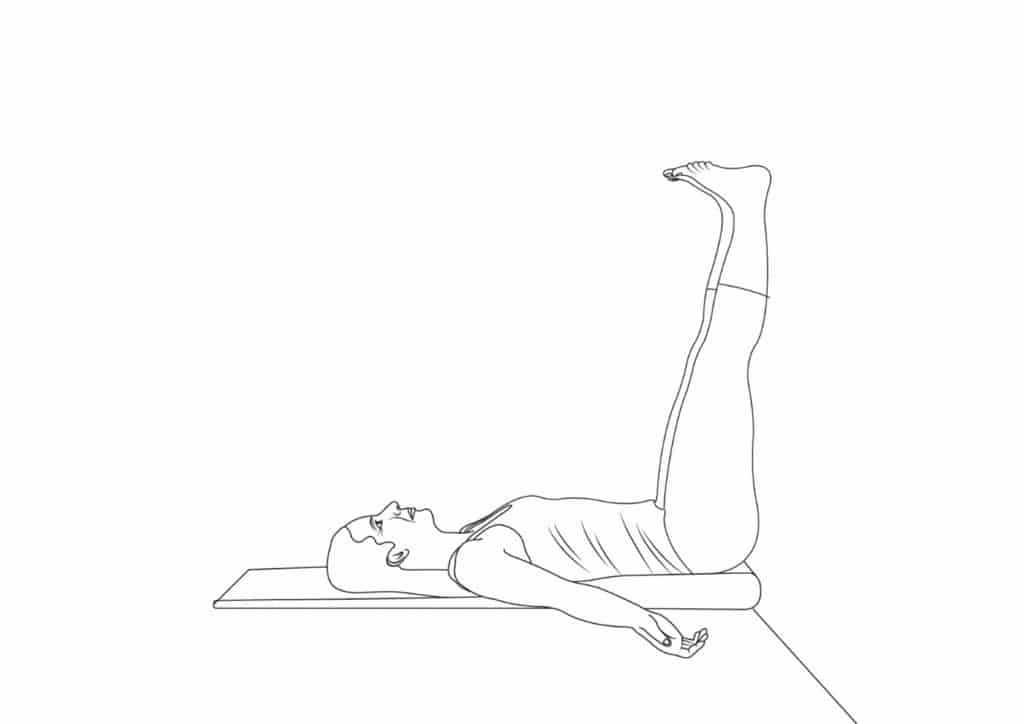
Legs on a Chair

This is a variation on the classic ‘legs up the wall’ yoga pose. Here the legs are supported by a chair (or sofa). To move into ‘legs on the chair’, you can start by sitting on a folded blanket facing the chair or sofa.

The knees are bent and feet placed on the floor. The hands are placed behind the pelvis and the back is slowly lowered to the floor. Then the feet are carefully lifted from the floor, to rest the heels and backs of the calves on the seat.

Legs on a Chair

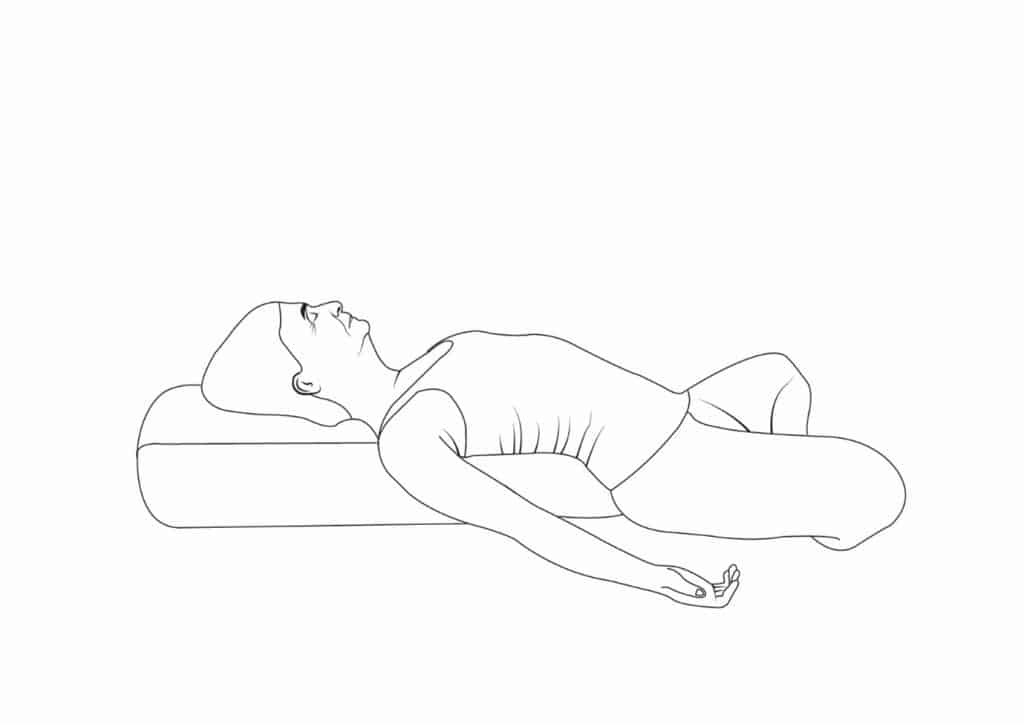
Lying Over a Bolster

Take a yoga bolster (or folded blankets or firm cushion) behind you with the edge of the bolster touching the lower spine. Depending on your physical limitations, carefully lower your body backwards over the bolster.

An alternative is to rest on the floor (or your bed) with your legs straight out – or knees bent, whichever is most comfortable – with a rolled towel or blanket under your knees.

Lying Over a Bolster

Correcting Improper Breathing Patterns

If the pelvis is overly contracted, breathing becomes restricted. Sometimes a habit (unhealthy) of ‘reverse’ breathing develops. Normally, on an inhale breath the diaphragm contracts and the pelvic floor (ideally) relaxes down.

On an exhale, the pelvic floor contracts passively. In reverse breathing the belly is pulled in, and the pelvic floor sucked up on the inhale breath.

Reverse breathing feeds the sensory nervous system stress response (fight, flight, freeze) releasing cortisol (stress hormone) into the body. If this continues, the central nervous system can become over-sensitised and on constant high alert. This leads to muscle guarding where muscles contract in the pelvis and elsewhere in the body causing more discomfit and pain.

Again, this is where a yoga therapist could assist. Practising breathwork, guided yoga Nidra (relaxation) and restorative poses is like pushing the reset switch. The central nervous system is given permission to soften the muscles, which decreases the stress response, enabling the pelvic floor muscles to unwind excess tension.

Are you experiencing urgent messages to find the bathroom and finding Kegels don’t help? Perhaps you’re experiencing pelvic pain during or after exercise? Do you know how to tell if you’re a reverse breather? Confused about how to tell if your pelvic floor muscles need tightening or relaxing? Please join the conversation and share your experiences.

Read More

Kameron Westcott’s Blue Floral Dress

Kameron Westcott’s Blue Floral Dress

Real Housewives of Dallas Instagram Fashion

Kameron Westcott looked pretty in pink  bold in blue—yes, you read that right—in her floral dress at the Nicky Hilton x @French_Sole event at Alice and Olivia Dallas last night. Really, ever since we spotted Kristin Cavallari’s slightly similar dress I’ve had cute little bows on my mind, so it’s no surprise Kameron was next to show up wearing some. And I’m here to deliver the deets on a fully stocked dress to you, all wrapped up in a bow, straight from Dallas.


The Realest Housewife,

Big Blonde Hair

Kameron Westcott's Blue Floral Dress


Click Here to Shop her Alice + Olivia Jocelyn Dress

Click Here for Additional Stock

Click Here for More Stock

Click Here for Even More Stock

Click here for Even MORE Stock

Originally posted at: Kameron Westcott’s Blue Floral Dress

Read More

Nighties and PJs for Older Women

nightwear for older women

Recently, one of my readers posted her answers to one of those Facebook quizzes (where you actually reveal all kinds of personal information for marketers.) Her answer for the “what do you wear to bed” question was “nothing.”

Now, I’m not a prude, and I certainly wouldn’t fault anyone for what they do or don’t wear when the temperatures and humidity are unbearable. But you’d never catch me going to bed in my birthday suit. That’s not just a fixture of my age or how I feel about my crepe-y skin. It has to do with my personality and style.

Why We Choose What We Wear to Bed

A couple of years ago, during a road trip with my sister, I put on my very old, very comfy cotton drawstring pajama bottoms and a similarly comfortable old tee shirt to turn in for the night. My sis, on the other hand, wore a long pink flowing nightgown.

I’m a laid-back natural type, and she’s always been a girly girl. Our styles haven’t changed in all these years, and at this point, they aren’t going to.

Now, if you are dressing for your man, every survey I read indicated that there was no clear preference in what they liked a woman to wear to bed. Old t-shirts, teddy sets, pjs, slinky nighties, even team jerseys got their praise.

So what should we older women wear for nighties? Whatever the heck we do want to! But let’s look at some of the varieties, some that are literally labeled “old lady nighties” (I didn’t make that up, it’s a “thing” – search on it) some that are slinky and sexy, and some that are plain – and just plain comfortable.

Textiles for Comfort

Starting with that last point, there is one thing that we older women can all agree upon: the material of what we wear to bed has to be comfortable. One of the reasons this becomes more important as we age is that our skin becomes thinner and is therefore more sensitive.

Regardless of how pretty a nightie might look on the hanger, we just don’t want anything that is scratchy against our skin, especially anywhere near our boobs. That means that stiff lace is out. And when you can find it, a garment that has a silkscreened label instead of one of those annoying tags on the neckline or the seams is a blessing.

Any knit fabric is pretty much fair game as far as comfort is concerned. But garments made from mostly natural fibers, those with no or very little synthetic component, are healthier for our skin in general. They allow it to breathe. After more than a year of trying to inhale through a face mask, we’ve become intimately aware of just how important air flow is!

The most popular natural materials for knit sleepwear include brushed cotton, rayon (which is cellulose, usually sourced from trees), and increasingly, bamboo. Bamboo is also a very ecologically sound choice. Anyone who has ever tried to tame a bamboo plant that is undermining a house foundation can attest to its self-regenerative ability.

Satin, if it is truly made by the efforts of many silkworms, is truly luxurious. These days almost all so-called satin that you find in department and specialty stores is actually polyester. But real silk satin nighties aren’t that terribly pricey.

And then, of course, in the colder climates and during long cold winter months, nothing beats 100% cotton flannel. The fluffy fibers trap air which is then warmed by your body heat. Unless you are still having hot flashes, flannel is the wintertime no brainer.

The feeling of a textile against our skin sends all kinds of feedback to our brains. Satiny fabrics read as pure sensuality and are more likely to release those yummy related hormones than, say, flannel. Also, the cut of the fabric has a psychological effect. A lot of slinky night gowns, both short and long, are cut on a bias. Anything with a bias cut implies motion and sensuality. It isn’t static or stiff.

But if a deep, child-like sleep is what you are hoping for, wearing brushed cotton or flannel might be more to your liking. Those fabrics are more, well, grounding, more the stuff of innocent dreams.

Gowns or Pajamas

I don’t know about you, but I have never had a nightgown or short nightie that didn’t creep further and further up my body at some point as I tossed and turned throughout the night. And I can’t stand my legs to be cold at night.

Those are the main reasons I opt for pajamas. But the downside, especially if you have put on some weight, is that even those expandable elastic or a drawstring cords can be a constant reminder of an expanding waistline. So there are tradeoffs.

Nighties often simply make one feel more feminine. (The afore-mentioned “old lady” nighties are a separate category. We’ll get to that in a minute.) One of my 50-something clients, just starting into a new relationship with a slightly younger man who pursued her mightily, asked for help shopping for nighties.

She went straight for the rack of black charmeuse, full-length slinky nightgowns. Her guy had always loved her feminine side and how she emphasized it. (He had been fantasizing about her for more than 30 years before they re-connected!)

But a long-sleeved nightshirt with piping trim, especially if it’s in a fine cotton or satin, can also be elegant and sexy. Piping is a classic trim element that speaks of refinement. Plaid patterned nightshirts are more, well, “yang” in their energy. But they can also be sexy because they are kind of like wearing your guy’s old shirt.

Moisture Wicking

My husband’s aunt had hot flashes well into her 80s! She was one of those people who craved the cold weather and winter snow. After her husband died, she left her home in the tropical climate he loved and moved back to a much cooler climate. Too bad she didn’t live long enough to know about something just on the horizon that might have made her sleep more pleasant.

Through the wonders of science, there are some new fabrics in nightwear that have been a god send for women who tend to run hot physically. These are, alas, made from man-made textiles. So, if you are sensitive to synthetics, they may not be a solution for you.

But the science behind them is fascinating and as with many things, was initially created for military use for troops that are deployed to extremely hot or humid climates. The goal was to create a microfiber that was as comfortable as soft cotton but that was able to wick moisture away from the body and keep you dry.

It also had to be anti-bacterial and remain odor free. The way it works is that as the moisture is wicked away from the body it also carries away excess heat, helping the body maintain its normal temperature.

Although I have personally avoided synthetics, one of the companies offering moisture-wicking loungewear and nightwear asked me to review some of their items and I was pleasantly surprised. They are in the UK and are called Cucumber as in “cool-as-a-cucumber.” This was my review including some photos of how I wore them.

“Old Lady” or “Sweet Young Thing”

So here’s the thing about the flannel nightgowns. They are not only comfortable and in their way, calming, they are also very practical. This is especially the case for anyone who has mobility issues, stiff joints or difficulty lifting or bending their knees.

Simply getting in and out of pajamas can be a challenge. A one-and-done nightgown that you just slip over your head or walk into and fasten with hooks or buttons makes total sense.

Generally, these types of nightgowns seem to come in three versions: plain with only slight embellishment, high-neck long-sleeved, often in flannel, and gauzy sheer cotton for warmer weather. They are also often designed with what are considered youthful style elements and trims.

You’ll typically see a lot of little floral patterns, pin-tucking, small ruffles at the neckline or hem, bib necklines, and round collars. Youthful style elements, as opposed to Romantic ones, tend to speak of modesty.

A lot of these types of nightgowns have that “Little House on the Prairie” look. Make of that what you will. They are just very comfortable and practical. And why not experience a second childhood? Unless you are experiencing a second coming-of-age… in which case, you might want to opt for the slinky nightgown.

Do you wear pjs or nighties? What is your favorite type? Has your style of nightwear changed over the years or recently? Has your significant other ever bought you any or commented on what you wore?

Read More