Month: February 2020

Travel and Coronavirus – What You Need to Know About Your Insurance Options

Coronavirus and Travel Senior Woman

With the outbreak of Coronavirus, you might be
worried about your travel plans. This article’s intention is to offer some
insight to assist you with the decisions you may need to make and the choices
that you have available as well as travel insurance considerations.

Are You Insured to Cancel Your Trip?

You’re unlikely to be insured for cancelation
due to something as trivial as worry unless you have purchased a policy that
allows you to cancel for any reason (CFAR).

If your policy includes CFAR, know that you
will still only be able to claim a percentage of your costs – the coverage will
be stated within your policy documentation.

Most policies exclude coverage or cancelation
for epidemics or pandemics, but they may cover non-medical evacuation should
governmental organizations call for it. To find out exactly what you are and
are not covered for, you need to read the fine print in your policy.

Your operator, airline, or hotel, rather than
your insurance company, may offer some alternatives to destinations or may
allow you to re-schedule, but there may be a cost for you to do this. At the
moment, in the case of those China-centric bookings, you may find a more
flexible attitude.

Travel operators don’t want to lose money, so
they are more likely to alter the itinerary under current health guidelines and
ensure that adequate health precautions and controls are being undertaken.

If the itinerary is changed to avoid effected
areas and complies with guidelines, then, in their eyes, there is no reason to
cancel.

Neither operators nor insurance companies will
offer you financial recompense because you no longer want to travel. This policy
sounds harsh if you are fearful, but if operators started to offer refunds
because travelers changed their minds, they wouldn’t be in business for long.

Should You Travel?

If you’re left with the choice of traveling or
losing your money, you might feel uncomfortable, but I would advise you to take
some time and find out the real risks.

A new virus is a great story and one that the
media love. Sensational quarantine stories and charting the spread of the virus
all make great headlines, but it’s only the facts that are going to allow you
to make an informed decision.

The WHO (World Health Organization), the CDC
(Centre for Disease Control), and your government’s travel bulletin are the
sources you should seek to get clear, factual, up-to-date advice.

Apart from travel to China, no travel
restrictions have been advised, and it’s important to remember that this virus
is less deadly than the flu. It’s newsworthy because it’s new.

Therefore, common sense and normal hygiene
protocols apply: wash your hands, avoid touching your face, and cough or sneeze
into your elbow to avoid contaminating your hands.

Travel Planning

If you are at the stage of planning your next
trip, then it’s evident that travel to China is not advisable. If you’re considering
a tour or cruise that includes China, you’ll notice that operators have already
made changes; find out what these are before discounting it as an option.

As for travel to other parts of Asia, gateways
are being strictly monitored and current travel advice is not precluding
travel. Precautions are in place to restrict the spread of the virus, but
ultimately, the choice is yours. If you choose to book, carefully consider your
insurance options.

If you’re feeling fearful at this stage, then
it might be best that you choose another destination. With the spread of any
new virus, it will hit a peak before it plateaus and infection rates drop.

We are not at that stage yet, so unless you can
afford to lose money in the event you no longer want to travel, then another
vacation option might be less worrisome for you.

Why Bother with Travel Insurance?

Holiday insurance is as vital to your holiday as
reading the small print is to getting the coverage you want and need.

While you are unlikely to be covered for
wanting to cancel your trip because you are worried, you are very likely to be
covered for trip interruption, if quarantine causes a missed connection, or if
the situation requires evacuation.

And holiday insurance goes beyond what your
domestic health policy, Medicare, or credit card will allow, plus it covers
more than health.

In a similar vein, operators often offer their
insurance policies, and while they may cover you for postponement costs, they
won’t cover you comprehensively for health and other issues.

It’s important not to rely on feeling healthy
either. Yes, you might be vital, but sprightly individuals can still have
accidents, be victims of theft, lose their luggage, or be unfortunate enough to
be caught up in other unforeseen events.

Only specific holiday insurance covers the full
gambit. Simply put, it’s important to understand the limitations of the policy
that you are buying and to ensure that you buy a product that covers the
elements that you require.

Yes, it’s a cost, but it’s part of the cost of
going on holiday – like the transfer to your hotel –
and not a cost that’s supplemental to your holiday – like using a limo instead
of a bus!

I invite you to book a 30-Minute Complimentary Exotic
Travel Planning Session
. If you are not ready to start planning, you
can still get your free
Guide to Money Saving
Travel Tips
.

What policy do you buy when you’re planning a
vacation? Have you had to deal with an epidemic while abroad? Would you cancel
a trip because of a disease outbreak? Please share your thoughts with the
community.

Read More

Thanks to Black Influencers, the Social Skincare Movement is Transforming Routines for the Better

It’s a universally acknowledged truth that the topic of skincare is more popular than ever. An industry once hyper-focused on pimples and anti-aging has grown to prioritize wellness and become synonymous (and often conflated) with self-care. Once wildly personal, skincare has gone public, often verging on theater—whether it’s a faux-casual selfie of someone eating pasta while masking or a highly produced video of a celebrity washing their face and getting dragged for doing it badly. There’s also an abundance of advice offered by experts and enthusiasts, sometimes the two unable to agree (and people having a hard time deciding who’s right).

The world of skincare, in its sheet-masking, serum-applying, carefully-documented glory, is often touted as the great unifier for people of all skin tones, skin types and needs. There’s something for everyone, it claims, the inherent invisibility of products allowing the industry to be slow in its focus on inclusivity and avoid the discussion in a way the makeup sector never could.

Skincare remains another site of privilege where Black people continue the fight to be seen and heard.

Skin of color, in its rich variation of tone and slowness to age, is seen as impenetrable and strong, much like the people who possess it. It’s a fallacy with complex ties to a system that has historically ignored Black people or purposefully denied them safe, effective care, and still makes it difficult for us to gain knowledge and achieve goals too. 

Before the internet, skincare advice came by way of friends, family and magazines. It was in these spaces that one learned how to shrink a blemish, ways to slow down the skin aging process, and which products were necessary for a dewy glow. It was beauty secrets whispered and passed down, lessons learned by watching and copying.

But Black people rarely got to see their unique challenges addressed outside of trusted circles since these narratives were routinely overlooked by print magazines claiming to service everyone. Things changed with the advent of social media, where previously marginalized communities were able to connect in quasi-public spaces about the shared issues they were facing and address the outlets and brands that had been ignoring them all along.

Instagram PhotoSource: Instagram

Leading the charge are dermatologists, estheticians and enthusiasts, who talk about things like hyperpigmentation, how to identify skin cancer (often caught at a much later stage in Black women) and answer questions that are often still ignored by mainstream media.

“If you look at major print magazines before the advent of online beauty blogs, most skincare articles and product advertisements within them did not speak to women of color,” says dermatology resident Adeline Kikam, known as the @brownskinderm on social media. “We’ve just recently started talking about how to care for Black skin and hair on a national level.” 

These thought leaders with proven influence have shifted the very concept of authority. Whereas outlets and publications were once on the cutting edge, determining the trends and uncovering the next new thing, the roles are now often reversed. 

https://twitter.com/cntlord0606__/status/1230680424940072960

One such influencer is Nayamka Roberts (also known as @LaBeautyologist), a trusted expert in the skincare space, thanks in part to her innovative “60-second rule.” But it didn’t start out that way. It took a while to find her people, Roberts tells me when we catch up via phone, noting that when she launched her Youtube channel in 2016, “no one really cared about skincare or talked about it.” Before focusing on skincare, she dabbled in natural hair and food but says the more she spoke about skincare, the more she realized people needed help.

Roberts, who notes she is “the only esthetician followed by Barack Obama” on Twitter, has nearly 150K followers on the platform, many of whom look to her for guidance about achieving glowy, luminous skin. Her 60-second rule—which she says is an ideal time frame for allowing the cleanser’s ingredients to interact with your skin (and for you to interact with yourself), has become so big it often loses attribution. She, like many women of color who have had ideas or disrupted spaces, has seen her concept outsize her, co-opted into mainstream discourse and often leaving her nameless.

And while Roberts acknowledges the ways her work has outgrown her influence, she ultimately wants to educate. “I don’t really want people to be dependent on brands or even dependent on me, it’s all about empowering people to know how to take care of themselves,” she says. 

Dermatologists have also found their way into the movement, using their clinical knowledge to intervene in a space that has often overlooked women of color. Kikam uses her platform as a way to inform and educate, dispelling common myths and sharing products that speak to common concerns for skin of color. “I wanted people of color to have a trusted space of evidence-based medicine related to their skin,” she says. Since starting her Instagram in 2017, her community has gone global and grown increasingly diverse.

These thought leaders with proven influence have shifted the very concept of authority.

“People of color everywhere demand to see themselves reflected in the way skincare is discussed,” she explains. Unlike many other platforms her size, Kikam touches on lasers and aesthetics, a space Black people have been historically shut out of or hesitant to discuss due to cultural norms and ideologies that suggest “black doesn’t crack.” Her willingness to shed light on these topics has created a judgment-free zone, where people are able to open up about conditions they’re often too embarrassed or nervous to discuss.

Instagram PhotoSource: Instagram

She’s also one of few dermatologists to discuss the long term effects of skin bleaching and conditions like hidradenitis suppurativa, an autoinflammatory condition that disproportionately affects Black women and results in painful lumps and discharge in areas like the groin and armpit. “By being able to articulate her symptoms better to her primary care doctor and bringing up the possibility that she may have HS based on what she had seen on my page, she was able to convince her primary care doctor to refer her to a dermatologist,” she shared.

Kikam says this happens often and while she’s happy to be part of pushing the conversation, she’s cautious of her role in a highly commercialized space. “I think the information on skincare needs to be accessible and affordable across all classes and not come off as elitist and exploitative.”

True inclusivity is specific and meets people where they’re at rather than demanding it happen the other way around.

It’s this work that pushes the conversation forward, but the skincare industry still has a long way to go. True inclusivity is specific and meets people where they’re at rather than demanding it happen the other way around. Brands and publications could take a page from Kikam and Roberts’s books, and use their platforms to center and consider these skincare concerns rather than add them in later or pretend they don’t exist.

We need education in both the clinical and social spaces, where people of color are foregrounded and given the same attention as their white counterparts. Until then, skincare remains another site of privilege where Black people continue the fight to be seen and heard.

Read More

Spectacular Hair Color Options for Fabulous Older Women (Photos)

Spectacular Hair Color Options for Fabulous Older Women

Should I let my hair go gray? We all face that tough decision sooner or later. We can let nature take control all along, or when gray first appears, we can punt and color our hair “for the time being.”

By age 60, it’s no longer the time being. I find that women our
age talk a lot about whether it’s time to stop coloring and find out what we
really look like.

We might find out that our hair is a soft and beautiful white. Or
it could be a shiny silver. Maybe it’s not even completely gray yet. But it’s
likely to just be either dull or white.

A Brighter Gray

Since I write for the hair industry, I asked for guidance from a
couple of hairdressers who love their clientele in this age range.

Frank Shortino, a Wella artist and owner of Shortino Salon and Spa
in York, Pennsylvania, says his “gray reduction” is a popular color service for
women who want to cover up the years without exactly covering the gray. This is
much less time-consuming and costly than keeping up with full gray coverage.

“I just put a little gold into the hair,” Frank tells me. He says
the warm tones light up not only the hair but also the face. “It’s like putting
a pinch of salt into your food,” he explains. “This is just a pinch of color in
the hair.”

Recapture Your Rich Color

Despite any vision of plucking out gray one strand at a time,
going gray typically begins as a gradual loss of vibrance. If you’re a
brunette, for example, one day you might look in the mirror and realize that
the brown is more taupe.

Youth’s vivid color fades, which you notice if you have long hair
because you can contrast the top with the ends that grew out of your head perhaps
years earlier. With short hair, you may not pick up on this evolution.

Often, highlights are the first solution for women who just want
their hair to look the same as it used to look. Highlights add brightness and
disguise what’s going on up there.

But highlights do not restore brilliance. As the fading deepens,
the next step tends to be single-process color. You choose a shade that’s as
close as you can get to the color your hair was before it began losing its
luster. Photos from your earlier adulthood can help with this.

Once you get used to a maintenance schedule for single-process
color, your stylist may circle back to highlights – not instead of the color but on top of it to give your hair
dimension and get closer to natural-looking hair color, which is never exactly
the same color.

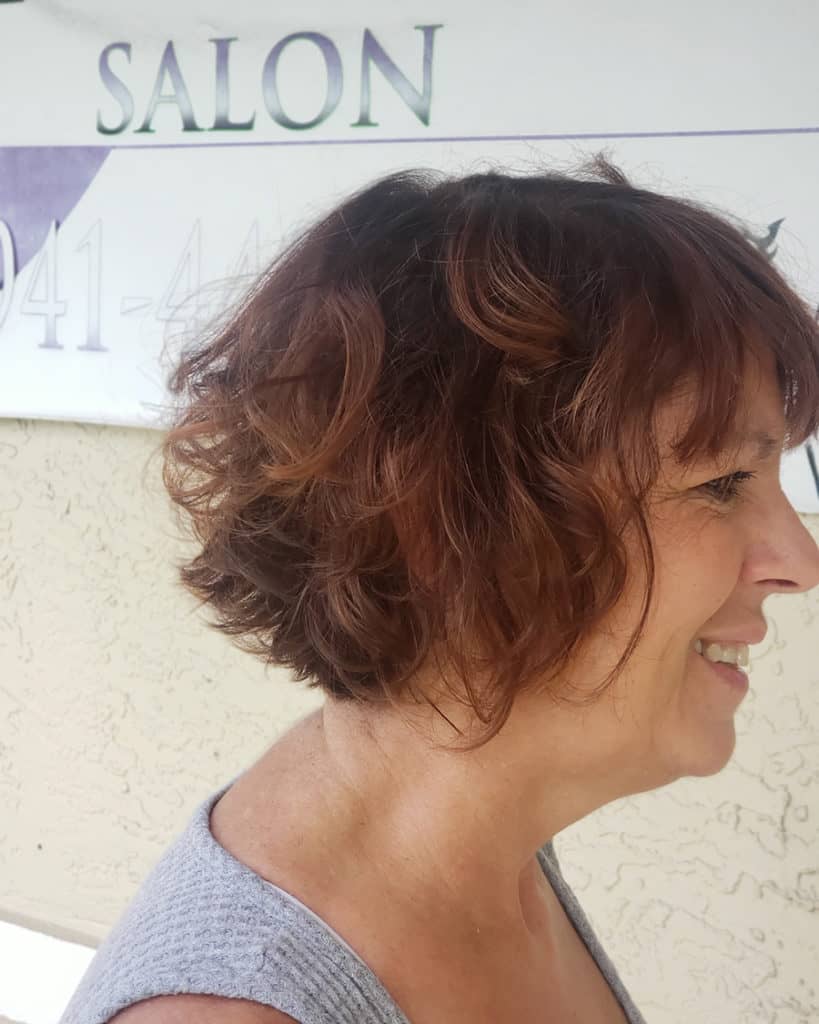
In the photos of Frank Shortino’s client shown below, the
difference from “before” to “after” is the vibrance. The shade is similar but
bolder and more youthful, aided by golden highlights. The cut further helps by
bringing out the wave, which builds additional dimension and movement.

Similar to Frank’s client is the chestnut look below designed by
Maria Mello, owner of Hair Ninja Salon in Brandenton, Florida. Caramel strokes
like these are a popular addition to many shades, acting as lowlights for
blondes and highlights for brunettes and reds.

For Maria’s client with longer blonde hair, a soft rose color
defines the accents. Highlights in rose, violet or blue are opening up more
choices for women of all ages.

Ready for Fashion Color Extravaganza?

Some of Maria’s clients really want to stand out, so she fills
that request by going full-speed with fashion color. Maria says she’s become
known in her area for these dramatic cherry, purple, magenta, and rainbow
looks.

“I always joke that it’s a great transformation and cheaper than a
sports car or plastic surgery,” Maria says. “I admire these women so much. One
told me that she’s done everything to please other people her whole life, and
now it was time to do something that makes her happy.”

Hair makeovers have Maria smiling, too.

“I love my job and especially this clientele, because I get to see
a woman’s face light up when we’re finished,” Maria says. “She finally sees
what I saw when she walked in the door – that she’s
beautiful.”

What color
did your hair turn with age? What are you doing about it? What hair color do
you enjoy most? Please share with our community!

Photo
credits: Images courtesy of
Shortino Salon and Spa and Hair Ninja Salon.

Read More

You Are Never Too Old To Wear a Smokey Eye (Video Tutorial)

You Are Never Too Old To Wear a Smokey Eye

Like many women my age, I don’t wear makeup to make an impression on other people. I wear it to look on the outside the way I feel on the inside. Most of the time, I go for a subtle look, but, there are times (like today) when I feel like being a bit bolder!

So, in today’s video, I would love to share with you a more dramatic evening makeup look. After all, you’re never too old to wear a smokey eye!

Let’s age beautifully, inside and out! Check out our own “Aging Beautifully” affirmation cards. They will inspire you to live your life to the fullest and enable you to find joy and passion in the decades ahead.

Do you still love playing with makeup and skincare? Why or why not? What are your favorite makeup products or brands?

Read More

Kristin Cavallari’s Eagle T Shirt

Kristin Cavallari’s Eagle T Shirt

Very Cavallari Season 3 Episode 7 Fashion

Kristin Cavallari looked totally fly (like an eagle) in her t shirt with hubby Jay Cutler “relaxing” on the farm. I must say, I’m not sure if I want the little ducklings swimming around or her tee more, but I’m totally on cuteness overload. Which, btw, is something that has potentially never been said, in history, about a reality tv show.


The Realest Housewife,

Big Blonde Hair


Kristin Cavallari's Eagle T Shirt

Click Here to Shop her Marissa Webb Eagle Logo Tee

Click Here to Shop her Uncommon James Necklace

Click Here to Shop her Studded Sneakers

Info: @KristinCavallari

Originally posted at: Kristin Cavallari’s Eagle T Shirt

Read More