Month: March 2020

3 Ways to Reduce Your Novel Coronavirus Risk as an Older Adult (+ 2 Ideas You May Have Missed)
3 Ways to Reduce Your Novel Coronavirus Risk as an Older Adult

Writing about
the novel coronavirus (COVID-19), or any new health risk for that matter,
involves a delicate balance; on the one hand, you don’t want to cause
unnecessary anxiety or fear and, on the other hand, you want to share the
facts, even when they are unpleasant.

So, even after
dozens of women emailed me about the coronavirus, I hesitated to share my
thoughts. After all, I’m not a medical professional. Like you, I am just an
older woman trying her best to keep herself and her family healthy.

But, the more
I thought about it, the more I realized that I had a responsibility to help get
the word out about the simple steps that we can take to protect ourselves. Over
the next few weeks, I will be producing a series of articles and videos to help
the women in our community. And, today, I’d like to start with the basics – what
can we do to protect ourselves from the Coronavirus as older adults.

What is the Novel Coronavirus and Who is Most at Risk?

According to
the World Health Organization (WHO), “Coronaviruses (CoV)
are a large family of viruses that cause illness ranging from the common cold
to more severe diseases such as Middle East Respiratory Syndrome (MERS-CoV) and
Severe Acute Respiratory Syndrome (SARS-CoV). A novel coronavirus (nCoV) is a
new strain that has not been previously identified in humans.”

Much is still
unknown about the novel coronavirus, but, the picture that is emerging is of a
virus that has a mortality rate several times higher than the common flu. In
addition, because many contagious people experience only mild symptoms, it is
proving difficult to contain, even in developed countries like the United
States.

So far, it seems that people over the age of 65, particularly those with underlying health conditions are at an increased risk for complications from the novel coronavirus and many countries around the world are encouraging us to be especially careful in the weeks and months ahead.

If all this
leaves you feeling a little powerless, or even anxious, you’re not alone.
People are not particularly good at dealing with unknown risks and the novel
coronavirus is no exception. But, the good news is that there are simple things
that each of us can do to protect ourselves and our loved ones. Here are a few
ideas from around the world.

Wash Your Hands the Right Way to Fight Back Against the
Coronavirus

The first recommendation that almost every government around the world is making is to wash your hands regularly with plenty of soap and warm water. This sounds simple, but, many of us aren’t washing our hands for nearly long enough.

Did you know
that many health organizations, including the CDC in the United States,
recommend washing your hands thoroughly for at least 20 seconds? To put this in
perspective, here are a few songs that you can sing in 20 seconds.

I Will Survive, by Gloria Gaynor

Happy Birthday

Staying Alive, by the Bee Gees

I Can Feel it Coming in the Air Tonight, by Phil Colins

Fever, by Peggie Lee

Personally, I
love to sing I Will Survive, but, when I’m with my 3-year-old grandson, Max, I
switch to Happy Birthday. It always makes us giggle.

Keep Your Distance in Social Situations 

Recently, the
CDC in the U.S. updated its coronavirus recommendations to say that older
adults should “stay at home as much as possible.” But, what if you need to get
out into the world, perhaps to go shopping for groceries or to pick up your
medications?

The best
advice that I have seen is to practice keeping your distance from others. This
could include avoiding close physical contact, like giving a friend that you meet
on the street a hug. Or, it could involve standing farther away from the other
people in the line at the supermarket.

At the end of
the day, if you have a support network, now is probably a good time to ask for
some help with your daily tasks so that you can stay at home. But, if you do
need to go out, a little “social distancing” will go a long way to reducing
your coronavirus risk.

Stock up on a Few Essentials – Food, Medication and
Household Items

By now, you have probably seen pictures on Facebook and Twitter of long lines at grocery stores and supermarkets. And, it is true that some people are going a bit over the top – no-one really needs 500 tins of baked beans and enough toilet paper to service a small army camp.

But, this
doesn’t mean that stocking up on a few essentials – including food, medications
and household items is irrational. In fact, the CDC recommends that each of us
have basic supplies on hand.

Given the fact
that supermarkets across the U.S. are likely to be busier than usual for the
next few weeks, this would be a good time to ask someone in your family to add
a few items onto their shopping list for you. This way, you can stay safe at
home, while getting the things that you need.

When I went to
the supermarket last week, I bought a 2-week supply of food, hygiene products,
soap, toilet paper, bottled water, batteries, ibuprofen and other basics. I
also asked my doctor for a refill on my medications. 

Of course,
this is a fast-moving situation and I highly encourage you to check out the
official recommendations from your government. Here are a few important links:

CDC’s
Recommendations for People at Higher Risk for Coronavirus Complications

World
Health Organization Coronavirus Information and Guidance

Now that I’ve
provided a round-up of what most governments around the world are recommending,
I wanted to add a couple of quick thoughts of my own.

Once again, I
am not a medical professional and I am not providing specific medical advice.
But, since these ideas fall into the “it couldn’t hurt and might actually help”
category and I am personally adding them to my toolkit.

Let a Little Sunlight (and Humidity) Into Your House

You probably
know that UV light is a powerful killer of bacteria and viruses. After all,
it’s used in hospitals around the world to clean medical instruments. But, what
about sunlight?

As it turns
out, sunlight is surprisingly effective at killing viruses and bacteria, even
when filtered through a window. According to a
recent study
, run by Dr. William Schaffner, an infectious disease
specialist at Vanderbilt University School of Medicine, “The major takeaway
from this study is that even if the sunlight goes through conventional panes of
glass, it retains a substantial capacity to kill bacteria and viruses. We did
not know whether the sunlight passing through panes of glass would retain some
of this capacity to disinfect, and it does. So that’s a great thing.”

So, why am I
personally going out of my way to open my blinds? Two reasons…

First, I want
to do everything in my power to stay out of the doctor’s office. So, if
sunlight can help to clean the surfaces in my house, I’m all for that! Maybe it
will give me a slight edge against the coronavirus… or, maybe it will just
reduce my risk of getting the flu or a common cold.

Second, I
don’t know about you, but, being stuck in my house isn’t great for my mood.
Letting a little sunlight into my house is helping to keep me happy and sane.

When the
warmer weather returns, I’ll probably give my skin a break and start filtering
out some of the light. But, for now, I’m just enjoying a little more radiance
in my life. It probably makes sense to ask your doctor of letting some more sun
into your house makes sense for you.

And, while
we’re on the subject of improving your home environment, did you know that
humidity levels above 40% can help to kill viruses. Specifically, a recent
review of 40
scientific studies
found that rooms with relative humidity levels in the
40-60% range have significantly fewer flu viruses floating around and on
surfaces.

So, maybe it’s time to invest in a humidifier. I did and I actually sleep much better!

Practice Good Dental Hygiene

For the most
part, our bodies are efficient at keeping bacteria and viruses out. Our skin is
a veritable fortress and there are only a few places that we are exposed to the
outside world – most importantly our noses and mouths.

So, perhaps it
won’t surprise you that a
recent Yale study
found that people who practice poor dental hygiene are at
a higher risk of contracting pneumonia. Now, we obviously don’t know if there
is a connection between dental hygiene and the coronavirus, but, I say, “what
have we got to lose.”

Why not be
extra dutiful with our brushing, flossing and mouthwash?

Finding the Golden Mean and Staying Healthy in the Time of the Novel Coronavirus

The
coronavirus is real. No, it’s not “just like the flu.” And, we really should
take it seriously. This means washing out hands regularly (and properly!),
keeping our distance from others and stocking up to a reasonable degree on
supplies.

At the same
time, we should not succumb to fear or a sense of hopelessness. We may not be
able to control everything related to the coronavirus, but, we can control some
things. And, even simple steps can go a long way to keeping us safe.

I hope that
the resources in this article were useful to you. I highly encourage you to
check the CDC’s website every few days to see if there are any new
recommendations. And, in the meantime, try to spend a bit more time at home,
enjoying a good book or diving into your Netflix recommendations list.

Are you
concerned about the coronavirus? Why or why not? What are you doing to protect
yourself? Let’s have a conversation.

Read More

I’m Obsessed With Keeping My Skin Firm & Here’s The Real Deal On How I Do It

As I dance with this decade known as my thirties, I find that my number one skincare priority has shifted. No longer am I burdened by hormonal breakouts (shoutout to spironolactone). My chief concern is how to firm my skin at home, in order to maintain my complexion’s texture and elasticity. I basically want you to be able to throw cooked spaghetti at my face and have it bounce right back off. That’s a mixed metaphor, but I hope it still paints a seductive mental picture of super bouncy skin.

My career as a beauty editor has led me to amalgamate a decade’s amount of skin wisdom from top dermatologists with my own personal experience. I’ve functioned as a beauty guinea pig, testing the thousands of products that arrive on my desk. Unfortunately, you’re probably going to balk at my advice, because it’s not fun at all: Forget the 10-step skincare routine, put down the cute packaging and drop your coins on active, proven ingredients.

You will find that most truly efficacious products come in unsexy yet airtight containers, which keep their powerful ingredients potent for as long as possible. You will also find that these products command a much higher price tag than your average impulse buy, and they don’t smell like rose petals mixed with kitten feet. However, if you choose to eschew superfluous products in lieu of performance-based ones, you might find that your overall beauty budget will benefit–and your skin will look as fantastic as possible.

Doctors agree with me. “For firm skin, I recommend looking for products that contain growth factors and peptides. Growth factors are essential as they trigger collagen and elastin production which are essential to the skin’s matrix,” says Dr. David Shafer, of Shafer Clinic Fifth Avenue. “Peptides are amino acids that make up the building blocks of our skin which are also necessary for skin structure.”

Without further ado, my time-honed advice for maintaining your skin’s supple factor for the long haul. 

Play the long game with growth factors

best firming serums image

SkinMedica.

Buy: SkinMedica TNS Essential Serum $281

Yes, this serum is expensive, but it’s one of the few topical products worth the sticker price: it boasts natural growth factors that spur skin to act and look younger. I’ve been using it for years, and my skin is consistently heralded with compliments. My own testimony aside, it’s one of the most doctor-endorsed products around. “SkinMedica’s groundbreaking research resulted in a formula comprised of naturally occurring growth factors (proteins), cytokines, antioxidants and matrix proteins that are responsible for healing the skin, and naturally boost the skin’s ability to rejuvenate itself,” says Dr. Shafer. Even though growth factors work over time to repair skin at a cellular level, I notice my skin looks younger and fresher within a few days of use. 

Apply peptides overnight for an instant boost

how to firm skin at home image

Elemis.

Buy: Elemis Peptide4 Plumping Pillow Facial $65

Combining growth factors with peptides provides the ideal one-two punch against sagging skin. Peptides are chains of amino acids that signal your skin to create new collagen, which is a very important structural protein for your skin. You may have heard of the ingestible collagen craze with its gummies and drink mixes, but there is actually zero research that proves that ingested collagen travels to your skin cells and fosters skin firmness. Zero. The best way to reap the benefits of collagen (other than a healthy diet) is to signal your skin to produce more of it with topical peptides. This silky overnight mask from Elemis acts like spackle for your skin. I wake up with glowy and plump skin in the morning, even after I’ve imbibed too many glasses of Sambuca.

Micro-needle one to two times a week


how to firm skin at home image

Sdara.


Buy: Sdara Microneedle Derma Roller $20

The benefits of micro-needling are twofold: first, poking tiny holes into your epidermis spurs skin to repair itself, sending fresh collagen and elastin to the surface. Secondly, micro-needling after applying a skincare product (such as the serums above) with active ingredients helps those ingredients penetrate deeper into your skin. If you’re forking over the cash for premium ingredients, you want to be absolutely certain you’re getting the maximum absorption and mileage out of them. While micro-needling may look scary, it’s not in the slightest, as long as you purchase a derm-approved tool laced with either stainless steel (more affordable) or gold-plated needles (less affordable) to assure cleanliness. I don’t always remember to microneedle my skin, but I try to do it at least once a week with the Environ Gold Roll. Whenever I do, my skin looks firmer and more even by the very next morning.

Our mission at STYLECASTER is to bring style to the people, and we only feature products we think you’ll love as much as we do. Please note that if you purchase something by clicking on a link within this story, we may receive a small commission of the sale and the retailer may receive certain auditable data for accounting purposes.

Read More

A Look at Violet and Purple Shampoos to Protect Your Blonde Hair Color

While redheads have to worry about their color fading from its brilliant and light-reflecting status, blondes and even those with lighter highlights living in brunette tresses have their fair share of hair color woes, too. The battle of warding off brassiness presents some concerns, especially in the summer, because so many things are working against your favor, including the sun, swimming pool, not to mention minerals already present in the water coming from your shower. If you’ve ever been around anyone who’s trying to protect the integrity of their hair, you’ve probably heard the question “Does my hair look brassy?”

Those with super platinum blonde locks have the potential to take on a hint of yellow instead of the icy cool hair color they originally intended. The pigments in purple or violet shampoo counteract brassiness or that faded orangey hue, leaving you with brighter and lighter hair color. These products work to tone your hair color back to what you intended it to be and are meant to be used sparingly as a method of treatment and not regular cleansing—that’s what your other shampoo is for. And if your hair type can get away with it, you should try to cut back on the regular lathering up as it is. To give you an idea of what types of violet or purple shampoos are out there, made with the purpose of color protection, we rounded up the below.

Our mission at STYLECASTER is to bring style to the people, and we only feature products we think you’ll love as much as we do. Please note that if you purchase something by clicking on a link within this story, we may receive a small commission of the sale and the retailer may receive certain auditable data for accounting purposes.


Read More

Leaving a Long-Time Career? Write a “Dear Job” Letter!

Leaving a Long-Time Career Write a “Dear Job” Letter!

Shortly after Karen and I decided to launch a business together,
she put some temporary brakes on it. Whereas for me this next stage was just a
pivot in direction for my freelance writing career, Karen felt she couldn’t
open the door to our new venture until she closed the door on her old one.

She’d devoted heart and soul to software testing for 33 years, and
she was having trouble transitioning out of that industry. She thought she
might achieve closure by writing a
farewell letter to her career
. She wanted to make two things clear to her
profession: they had a good thing going together, and here’s why it’s necessary
to break things off.

This “Dear Job” letter worked very well for Karen. Writing it all
out provided her with a sense of relief, as if she’d flicked the pain of
separation off her shoulder. And if she’d been the only one to read it, she
says that would have been good enough.

A Farewell Letter Gone Viral

But she wasn’t the only one – far from
it. Karen’s international reputation as a seasoned expert in her field had
earned her an impressive LinkedIn and Twitter following.

She’d been quiet on those platforms recently, so people took
notice when, seemingly out of the blue, she posted a link to her explanation of
what was going on with her.

The points Karen made resonated within her industry and beyond it.
She was showered with comments, tweets and emails. People shared the link, and
within two weeks it had attracted more than 13,000 views.

A newsletter in the tech field asked permission to run the
farewell, and she even received two job offers in case she wasn’t serious about
dropping out.

Most important to me, of course, is that Karen’s focus is now on
our new business, Home
Memoir
. She’s relaxed and so glad she wrote and published her letter.

You can achieve this same closure if you’re leaving a career. Just
write it all out! Based on Karen’s letter, here’s how you can structure your
farewell:

Introduce the Matter

Give a little preview of what this letter is about. Karen wrote,
“In tech (and perhaps in most industries these days), no one will be giving me
a gold watch to say thanks and to send me on my way, so I am doing this for
myself.”

The Good: Why You Were Together So Long

Karen broke her good memories into two parts – the specifics of benefits inherent in a successful career in her
industry, and then the growth she experienced that she could apply to other
types of work and to her personal life.

The first part included perks such as travel, flexibility, and
intellectual satisfaction. The second covered triumphs like overcoming a fear
of public speaking and learning to stand up for her ideas in a male-dominated
profession.

Why You’re Leaving

Things were good for decades, so what changed? Like Karen, you may
want to cut down the long hours or acknowledge that your passion for the
industry has begun to soften. Maybe it’s begun to feel like a first chapter in
your professional life, not the whole book.

My favorite sentence in Karen’s letter is: “I used to be one of
the young ones, and I was young for a long time and then I wasn’t.”

What’s Next for You

You don’t have to rub it in, but it’s only fair to inform your
career about your plans, right? Software testing was a surprise career for
Karen, who has a degree in journalism and figured she’d probably be a newspaper
reporter or work in some related writing position.

Although she did blog for trade journals in the tech field, she
wanted to delve full-time in writing and publishing.

Close on a Note of Gratitude

Karen used her final paragraphs to thank colleagues. It was
important to her to wish everyone well.

Karen’s not looking back. She turned down the job offers and uses
her days to write, exercise, spend time with family, and build our business – exactly what she wants to be doing now.

After writing your own farewell letter – whether just as clarity and closure for yourself or as a vehicle to
share your thoughts with a wider audience – you may
find yourself relieved, open, and ready to face your next step.

How long have you been in your career? Are you
sensing a shift? What might that shift be? How do you plan to make your
transition? Would writing a “Dear Job” letter be something that could bring you
closure? Please share your thoughts and let’s have a conversation!

Read More

Celebrating Our Role Models on International Women’s Day

Celebrating Our Role Models on International Women’s Day

International Women’s Day is on Sunday, March 8, and it’s a great time to not only honor and celebrate those women who came before us, but also those who continue to inspire us on our life journeys.

Even though many of us who are baby
boomers have now become role models for future generations, we still have fond memories
of special women who have greatly influenced our lives.

Living in a Different Age

In general, we women of a certain age
are young at heart. Most of us grew up during a time of optimism and growth,
and we want to continue to live life to the fullest. We have no interest in
retiring at 65; in fact, many of us feel more vibrant and energetic than ever.

We are proud of the fact that we look
younger than our actual years, because we take good care of ourselves. Needless
to say, we have stood on the shoulders of giants, but who were these
individuals? Perhaps this is a good time to reflect on those women who impacted
us at a deeper level earlier in our lives.

On a personal level, there were many
women who paved the path for me and set the stage for my role as a powerful woman.
Some were friends, relatives, and professional colleagues, while others were
those who I knew through their work or writings.

My Earliest Role Model

My grandmother was probably my
earliest and most significant influence. She lived with us and was my caretaker
while my immigrant parents worked long hours at their retail store in Brooklyn.
My grandmother, who was orphaned at the age of 11 during World War I, had a
worldview that strongly influenced mine.

She was grateful for her life, and
because she lost her parents to cholera at an early age, she learned to be
happy with very little. I was an only child, and my existence gave her a
purpose.

When I became more independent and
started walking to school by myself, her role as a woman shifted. She no longer
felt needed, and sadly, she took her life while living in my childhood home.

Lessons from Grandmother

As a 10-year-old, my grief ran deep, so
to help me cope, my mother gave me a Kahlil Gibran journal where I could write
letters to my grandmother. Within those pages, I thanked her for having spent
the first 10 years of my life with me.

I also expressed gratitude to her for
sharing three very important passions – journal writing, needlepoint, and dancing. (In fact, my parents met at a
dance hall in New York when my mother was dropping off my grandmother so she
could dance!)

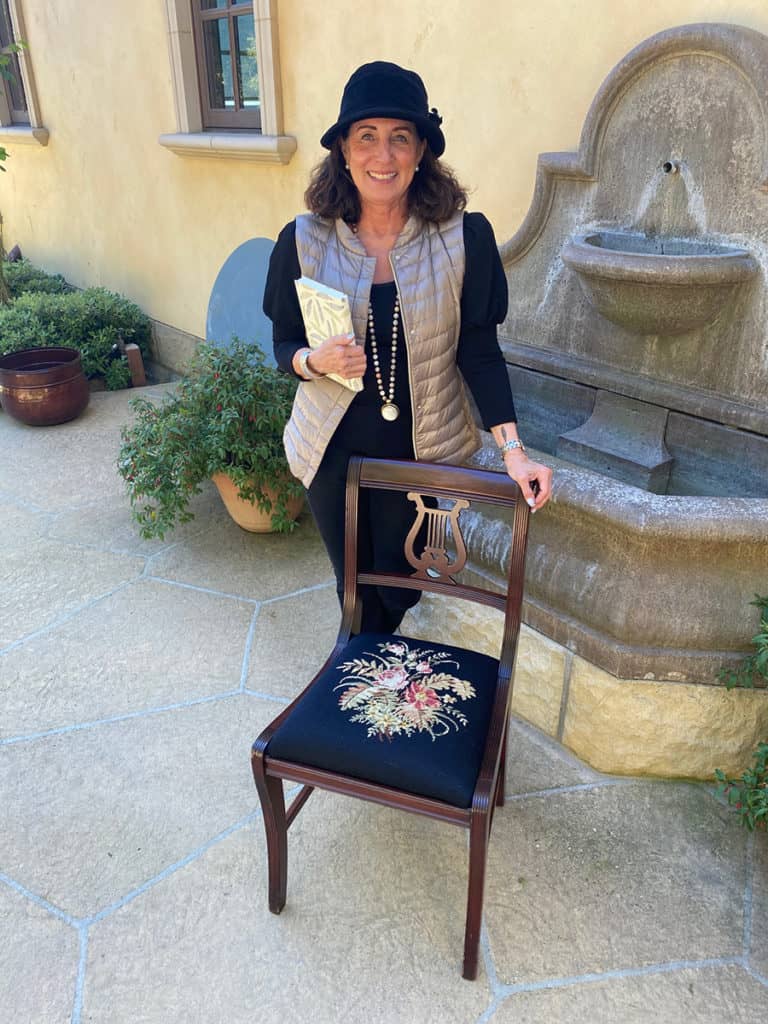
And when I was about eight years old,
she taught me how to needlepoint. I started on a larger canvas and would sit
beside her as she needled on a smaller-holed canvas. I still have the three
needlepoint chairs she made, which are now more than 100 years old.

A picture containing indoor

Description automatically generated

My grandmother wrote down her
thoughts regularly while she was alive, and I was blessed to find her journal, where
she’d written down the details of her life as an orphan in Poland during the
war.

Finding this journal was a true gift
and was the basis for one of the books I authored: Regina’s Closet: Finding
My Grandmother’s Secret Journal
.

Other Influential Figures

During my adolescent years in the
1960s, there were very few female role models, but since that time, and with the
advent of the Women’s Liberation Movement, more and more women started to rise
to new heights. The second wave of the movement was that of “feminism.”

Many feminists influenced and
inspired the woman I’ve become, and their achievements helped me realize that
the sky is the limit and that I should always follow my passions.

Some of these women were political activists
as well as being accomplished professionals: Anaïs Nin, Eleanor Roosevelt, Jacqueline
Onassis, Joan Baez, Judy Collins, Gloria Steinem, and Arianna Huffington, among
others.

Eternal Wisdom from Those Long Gone

I am now 65, and many of my former
role models have passed away, but the memories of what they taught me will be
with me forever. And the truth is, we no longer need role models – we now fulfill that role for
future generations… and
what a huge responsibility that is!

I realize the importance of daily reflection,
and the value of facing my fears and sharing my stories, as doing so will help young
women navigate their own journeys. I want to constantly remind them to listen
to their hearts and to live out their dreams.

The gift of life is precious, and we
have no idea how long we will be on this planet, so we need to make the most of
every single day.

Who were your role models back when
you were younger? Which lessons you learned from them are most vivid to you
today? To whom are you a role model at this stage in your life? Please share
your thoughts and stories with our community!

Read More