Month: March 2021

The 4 Lifestyles We Slide Into After Retirement… and How they Impact Our Happiness

Retirement

More women than not, in their 60s and beyond, wholeheartedly embrace life. Because of my lifestyle, I have met hundreds of women in their 60s, 70s and beyond who I notice are enjoying life, even those living under unpleasant circumstances.

Some are married, some single, some widowed or divorced. Some have aches and pains, some are lonely, some have suffered illnesses, some are ill. Some have successful careers; others are searching for a purpose. And there are many who have had to learn to conserve their retirement funds.

I noticed these women took courses, played cards, needlepointed, attended group therapy, did crossword puzzles, had careers or started new ones after the age of 60. They travelled solo or with spouses, gabbed with girlfriends for fun and support and moved on to retirement communities and spent loving time with their family.

They were self-motivated – even those with problems – to live a vibrant lifestyle. I have my personal feelings on what motivated this group of women over 60 because I was one of them.

My answer: happiness takes work. Here are four categories many woman slide into after retirement.

A Quiet Lifestyle of Contentment

Many of you have come to terms with your age and lifestyle. You are content. Good for you. I expect you appreciate yourselves. You are the women no longer looking for acceptance and affirmation.

Being part of the so-called “in crowd” isn’t as important as having meaningful relationships. You enjoy the quiet of your day and you are content and confident in your life choices. You possess a quiet power and feel your relevancy and visibility. I am that woman now.

A Career and Busy Lifestyle

The woman who loves her career is fortunate. She blooms. She awakens each morning feeling productive. Productivity means output. Output produces positivity. There is a richness to her lifestyle.

She smiles on the inside and out. The wheels of her mind are constantly turning. She is anything but bored. She is emotionally and physically healthy because she is living a relevant lifestyle. She is a connected woman, a visible woman. I am that woman now.

A Survivor

There are many women living with clouds over their shoulders. I feel your pain because I was there. I was widowed in my 40s, had cancer in my 50s. In my 60s my second husband’s son committed suicide and on and on.

Dear readers, you must try and help yourself. Seek help through private or professional group therapy on all matters from finance to widowhood, to loneliness or illness. Do consider joining or putting together a focus group of women friends to discuss your issues.

This really works. Before the pandemic, I hosted a monthly focus group at my home where we talked about our issues. Everyone would leave feeling they will try and make sweet lemonade out of lemons because we gave one another intelligent and hopeful answers to situations. Each of us realized happiness takes work.

A New Purpose

These women are passionate about staying vital and visible and are seeking answers. They are frustrated and feeling hampered by their daily lifestyle. Here is an idea for you. It worked for me and I would love to share.

Here is the story. Over four years ago, I can best describe myself as restless and searching. I was very busy all day doing things I no longer enjoyed. I was frustrated, having no idea what path to pursue.

One day by happenstance, I shared my feelings with another woman. We had just met. I told her I was looking for a new purpose. To this day, I remember her words: She said, “Keep a journal for three months and you will find your voice, your purpose.” I asked her how she knew. She said to me, “I am a writer.” I remember my answer: “I can’t keep a journal. I am not a writer.”

But I did and you know why? Because she told me I would find my voice. Those five words pushed me into the impossible in my 60s and today I am a writer and I own a website, Honeygood.com. You see dear readers, anything is possible.

The first thing you must do is – start! The first thing you must understand is that happiness takes work!

So, I am passing on that writer’s suggestion – keep a daily journal for three months, never miss a day and reread every entry three months later. I truly believe you, too, will find your voice.

Let me pass on my mantra. “I will not stop pursuing my new purpose because I want to be fulfilled and I know happiness takes work.”

For those of you seeking a new purpose I am hopeful I might be pushing you into finding your voice. For those of you facing personal hardships, why not “start” your own focus group? Nothing good will happen unless you realize that: happiness takes work. This is true at any age… but, it is especially true after retirement.

And for those of you who have found contentment or who are involved in careers, help your sisters in need. I am certain they will be as grateful as I was and am to the writer who pushed me to start.

Have you reached retirement? If so, how would you describe your life after retirement? If not, how do you want to spend the next 20-30 years? Please join the conversation.

Read More

The 15-Minute Morning Routine to Improve Mobility at Any Age (VIDEO)

morning movement routine

What do you think of when you hear the word “fitness”? Running marathons and mountain climbing? Playing sports and lifting weights? Stretching and curling yourself into challenging positions in yoga class? Those activities are great, especially if you find joy in doing them. But at its core, fitness is about mobility first.

Most of our lives, we’re sold the idea that being fit involves great feats of endurance, strength, stamina, and flexibility. The stream of images in the media to support this idea is endless. But physical fitness is more than those things, and simpler.

Mobility vs. Flexibility

Throughout my career teaching Pilates and other movement systems, I’ve heard countless people say things like, “I’m not very flexible,” or “I’ve never been very strong.” But often, our limited definitions of “flexible” and “strong” are holding us back from becoming just that.

Your body is a collection of integrated systems. Every system needs to show up to the party every day if you’re going to have a good time. And for those of us who have made it to age 60, I think we’ve earned our good time!

mobility vs flexibility

What Is Mobility?

Fitness, fundamentally, is about whole-body mobility. Mobility means moving freely and easily through a full range of motion in all of your joints. When your joints are moving as they were intended to, all of your muscles are too.

Your musculoskeletal system interacts with other systems – respiratory, digestive, circulatory, and so on – to help your body do what it’s supposed to do. This is why we have expressions like, “If you don’t move it, you lose it,” and “The more you move, the better you feel.”

Making Daily Movement Your Fitness Foundation

The good news here is that doing little things consistently can make a big difference for your whole body. As we age, these little things become critical for maintaining our mobility and continuing to do what we love to do.

Having a simple, daily movement routine to maintain mobility and engage your body’s systems is the foundation for any fitness goal. In more playful terms, we get to do bigger things if we start by wiggling the little things.

Moving in a thoughtful, balanced way on a daily basis has both short-term and long-term benefits for our health and wellness. And remember: It’s always easier to maintain our mobility than it is to regain it after we’ve lost it.

A daily movement routine:

  • Reduces inflammation and the achy joints that accompany it.
  • Stimulates our body’s systems and helps us feel more energized.
  • Encourages breathing and a mindful start to our day.
  • Creates balance by engaging our muscles.
  • Establishes a habit of moving more and sitting less.

15 Minutes of Movement a Day Keeps the Pain Away

This short video routine will guide you through three simple sets of movement to perform when you wake up in the morning that can impact your day in a big way. Or, use the guidelines below to work through the routine at your own pace. No special props are needed. In fact, you can do most of these things without ever leaving your bed.

These exercises are safe and appropriate for people with osteoporosis. Remember to move and breathe slowly, and to never move through pain. When implementing any new exercise routine, be sure to consult your physician with any questions or concerns.

For the exercises below, repeat each movement four or five times before moving on to the next one.

#1 Scan and Stretch Your Body While Lying Flat

Lie flat on your back in bed or on a mat on the floor. Place a flat pillow or folded towel under your head to maintain spinal alignment. Close your eyes and slowly scan your body from head to toe. Take note of the weight of your body and how each part of you is making contact with the surface below you.

Ankles and feet

  • First, make circles with your ankles in one direction, then the other.
  • Next, flex and point your toes slowly several times, engaging your entire foot each time.
  • Last, crunch your toes as though you are making fists with your feet, then spread them out wide.

Head and neck

  • First, slowly turn your chin from one shoulder to the other as though you were shaking your head “no.” Be sure to go slowly.
  • Next, draw small circles in each direction with your nose, as though you were drawing a circle on a foggy window.
  • Last, gently move your chin and eyes downward while lengthening the back of your neck (a gentle press into the pillow or towel can help), then turn your chin from one shoulder to the other again.

Whole body

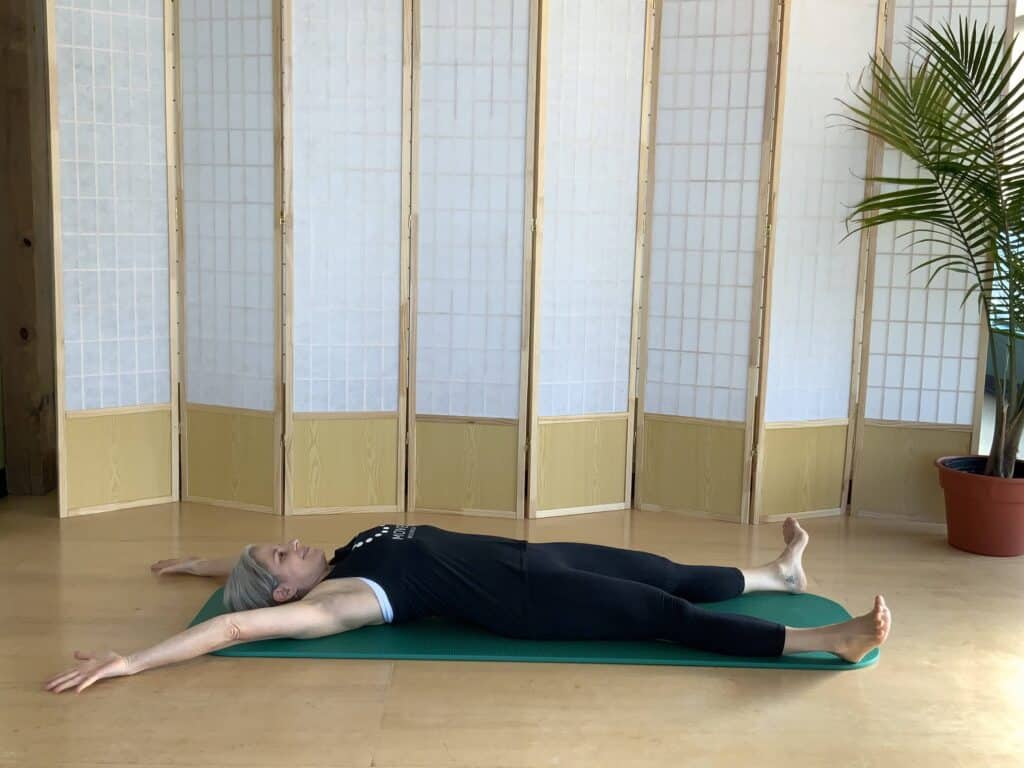
  • First, reach your arms and legs out as though your body is a big “X.”
  • Next, stretch and breathe into your whole body on an inhale, then feel your body relax and release into the bed on an exhale.
  • Then, stretch and reach with your right arm and leg on an inhale and let them relax on the exhale, then do the same on the left.
  • Last, finish with one final whole body stretch on the inhale and release into the bed on the exhale.

#2 Open and Elongate Your Upper Body While Sitting Upright

Sit on the edge of your bed with your feet flat on the ground. You can also sit on a chair or on a mat on the floor with your legs crossed. Be sure to have a long upright spine.

Hands and forearms

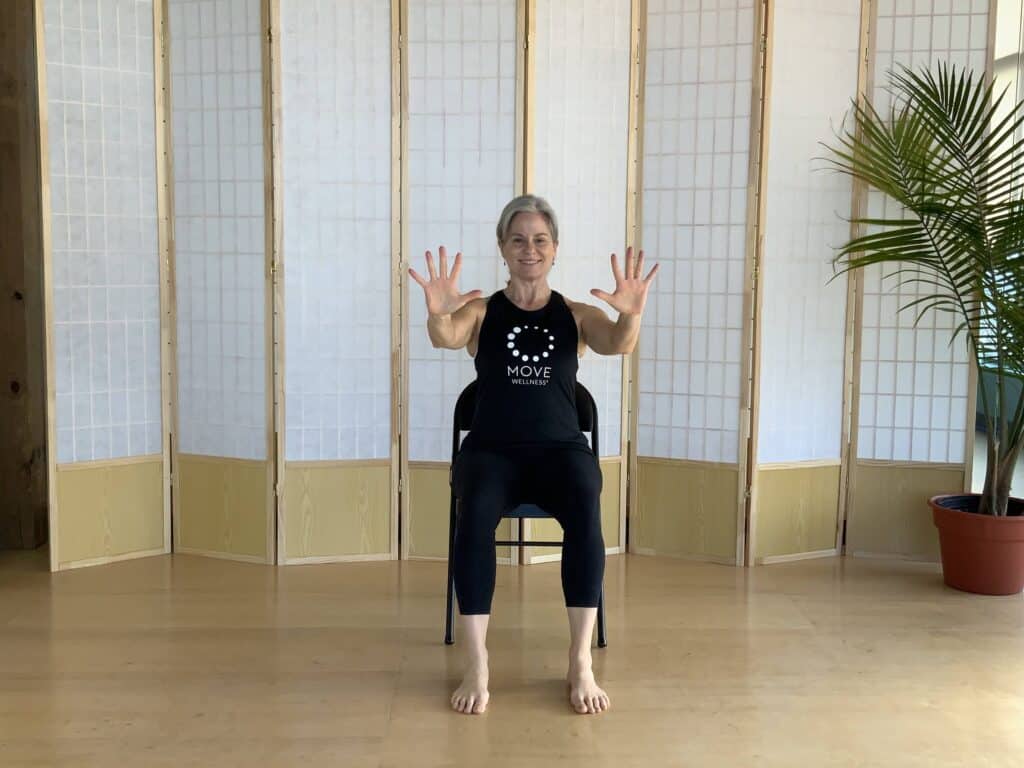
  • First, reach your arms directly in front of you.
  • Next, just as you did with your feet earlier, slowly flex and extend your wrists, circle them in each direction, make fists and then spread your fingers wide.
Hands and forearms

Shoulders and arms

  • First, roll your shoulders forward, then backward.
  • Next, touch your fingertips to your shoulders as though you were creating chicken wings, and circle your elbows forward, then backward.
  • Last, do full arm circles forward, then backward.

Waist and hips

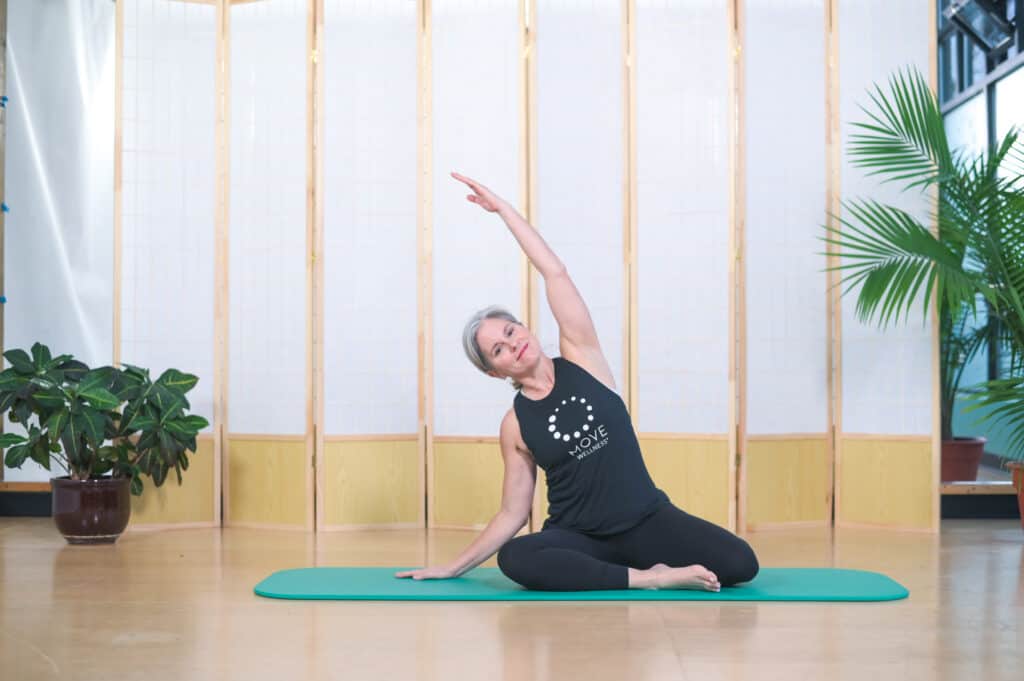
  • First, reach one arm straight up overhead and then reach gently toward the opposite side keeping both sides of your waist long. Repeat with the other arm.
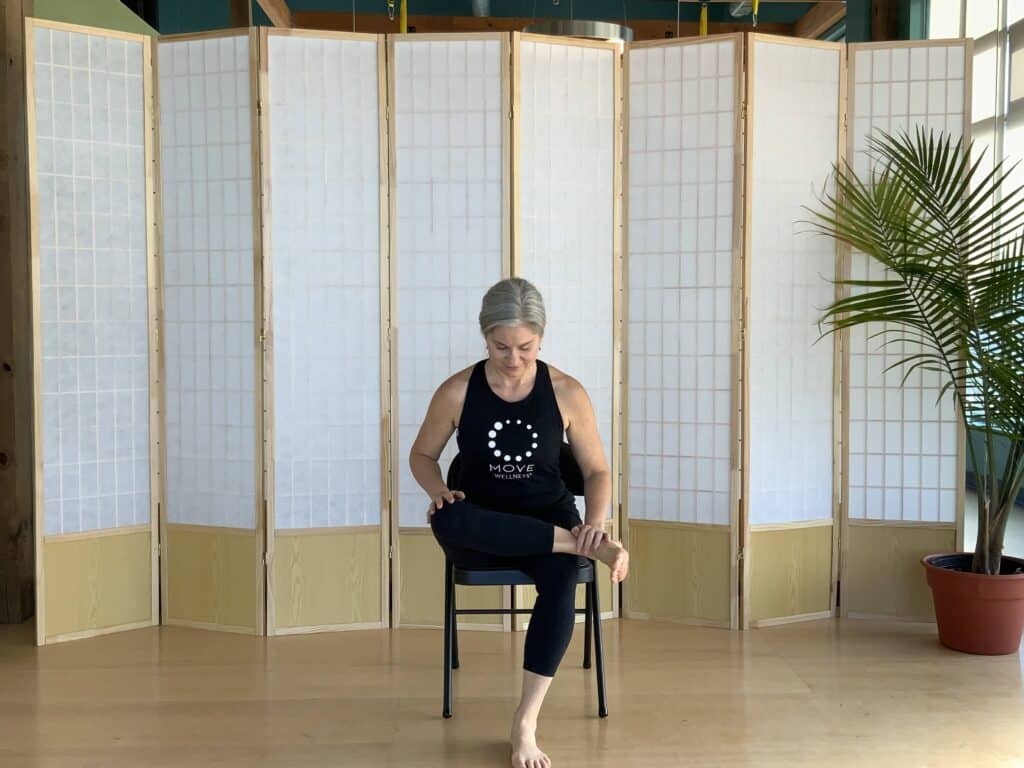
  • Then cross one ankle over the other knee and gently breathe into a hip and glute stretch. Repeat with the other leg.
Waist and hips

#3 Mobilize Your Spine and Lower Body While Standing Up

Stand near a dresser, table or sturdy chair for support (as needed) with your feet directly underneath you, but not touching. Notice how every inch of your feet feels. Be sure that your weight is distributed evenly between both feet.

Toes and feet

  • First, gently rock forward and backward and then side to side, feeling all the edges of your feet on the floor. Keep your eyes open to avoid losing your balance.
  • Next, lift all 10 toes off of the floor, noticing the arch in your foot as you do it, and then try to put your toes back down while still maintaining the arch. (Hold onto something for balance as needed.)
  • Last, rest your hands on the chair or dresser for balance and lift your heels off the floor while keeping your ankle aligned with the center of your foot (no rolling outward). As you lower your heels, keep reaching through the top of your head as though you’re continuing to grow taller as your heels lower down.

Torso

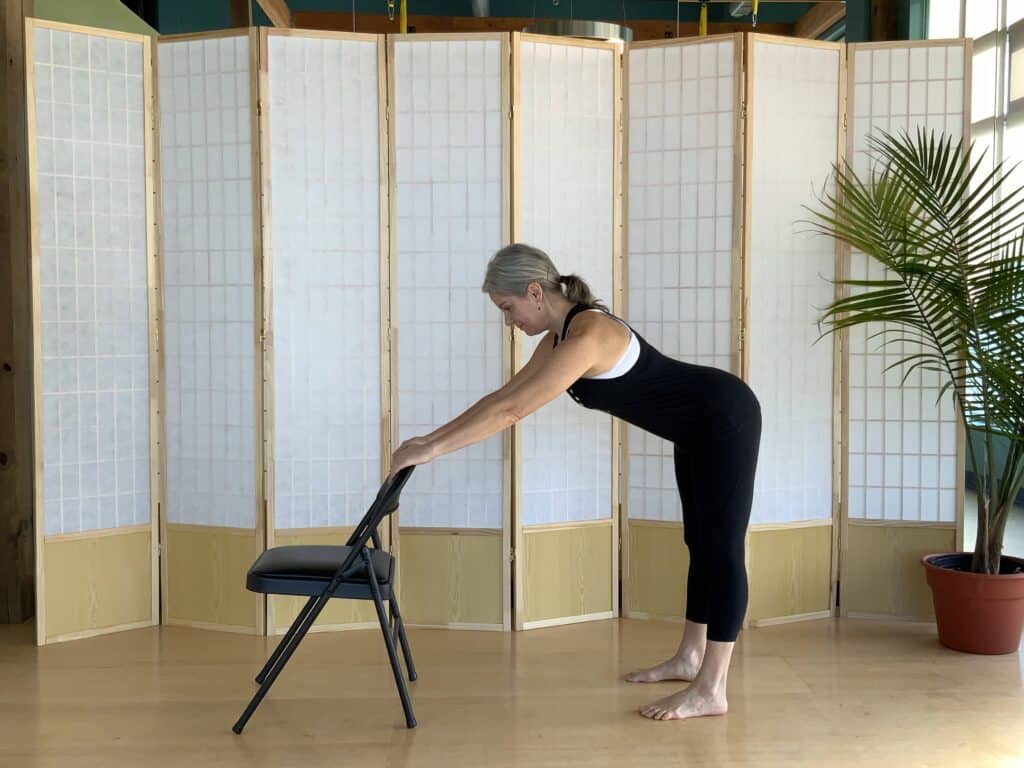
  • First, with your hands still resting on the chair, take two big steps back and fold forward at the hips to create a 90 degree angle with your body. Your spine should be long and neutral, your face looking toward the floor, and your legs either straight or slightly bent. If this is a challenging stretch, it will get easier over time. Keep your abdominals lifted and engaged.
  • Next, gently reach one arm directly out to the side while keeping your shoulders and hips square. Reach that arm underneath you past the opposite shoulder as though you were threading it, feeling the stretch and twist in your back, ribs and shoulder. Follow your hand with your eyes.
  • Last, pull the arm back through the starting position and reach it toward the ceiling as though you were reaching back and up to see something above you. Repeat with the other arm.
Torso

Spine

  • First, while still in the 90 degree fold with your hands resting on the chair, roll through a cat stretch by curling your spine starting at the tailbone. As your back rounds, use your glutes and abdominals to help you feel the stretch in your lower back as you inhale. Exhale as you roll back out and return to the neutral position.
  • Next, stand up straight, clasp your hands behind your head, gently press your head into your hands and lift your chest upward as you inhale. Exhale as you relax back to neutral.
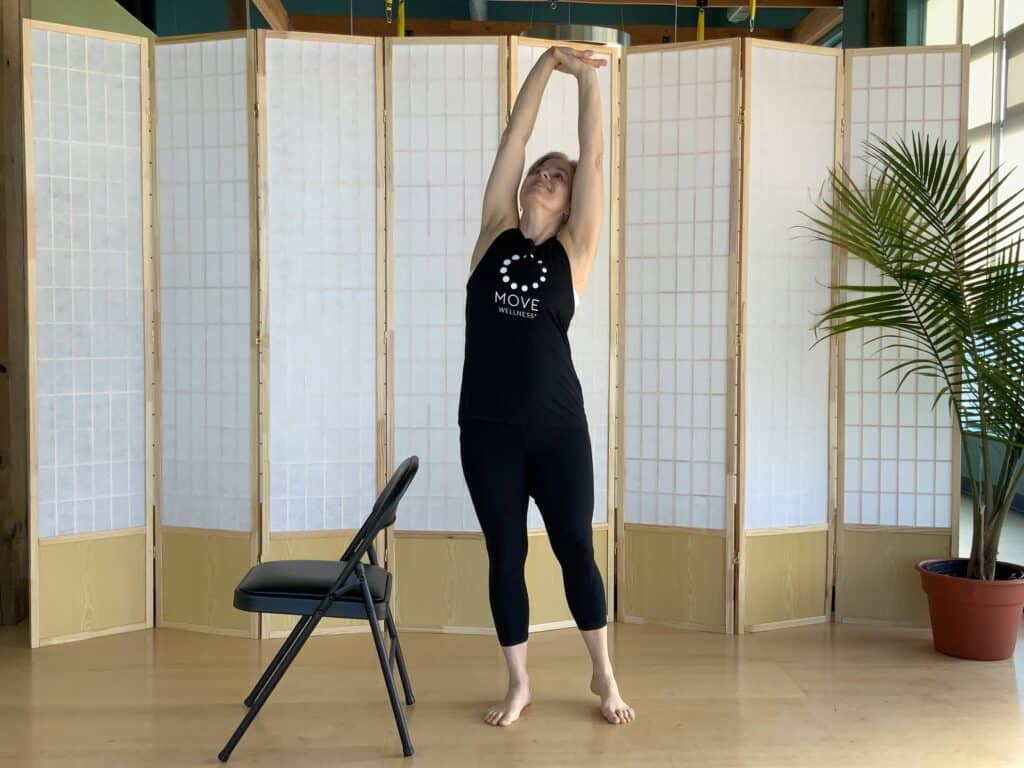
  • Last, stretch your right arm overhead, gently grabbing that wrist with your left hand, and stretch the heel of your right hand up and slightly over while reaching the heel of your right foot further into the floor like the root of a tree. Repeat on the other side.

#4 Finish with a Moment of Gratitude

Finally, take a moment to stand quietly and notice how your body feels. Note where things feel more awake and engaged than when you first woke up. Pay attention to the spots where you might want to give some extra love and attention later in the day.

Allow yourself to express some gratitude for the body you have and what you’re able to do with it, whether that’s climbing a mountain or just moving through your day in an enjoyable, unrestricted way.

Enjoy a free trial of livestream movement classes with MOVE Wellness.

Do you have a morning movement routine? What does it entail? Have you thought about creating one? Which of the stretches listed above do you perform? Please share with the community!

Read More

How to Deal with the Grief of the Loss of a Pet After 60

Grief-of-the-Loss-of-a-Pet-After-60

Coping with the loss of a pet is incredibly difficult at any age. As you probably already know, it doesn’t matter if you are six or 60 – the raw emotions of pet loss can make you feel alone, angry or even numb.

As older adults dealing with the loss of a pet, we can be left with an entirely different level of emotional intensity with our grief journey. In my practice, I often see older adults equate the loss of their pet with their mortality, which in turn stimulates the sense that their grief is not healthy.

Plus, as an older adult, you may have already experienced more consistent loss of parents, spouses, siblings, children or even close friends than a younger adult. You may live alone, and your pet is your primary companion. Whatever your circumstance is, no matter your age, coping with the loss of a pet is painful.

This article will help you understand and support the intensity of dealing with the loss of a pet and normal grief after 60.

Normal Grief from the Loss of a Pet

Are you feeling hopeless, angry, depressed or even relieved that your pet is reaching the end of its life or is no longer physically with you? Please understand you are experiencing normal grief.

I had a client named Carmon. I talk about her and her 12-year-old Border Collie named Jetson in my book My Dog Has Died: What Do I Do? Making Decisions and Healing the Trauma of Pet Loss.

When we had our first conversation, Carmon was so upset that she couldn’t form complete sentences when explaining what she was experiencing. She was crying, had bouts of rage mixed with sadness and, at times, she had difficulty making sense out of what she was feeling. She even started laughing at one point.

I know this might sound a little strange, but all of Carmon’s feelings and emotions were normal. She felt like she was going crazy with all the chaos in her mind and believed that what she was feeling was abnormal.

When she learned that her emotions were normal and healthy, she began to feel like she was not the crazy 63-year-old woman who lived alone with her dog, which is what some of her friends were telling her.

Normal Grief Feelings

Here are some normal feelings of grief that you may experience now or later in your journey when dealing with the loss of a pet.

Physical sensations may consist of: crying, sobbing, wailing, numbness, dry mouth, nausea, tightness in the chest, restlessness, fatigue, sleep disturbance, appetite disturbance, dizziness, fainting or shortness of breath.

Intellectual responses may include: sense of unreality, inability to concentrate, feeling preoccupied with the loss, hallucinations concerning the loss, a sense that time is passing very slowly or a desire to rationalize feelings about the loss.

Emotional responses may range from: anger, depression, guilt, anxiety, relief, irritability, desire to blame others for the loss, self- doubt, lowered self-esteem, feeling overwhelmed or feeling out of control, hopeless, or helpless.

Social feelings can include feelings of isolation or alienation, feeling rejected by others, or a reluctance to ask for help.

Spiritual feelings can be feeling angry at your deity after your dog died and blaming them for the loss, or even bargaining to try and get your dog back.

A Life of Its Own

As you can see, normal grief is varied and expansive. The thing about grief is that it has a life of its own. What this means is that you can be going through a quiet period of your journey when you are feeling relatively good. Then something happens, and it triggers intense, and perhaps unexpected, feelings of pet grief.

Pet grief in your 60s can easily trigger a feeling of unresolved grief from when you were younger. I often hear this from my clients when seeking pet grief support. They tell me that their current loss reminds them of the pet loss grief they experienced when a young adult.

I am here to tell you to let this happen. Let yourself feel what you are going through. Don’t hide your feelings, let them rage. Let your tears flow. It’s healthy and necessary.

Abnormal Grief

The thing about grief is that it can also become abnormal as well. Keep in mind if you can no longer function with your life, feel suicidal, or if any of the normal grief feelings become extreme, this is considered unhealthy grief.

Keep in Mind

Everyone grieves and deals with the loss of a pet differently, so get to know your different feelings. When you take the time to learn and cherish your journey the grief becomes more manageable.

Have you ever had to deal with the loss of a pet? How did you deal with the grief that came with this experience? Do you feel more comfortable with your feelings now that you know they are normal? Please share your answers in the comments below.

Read More

How a Low Functioning Thyroid Can Lead to Weight Gain After 50

Weight Gain After 50

In a previous article I discussed the effects of estrogen on your body and subsequent weight gain. Then I followed with a discussion on cortisol, also known as the stress hormone.

This week I am going to assess how having a low functioning thyroid could be adding to your weight gain woes, even if all your blood levels come back normal.

Thyroid and Weight Gain

Weight gain can be directly linked with thyroid problems. Thyroid issues develop over time. You may have been displaying signs of low thyroid function in your 30s or 40s but were able to push through it.

Back then you were able to exercise a little more to lose any extra weight, or sleep in over the weekends to make up for any tiredness. You probably did not give these changes a second thought.

As you enter your late 40s, these symptoms tend to become more apparent because of any hormonal fluctuations that are also experienced during that time. You need to listen to your thyroid and the signs your body is receiving, and nurture your thyroid if you want to lose weight and gain energy.

Weight gain is typically linked to an under active thyroid because it slows down your metabolism. This results in weight gain and difficulty losing extra weight.

An under active thyroid gland, a condition referred to as hypothyroidism, is where your thyroid gland doesn’t produce enough hormones. Common signs of an under active thyroid are tiredness, weight gain and feeling depressed.

Weight Gain and Hormone Shifts

Women’s weight tends to fluctuate, especially when hormone levels are shifting, which happens as you approach menopause. Many women try to diet to counter this with unhealthy eating plans or a plan that does not address their thyroid, only to make things worse.

Eating the wrong foods can decrease your gut mobility, which slows down your metabolism and causes you to gain more weight. Then, when you find that you do not get the weight loss you were expecting, you revert back to your old eating habits.

Low thyroid function is associated with weight gain due to the fact that the thyroid gland controls fuel-efficiency and your metabolism. With too little thyroid, the fuel (your food) is burned at a lower rate. If meal sizes are the same, weight gain occurs.

Tiredness associated with low thyroid function also can find you too tired to exercise as much as you would like to, further adding to weight gain.

A note of caution: Although weight gain often occurs with hypothyroidism, it is a nonspecific change because increasing weight also occurs with decreased exercise, stress and as a side effect of many drugs.

So do not be quick to assume that you have an under active thyroid if you have gained weight or are unable to lose weight.

Causes of Low Thyroid Function

Estrogen dominance can decrease your thyroid activity by inhibiting the release of thyroid stimulating hormone (TSH). TSH is a hormone secreted by your pituitary gland when your thyroid hormone levels are low. Low thyroid function can also cause progesterone levels to decrease.

Hypothyroidism

An under active thyroid, referred to as hypothyroidism, can present with symptoms that are usually mild and nonspecific. Therefore, it can be easy to dismiss them at the start as not being particularly important. But this is an issue that needs to be addressed.

Hypothyroidism stems from a problem with the thyroid gland, which reduces the amount of the hormone thyroxine it produces.

An under active thyroid can lead to fatigue, brain fog, weight gain, depression, constantly feeling cold and even hair loss. All of these can also be experienced during perimenopause and menopause. A common cause of hypothyroidism is Hashimoto’s disease.

Sub-Clinical Hypothyroidism

You do not have to have a disease of the thyroid to feel the effects of low thyroid function.

Many of my clients would be in tears with the tiredness and exhaustion they experience, yet blood tests come back normal, making them feel that they are going crazy. It certainly does not help when their doctor will not listen to what they are feeling and will only respond to blood tests.

What could be happening is a condition referred to as sub-clinical hypothyroidism where your thyroid is not working to its full potential but blood tests are coming back within normal ranges.

All your blood tests may come back normal but you are most certainly experiencing nearly every symptom associated with low thyroid function. Even low thyroid function can lead to weight gain, especially when it is interconnected with other hormonal issues.

If your thyroid is not functioning as well as it should be, all of your efforts to curb weight gain and achieve hormone harmony may be futile.

Hypothyroidism can occur at any stage in life but it most commonly occurs in women between the ages of 40 and 50. At this age, some women mistake their symptoms are just a part of the menopause or getting older.

Both perimenopause and hypothyroidism commonly occur in midlife women. Perimenopause is a phase that happens for all women and the incidence of hypothyroidism increases with increasing age, especially in women. Therefore, perimenopause and new onset hypothyroidism may occur together.

Here are top 5 tips to improve your thyroid function and help curb the battle of the belly fat.

Decrease the Amount of Processed Foods

A diet high in processed foods can cause inflammation in the body. It also inhibits the thyroid hormone conversion of T4 to T3, T3 being the active form that the body uses.

Gluten and the Thyroid

There is a strong connection between gluten reactions and the thyroid. Some people will be able to completely put their conditions into remission by going gluten-free, while others may need to dig a bit deeper. Eliminating gluten from your diet for 1-3 weeks can be of great benefit.

Selenium and Zinc

Two nutrients directly involved in thyroid function are selenium and zinc. Consuming a diet naturally rich in selenium and zinc is critical for maintaining a healthy thyroid and metabolism. These foods include brazil nuts, tuna, sardines, eggs and pumpkin seeds.

Vitamin D

Get more Vitamin D into your body. This fat soluble vitamin is necessary for thyroid hormone production in the pituitary gland. So be sure to get out and bare your arms and legs at least 20 minutes a day, without UV protection to absorb essential Vitamin D.

Depend on Greens

Add a green smoothie to your diet. This is one of the best ways to make sure you are getting enough nutrients into your day. It is easy to make, easy to digest and packed full of vitamins and minerals that your body needs.

To make it even easier to find out more about the wonders of green smoothies, join the next Green Smoothie Challenge that starts on September 25th 2017. Click here if you would like to join me on the challenge. Your thyroid will thank you for it!

Do you think your thyroid is sluggish? Have you had any blood tests to ascertain if your thyroid function is low only to be told everything is fine? I would love to know what experience you have had. Let me know in the comments below.

Read More

These Stronghold Eyebrow Gels Are the Secret to Brows on Fleek

Some days you wake up with brows like two shapely goddesses ready to take on the world, but most days they pull a Miley Cyrus and can’t be tamed with a stroke of a spoolie brush. To keep your brows in formation, Beyonce-style, what you need is a sleight of hand and a lot of products: pencils for detailing, powders for filling and eyebrow gel to lock in the finished look. 

If nothing else, eyebrow gel is the number one brow product everyone should own because while she plays well with others, she works independently, too: Brow gel sets in product, brushes, volumizes and aligns each fiber just so to meet your mold. No powders or pencils? No problem. This type of gel isn’t the clear pomade guys use to style their coif; some formulas are available tinted to match your natural brow color. This way, you can fill in your brows and define their shape with a single tool.  

Bottom line: Brow gels are an asset to any beauty collection, and if you aren’t already stocked up on products, we’ve rounded up some of the best eyebrow gels on the market to peak your interest. 

Read More