Month: April 2021

Lessons You Can Learn from a Tour in Your Local Cemetery

local cemetery

If you’re looking to explore your roots, or just want to soak up some regional history, look no further than your local cemetery. On most mornings, that is exactly where I go, because I am a funeral director. But I often head there on my off-time, too. Working as a funeral director has piqued my curiosity about the lives of those who rest beneath the monuments.

In fact, it was such interest that inspired me to author two books about notable American cemeteries: Green-Wood Cemetery and Gardens of Stone.

I’m far from alone in my interest. Touring cemeteries has become a huge pastime as evidenced by the many hashtags, such as #tombstonetourism and #cemeterywandering, to be found on social media.

walking in a cemetery

Whether small churchyard cemeteries or large, elaborate necropolises, cemeteries today are regarded as cultural repositories and outdoor museums. What’s more, they are visual reminders that every life has a story, and one of them may be the story of your ancestors.

Learning About Your Ancestry

“Discovering the cemeteries and graveyards of your ancestors is a great place to further your genealogical research, as well as a make a physical connection to ancestral family,” says Valerie Elkins, a family history expert and professional genealogist based in Colorado Springs, Colorado.

“Besides the commonly found information of name, birth and death dates, grave headstones may include clues on where to find further information to aid your research,” she says.

That information may include the person’s hometown, even in another country. Emblems on tombstones can provide clues to past membership in fraternal organizations, a person’s religion, and their veteran status, Elkins explains.

“Neighboring headstones can link families together, so it is important to pay attention to those graves surrounding them. Shared death dates might tell you that they died from the same cause such as a natural disaster, a disease outbreak, or that they died to possible unnatural causes such as war or murder.”

Elkins recommends the Internet as a good starting point if you are unable to locate your ancestor’s grave. FamilySearch.org, a free website, provides access to millions of records that the Family History Library, the world’s largest genealogical library, has available.

Ancestry.com, which has a large catalog of cemetery records, is also a good resource. It is a premium website, but local libraries often provide free access.

And if online research doesn’t work, Elkins says it pays to contact local and state genealogy societies, which may be the key to finding information about cemeteries, even unpublished small family graveyards, especially since cemeteries’ names may have changed over time.

“Once you locate your loved one’s headstone, take photos of the stone,” she says. “Some headstones have information on the back and sides of the stone, so be sure and record this as well. Take pictures of the neighboring headstones to research later.”

Touring for Pleasure

While many visit cemeteries to trace their family lineage, others go to view the splendid architecture and learn more about local history.

“The history of America is in cemeteries,” says Marge Raymond, a veteran senior tour guide for Brooklyn, New York’s renowned Green-Wood Cemetery.

Raymond, who knows just about every inch of the cemetery’s 478 acres, first discovered Green-Wood through her interest in bird-watching.

“I was captivated by the beauty of Green-Wood and wanted to know everything about it,” Raymond recalls. She began to go on tours offered by the cemetery, soon becoming a volunteer who welcomed visitors and manned the cemetery’s book cart.

Her dedication was rewarded when, in 2007, Raymond became an official Green-Wood Historic Fund tour guide. Early on, she created three unique routes for the trolley tour, and for over a decade has given hundreds of walking, and private, tours.

Raymond’s knack for storytelling has garnered her scores of glowing reviews on Tripadvisor, as well a reputation as one of New York’s most popular tour guides. She is also a professional vocalist, who has sung with such legends as Rock and Roll’s Steven Tyler of Aerosmith and was in the chorus for the late tenor, Luciano Pavarotti.

Sometimes billed as “the singing tour guide,” Raymond has been known to break into song at a gravesite, to the delight of those on her tour. One of those gravesites is that of Leonard Bernstein on Battle Hill, which occupies the highest point in Brooklyn and is a favorite spot of Raymond’s.

touring battle hill

“I would call it a trifecta. There’s the remarkable Civil War Monument erected in 1869 by the City of New York, the statue of Minerva, the sister statue to the Statue of Liberty, and the grave of our beloved maestro Leonard Bernstein.” And, she says, “you can’t beat the view of the New York City skyline from that vantage point.”

What to Know Before You Go

Whether you’re taking a guided tour, or mapping out your own self-guided walk, here are some helpful tips from Elkins and Raymond to get the most out of your tour.

Familiarize Yourself with the Cemetery and Its Notable Inhabitants

“People come into the cemetery and look around. They may recall a name or two, but sometimes tourists don’t know the significance of what they’re looking at. That’s where a guided tour comes in. A tour guide knows the grounds and the stories behind the monuments,” Raymond says.

Search Find A Grave and Billion Graves

“Findagrave.com and BillionGraves.com are websites that have indexed thousands of graves from cemeteries around the world and are easily searchable,” says Elkins. BillionGraves.com also allows you to record the GPS coordinates of a headstone, along with the headstone’s information, to make it easier for others to locate.

Ask Questions of the Tour Guide

Don’t be a passive spectator. If something catches your interest, or you have a question, make sure to ask your guide. They welcome your interest.

Venture Off the Beaten Path

“I’ll find something interesting written on a headstone, then I’ll go and look it up,” says Raymond, who, while traversing Green-Wood’s public lots came across the grave of an early 20th century cyclist whose stone monument noted that he “died from exhaustion” after winning a race.

Tailor the Tour to Your Special Interests

Whether those interests are legendary movie stars, natural disasters, world wars, inventors, organized crime figures, or sports figures, there’s likely a tour for that interest.

Size Up the Particulars of the Tour

It is practical to have some numbers. How long is the tour? What’s the terrain like? Is there a trolley or bus alternative to walking? Needless to say, wear comfortable shoes, bring water, and don’t forget the sunscreen.

Know the Cost

Costs vary from cemetery to cemetery. Members of historic funds often quality for a discount.

If you’re planning to be in New York this spring, Raymond will be giving tours on April 17th at 1 pm & April 30th at 7 pm, and on May 8th & May 30th at 1:00 pm. Head over to https://www.green-wood.com/calendar/ for more details. And as one Tripadvisor reviewer recommends:

“Make sure to ask for Marge when you book, she’s like a walking history book!”

How often do you visit your local cemetery? What is the primary reason to go? Have you been on a cemetery tour? Do you think you’d go to one if available in your area? What would you look for? Do you have a favorite cemetery? Please share with the community!

Read More
Herbivore’s Latest Aesthetic Serum Hydrates & Plumps While Looking Pretty

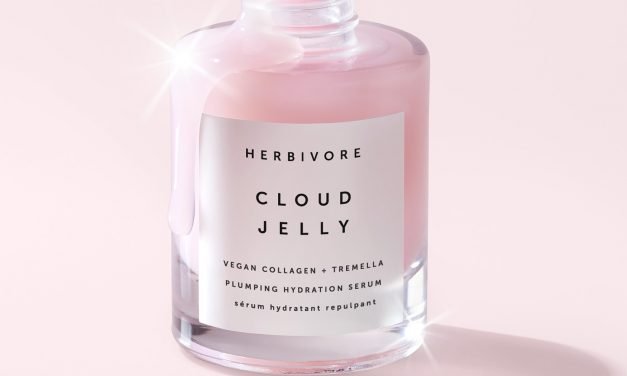
It’s not often that a skincare product looks and smells great—and actually works. Most of my favorite products smell, well, like hot dog water. Shudder. But Herbivore’s Cloud Jelly Serum smells great, feels great and looks cute on my counter all at the same time. And it’s made with my least favorite vegetable. (To eat, that is.) Intrigued? Allow me to explain.

Hyaluronic acid is a trending ingredient that seems to pop up in every skincare product whether it needs it or not. Sure, it’s hydrating but there are other options that can work just as well for certain skin types—if not better. Herbivore’s Cloud Jelly is packed with Tremella mushrooms, a hydrating alternative to hyaluronic acid. Also known as snow mushrooms, the white gelatinous flower has been used in Asian medicine and skincare for thousands of years. Now, skincare brands are realizing how stellar it is for skin plumping even on the most sensitive skin.

Our mission at STYLECASTER is to bring style to the people, and we only feature products we think you’ll love as much as we do. Please note that if you purchase something by clicking on a link within this story, we may receive a small commission of the sale.

Herbivore cloud jelly

Herbivore.

Tremella mushrooms have been shown to pull moisture into the skin, maybe even penetrating the skin better than hyaluronic acid. Brands are catching on and all of a sudden it’s all about snow mushrooms—and I’m not bad about it. Of course, that’s not all that makes Cloud Jelly work. It also contains vegan collagen to moisturize and nourish skin, as well as antioxident-rich strawberry extract to brighten skin.

Cloud Jelly has a pleasant fruity smell that doesn’t feel fake and overpowering. It goes on smooth and silky without being sticky and it sinks into skin surprisingly quickly.  I’ve only been using it for a few weeks but I do feel glow-y after using it. While I usually only use serums at night, I found it even works well under makeup so it’s safe to use twice a day if you so choose. Plus, since it’s lightweight, I’m not worried about it breaking me out.

If you’re a fan of other Herbivore products, including the fan-fave Prism 20% AHA + 5% BHA Exfoliating Glow Facial, or you’re a newbie to the brand, I think you’ll find Cloud Jelly fits seamlessly into your skincare routine.

STYLECASTER | Ashley Benson Interview


Read More

Summer House Fashion: Season 5 Episode 11

Summer House Fashion: Season 5 Episode 11

Derby day! 🐎👒 According to the previews for this week’s episode of Summer House the cast brings the Kentucky Derby to the Hamptons with a party featuring “race horses” (well, housemates galloping in horse costumes lol), mint juleps and extravagant hats. And of course, some pretty pastel-hued dresses that we’re willing to place a bet you’ll love.

*Additional looks will be added after the show airs*


Fashionably,

Faryn


Amanda Batula’s Metallic Mint Ruffle Dress

Amanda Batula's Metallic Mint Ruffle Dress

Click Here to See Her Sold Out Sabina Musayev Dress

Click Here to Shop it in Purple

Style Stealers:

!function(d,s,id)
var e, p = /^http:/.test(d.location) ? ‘http’ : ‘https’;
if(!d.getElementById(id))
e = d.createElement(s);
e.id = id;
e.src = p + ‘://widgets.rewardstyle.com/js/shopthepost.js’;
d.body.appendChild(e);

if(typeof window.__stp === ‘object’) if(d.readyState === ‘complete’)
window.__stp.init();

(document, ‘script’, ‘shopthepost-script’);


Turn on your JavaScript to view content


Paige DeSorbo’s Pink Polka Dot Ruffle Dress

Paige DeSorbo’s Pink Polka Dot Ruffle Dress

Click Here to See Her Sold Out NBD Dress

Style Stealers:

!function(d,s,id)
var e, p = /^http:/.test(d.location) ? ‘http’ : ‘https’;
if(!d.getElementById(id))
e = d.createElement(s);
e.id = id;
e.src = p + ‘://widgets.rewardstyle.com/js/shopthepost.js’;
d.body.appendChild(e);

if(typeof window.__stp === ‘object’) if(d.readyState === ‘complete’)
window.__stp.init();

(document, ‘script’, ‘shopthepost-script’);


Turn on your JavaScript to view content


Ciara Miller’s Floral Sequin Dress

Ciara Miller’s Floral Sequin Dress

Click Here to See Her Sold Out Lovers + Friends Dress

Style Stealers:

!function(d,s,id)
var e, p = /^http:/.test(d.location) ? ‘http’ : ‘https’;
if(!d.getElementById(id))
e = d.createElement(s);
e.id = id;
e.src = p + ‘://widgets.rewardstyle.com/js/shopthepost.js’;
d.body.appendChild(e);

if(typeof window.__stp === ‘object’) if(d.readyState === ‘complete’)
window.__stp.init();

(document, ‘script’, ‘shopthepost-script’);


Turn on your JavaScript to view content


Lindsay Hubbard’s Purple Blazer Dress

Lindsay Hubbard’s Purple Blazer Dress

Click Here to See Her Sold Out Lovers + Friends Dress

Style Stealers:

!function(d,s,id)
var e, p = /^http:/.test(d.location) ? ‘http’ : ‘https’;
if(!d.getElementById(id))
e = d.createElement(s);
e.id = id;
e.src = p + ‘://widgets.rewardstyle.com/js/shopthepost.js’;
d.body.appendChild(e);

if(typeof window.__stp === ‘object’) if(d.readyState === ‘complete’)
window.__stp.init();

(document, ‘script’, ‘shopthepost-script’);


Turn on your JavaScript to view content


Originally posted at: Summer House Fashion: Season 5 Episode 11

Read More

How to Rock the Transition to Your Next Best Life in Retirement

Life-in-Retirement

Some things in life are easier not to think about, like death, taxes or facing a major transition such as retirement. Fortunately, my son, a financial advisor and business owner, had one of those “Mom, let’s sit down and talk about your finances” discussions with me several years ago.

At the time I felt like a young, 54-year-old child getting the sage advice we parents are supposed to dole out. Naturally, I got good advice, and that discussion helped me get my retirement finances in order.

I set goals for myself and put a plan into action so I’d be financially ready to retire from teaching (now just 14 short months away).

Transitions: When Goal-Setting Isn’t Enough

Goals can be useful for both short- and long-term plans. My financial plan for retirement was a long-term goal. Short term goals could include anything from trying to lose 10 pounds before summer starts to raising money through crowdfunding to help victims of a natural disaster.

I don’t deny that setting long- and short-term goals is important. They keep us motivated and help us focus on what we want to accomplish.

I’ve always been a big fan of goal-setting. However, as valuable as they are, I don’t believe goals alone are always sufficient for living our best lives when we are facing any kind of major life transition.

Retirement is a major transition, but it likely won’t be the first or last one for any of us. Many of us will lose a partner or spouse, experience changes in our health or mobility, start an encore business, or take on new responsibilities that we hadn’t planned to assume, such as raising grandchildren.

These transitions usually require a bit of reinventing and a whole lot of adjusting that no amount of goal setting can completely address.

Beyond Goal-Setting

William Bridges, author of Transitions: Making Sense of Life’s Changes (2004), explains that after something ends, we have to deal with what he calls “the neutral zone” – a place of uncertainty before something new begins.

It is in this period of uncertainty that we have a rich opportunity to think about how we want to begin the next chapter of our lives.

Regardless of the type of transition we may face, we can view it as a new chance to reinvent our lives. To do this, we need to start by having a clear picture of what we want the next chapter of our lives to look like. Then we can develop a transition plan to help that vision become a reality.

This approach is more like aligning our lives with a vision than setting goals and achieving them. I like to think of this process as behavioral orthodontics. In essence, that’s what it involves – gradual behavioral alignment based on a vision we want to sustain.

Picture Your Next Best Chapter

Unlike goal-setting, creating a clear vision for our lives doesn’t necessarily involve a linear process. In fact, identifying a clear vision for our future often involves our intuitive, creative abilities. Having a vision means we “see” the next best life we really want for ourselves.

As I noted in my Live Your Best Life at Any Age TEDx talk, creating a vision for ourselves involves work. As I also explained, there are a number of tools available that can help us “see” our best selves in the future.

One of my preferred ways of crystalizing my next best life is to do some reflective journaling. This involves regular journaling about experiences, passions and unfulfilled dreams. When using this approach, I regularly review my journals and look for themes.


I ask myself questions like, “What is really, really important to me?” “What do I love doing more than anything?” “What talents or skills do I have that need to be shared with others?”


Another personal favorite I use is to identify role models of people whose lives speak to me. Some of my role models, like Susan B. Anthony, are from history. Others are contemporary. I find that I’m especially drawn to strong women who are willing to speak up for those who do not have a voice.

While it does take a lot of work, having a clear picture of the next life you really want is incredibly empowering. Because I have a clear picture or vision for my next life, I feel more than ready to start transitioning into the new 3.0 version of me.

Create a Sustainable Transition Plan

Once we have a clear picture of our next best life, we can take that vision and break it down into measurable components. The vision I have for my next best life is this: I invest in others to help them be their best. To me, one of the components of investing in others is to share empowerment strategies with groups of people.

Rather than setting a goal of giving a certain number of presentations once I retire, I have committed myself to giving at least some presentations before I retire. If I give a presentation beyond the classroom every six months, I’m doing something.

If I give a presentation every four months, I’m starting to make progress. If I give a presentation every quarter, I’m starting to live the life I’m going to want once I retire. In the last six months, I’ve averaged a presentation every two-three months. I’m becoming who I want to be.

When I’m no longer teaching, my intention is to speak about empowerment strategies one to two times a month. Because I’m already practicing these behaviors, it will be natural for me to gradually increase my speaking frequency after I retire.

Your Next Best Life

What do you see for your next best life? If you are too busy taking care of the day-to-day business of living, I challenge you to stop, take time and ask yourself, “What do I really, really want my life to look like in the near and not-so-near future?”

By taking time for yourself now, you can live your best life at any age.

I’ve shared some of my dreams. What are yours? Are you already living your dream? What do you see for yourself in the future? What insights are you willing to share about dealing with transitions and living your next best life? I’d love to read your thoughts in the comments below.

Read More

Best Multivitamins and Supplements for Women Over 50

multivitamins and supplements for older women

Are you considering adding supplements or a multivitamin to your daily regimen? Even if we eat a balanced diet and take care of ourselves, we may need to supplement with vitamins and minerals as we age. Vitamin deficiencies may creep up on us and start to cause small or big health issues over time.

There are different ways of taking vitamins. You can take individual supplements that deliver specific nutrients, or you can take a multivitamin that contains several combined nutrients.

Individual supplements consisting of specific vitamins and minerals are often taken for therapeutic purposes to help with an existing condition, while a multivitamin is often taken as a dietary safety net to curve off potential health issues and to make sure that the body is receiving essential doses of vitamins and minerals daily.

How do you know which is best for you? Your doctor will be the best person to answer this question if you are uncertain. Remember, dietary supplements are not intended to replace food. They are also not intended to diagnose, treat or prevent diseases.

Always speak with your doctor about any new medications, and that includes supplements and vitamins.

Supplements for Women Over 50

If you browse the web and read news pieces, magazine articles, or blog posts on a regular basis, chances are you have come across lots of different opinions about vitamins and supplements.

It can be very confusing, especially if you are just introducing yourself to a healthier lifestyle and you’re considering adding supplements to your diet.

Here is a short list of some of the most important supplements that women should be taking as they get older.

Co Q-10

You’ve probably heard of this formula on numerous occasions, but you may have no idea what it is or what it does. Co Q-10 is short for Coenzyme Q-10.

This supplement is best known for helping to support a healthy cardiovascular system. Co Q-10 naturally appears in almost every cell in the body and our Co Q-10 levels may decrease with age. Co Q-10 helps our bodies convert food to energy and may also be important to nervous system health.

Fish Oil

We know that fish oils contain heart-healthy nutrients you need called omega-3 fatty acids. Fish oils contain EPA and DHA, the important fatty acids that help benefit the heart, joints, and bones.

Omega-3 fatty acids are derived from many sources. You can choose from cod liver, salmon, and krill oil.

In addition, Vitamin A in cod liver oil assists eyesight and skin maintenance and vitamin D helps maintain strong bones. Krill oil, derived from small crustaceans, naturally contains astaxanthin.

Vitamin D

According to recent studies, up to 75% of adults and teens could use more Vitamin D. Sunlight provides a good source of Vitamin D, but many of us aren’t spending enough time in the sun these days to provide adequate levels of this important vitamin. People who live in northern climates often have reduced levels of Vitamin D, especially during the winter months.

Many health experts recommend that adults get approximately 2000 IU of Vitamin D every day for optimal health benefits. Why is Vitamin D important to us? Vitamin D assists in the absorption of calcium.

As we age, Vitamin D absorption decreases, and the skin produces Vitamin D less efficiently.

To complicate matters, very few foods in nature contain Vitamin D, making it more important to find alternative supplements.

Vitamin K2

Vitamins D3 and K2 work together for your bones and heart. Vitamin D creates K2 dependent proteins that move calcium, and K2 activates those proteins.

“The biological role of vitamin K2 is to help move calcium into the proper areas in your body, such as your bones and teeth. It also helps remove calcium from areas where it shouldn’t be, such as in your arteries and soft tissues,” says Dr. Kate, author of Vitamin K2 and the Calcium Paradox: How a Little-Known Vitamin Could Save Your Life.

Besides shuttling calcium, Vitamin K2 is important for the prevention of heart disease, heart attack and stroke, brain disease, and because it activates proteins that promote cell growth, it may help to prevent cancer.

Vitamin C

By now, most of us understand that we can get Vitamin C from citrus fruits and other dietary sources. But how many of us know why Vitamin C is an important nutrient?

There are a few reasons our bodies require this vitamin. Vitamin C helps aid in the formation of collagen. Collagen is an amino acid-rich substance, which can provide raw materials for connective tissues like ligaments and bones.

Vitamin C helps aid our immune system health, and it is also a “super antioxidant” that helps fight cell-damaging free radicals.

Because our bodies require Vitamin C and because we cannot make or store Vitamin C, we have to get our daily dose from food and supplements. Since many of us don’t eat enough fruits and vegetables to reach our daily recommendation, it may be necessary to supplement.

Magnesium

Magnesium is an important mineral for long-term health. It helps maintain the ‘pumps’ that control the movement of salts in and out of cells. It is also essential for healthy nerve conduction, muscle relaxation, healthy bones, and energy production.

Lack of magnesium is one of the most common mineral deficiencies and adequate intakes are even associated with longevity. Magnesium helps to relax muscles in blood vessel linings, lower blood pressure, reduce arterial spasm, and protect against heart attack and stroke.

Studies have shown that people with Alzheimer’s had lower levels of magnesium in their cerebrospinal fluid than those who did not have the disease.

Magnesium is also highly recommended by doctors as a relief for chronic constipation. The recommended intake for magnesium varies from 375mg in the EU to 400mg in the US.

For more information about the importance of magnesium for women over 60, please watch Margaret’s interview with Lynda Goldman.

Looking for even more supplement tips? See Sarah Brewer’s 6 best vitamins and supplements for women over 60.

What About Multivitamins for Older Women?

Multivitamins aim to help provide the essential vitamins and minerals needed in a single daily serving.

Multivitamins typically come in different formulations for varying nutritional needs based on gender and age. For instance, there are senior-specific multivitamins that take into consideration the concerns of people over the age of 50. Senior-specific multivitamins may focus on bone and heart health vitamins and minerals.

Preferably, look for multivitamins designed for women over 50 in order to get the best nutrients for your body and mind.

Do You Need a Multivitamin?

A multivitamin is definitely recommended for people with poor eating habits who don’t get enough nutrients through their food every day. A multivitamin created specifically for women over 50 may also be beneficial even for those who do eat well to help slow down aging and prevent some illnesses.

As women age and go through menopause they may experience deficiencies in certain nutrients, like vitamins B6, B12, and D for example. Also, when menstruation ceases, we need less iron and more calcium. Multivitamins designed for older women will take all these age-related health concerns into consideration.

What if You Take More Than the Recommended 100% Daily Value?

Dr. Ana Lamnari explains that “it is important to know that daily values have been established as minimum doses that will prevent deficiency. This is a pretty low bar to clear. FDA has recognized that in 2016 and has consequently updated many daily values, including the one for vitamin D from 400 IU to 800 IU.”

Dr. Lamnari likes to have at least 1,000 IU of vitamin D in her multivitamin. She says: “Often, even that may not be enough, and you may need to resort to taking extra vitamin D in addition to the multivitamin. In any person with normal kidney function the vitamin B12 excess will be easily excreted. For that reason, it should be safe for most of us to take larger quantities of vitamin B12.”

She suggests avoiding iron, unless you have been told that you are iron deficient. She warns that “Too much iron increases oxidative stress and can be a cause of chronic inflammation.”

Most multivitamins for women over 50 are iron-free and that is one of the reasons it’s important to choose a multivitamin that is specifically created for older women in mind.

Best Multivitamins for Older Women

After much research and reading consumer product reviews, we came up with a list of multivitamins that we feel can provide the best supplementation our over-50 bodies need.

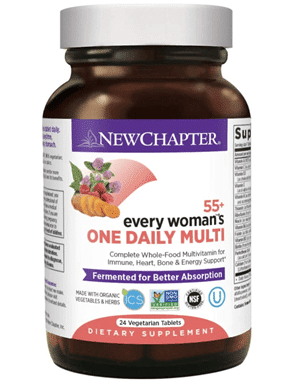
New Chapter Every Woman’s One Daily

New Chapter Every Woman’s One Daily

The New Chapter one-daily tablet is packed with vitamins, minerals, herbs, and superfood botanical blends to maintain good health and vitality.

This multivitamin is iron-free and is gentle enough to take any time during the day, even on an empty stomach. New Chapter Every Woman’s One Daily helps support your immune system, your heart health, your energy level, your digestive system, and also helps eye and bone health.

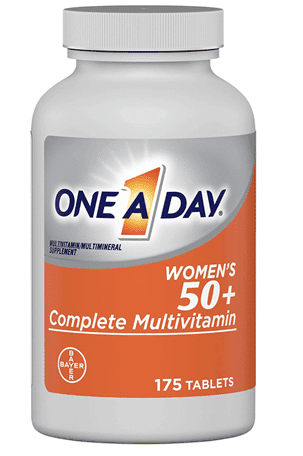
One A Day Women’s 50+

One A Day Women’s 50+

One A Day Women’s 50+ multivitamin offers a wide variety of essential nutrients in an easy-to-take tablet. This multivitamin helps support healthy brain function with all vital B vitamins. It’s formulated to promote bone health, joint health, heart health, eye health, immune health, and also boost physical energy by helping convert food to fuel.

Also, One A Day Women’s 50+ is free of gluten, wheat, soy allergens, dairy, and artificial sweeteners.

MegaFood Multivitamin for Women Over 55

MegaFood Multivitamin for Women Over 55

The MegaFood Multivitamin for Women Over 55 is made with real food, wholesome nutritional yeast, and added nutrients like a perfect blend of vitamins, minerals, and green tea leaf extract to support a woman’s unique physiological needs.

It includes 1000 IU of vitamin D to support healthy bones, essential B vitamins, and zinc to support cognitive function.

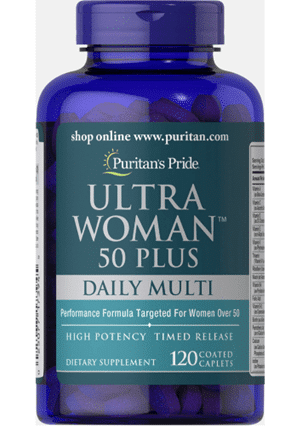
Puritan’s Pride Ultra Woman™ 50 Plus Multi-Vitamin with Zinc

Puritan's Pride Ultra Woman™ 50 Plus Multi-Vitamin with Zinc

Puritan’s Pride Ultra Woman 50 Plus multivitamins are high-potency caplets that provide powerful antioxidants that promote strong, healthy bones, and contribute to metabolic health and energy production. It also can support healthy hair, skin, and nails.

The caplets are time-released to provide a gradual release of nutrients, so you can continue to benefit throughout the day.

Thorne Women’s Multi 50+

Thorne Women's Multi 50+

Thorne Women’s Multi 50+ is a comprehensive daily multivitamin/mineral combination that provides support for a healthy, active lifestyle.

The multivitamin is designed with nutrients the body can easily absorb and is formulated for individuals at low risk for iron deficiency, including post-menopausal women.

SmartyPants Masters Complete Women 50+ Gummy

SmartyPants Masters Complete Women 50+ Gummy

You may find it difficult to swallow the traditional large multivitamins and that is where gummy vitamins come in handy.

The SmartyPants Complete Women 50+ Gummy uses the highest-quality ingredients available to deliver omega-3 EPA and DHA essential fatty acids (from fish oil) to help support your eye, bone, heart, and immune health. They are easy to take and taste yummy.

Do you take supplements or a daily multivitamin designed for women over 50? Did you start by your doctor’s recommendation or was this your own choice? What is your favorite brand and why? Let us know in the comments below.

Disclaimer: This article is not intended to provide medical advice. Please consult with your doctor to get specific medical advice for your situation.

Read More