
Month: May 2021

Crucial Retirement Milestones in Your 60s (VIDEO)

retirement milestones

As you navigate your 60s, you have several critical retirement planning milestones to work through. While that may be intimidating, the tasks are all manageable, especially if you give yourself plenty of time to learn about your options.

You gain access to valuable benefits in your 60s, and the choices you make can affect your comfort in retirement. You also enter a phase in life where financial decisions matter more than ever.

You’re likely near the end of your working years, although you can certainly work longer if it’s rewarding (and if you’re fortunate enough to have good health). But it’s hard to go back to work and recover from financial mishaps when you’re hoping to leave the work world behind you.

At this stage, it’s important to make the transition out of full-time work as smooth as possible. Getting familiar with the retirement-related events below can help you make smart decisions and reduce the chances of mistakes.

Retirement Account Withdrawals: Age 59 ½

Once you reach age 59 ½, it becomes easier to take distributions from retirement accounts. For example, you can pull funds from traditional IRAs without early withdrawal penalties adding 10% or more to the taxes you owe on withdrawals.

You can retire before reaching 59 ½ , but you’ll want to have a plan for managing taxes. For example, pulling money from Roth accounts or spending from taxable brokerage accounts might help you bridge the gap until you can tap your pre-tax savings. Other strategies can also help you spend from your savings in tax-savvy ways, and a CPA or financial planner can help you explore ideas.

Planning tip: Make an income plan so you know how much you can draw from your savings. You want the funds to last for the rest of your life, and it’s important to include things like taxes, rising costs, and healthcare needs in your estimate.

Enroll in Medicare: 3 Months Before Age 65

Most people become eligible for Medicare at age 65, and it’s crucial to enroll in a timely fashion. If you miss a deadline, you risk paying higher costs for the rest of your life, and you may be without coverage temporarily.

The earliest you can enroll in Medicare is three months before your 65th birthday. It takes time to process your application, and mistakes can add delays, so it’s wise to get the ball rolling as soon as possible.

Planning tip: If you’re still working at age 65, you might have the option to use your employer’s health plan. But things can get complicated quickly. Speak with your health insurance provider as you approach age 65 to find out how to avoid problems.

Apply for Social Security: 4 Months Before Income Starts

You can also sign up for Social Security several months before benefits begin. Doing so can help minimize stress and ensure that you receive retirement income when you need it. The Social Security Administration allows you to apply for your retirement income benefit four months before you want payments to begin, and you might as well take advantage of that opportunity.

Most people can begin benefits as early as age 62. But claiming early results in a reduced benefit, and you’ll have to live with that reduction for the rest of your life. It’s not necessarily the wrong move, and it could make sense when you need immediate income, but waiting to claim is often an excellent strategy.

For example, if you were born in 1960 or later, claiming at age 62 leads to a 30% reduction in your Social Security retirement benefit. If that happens, for every $1,000 you could get at Full Retirement Age (FRA), you’d get just $700. On the other hand, if you wait until after your FRA, your monthly benefit can increase by roughly 8% per year until you reach age 70.

Planning tip: You don’t need to claim Social Security Benefits exactly when you retire. In some cases, it’s smart to spend from your savings or do Roth conversions for a few years before you begin taking Social Security income.

Required Minimum Distributions: Age 72

After you reach age 72, you’re generally required to take withdrawals from pre-tax retirement accounts whether you want the money or not. The IRS provides a schedule for you to follow, and you start with relatively small amounts. As a result, these required minimum distributions (RMDs) add to your taxable income, which prevents you from keeping that money sheltered from taxes indefinitely.

One of the most important things to know about RMDs is that there’s a steep penalty for failing to follow the rules. If you miss an annual RMD, there’s an excise tax that amounts to 50% of what you were supposed to withdraw.

Planning tip: Set annual reminders to be sure you never miss an RMD. The deadline in most years is December 31st, but I often do this for clients in October. That way, you stay invested for most of the year, and if anything goes wrong, you have extra time to fix things. Check with a CPA to verify that you’ll avoid problems on your tax return.

Pension Decisions: Several Years Before Retirement

If your employer offers a pension, review your options and start making decisions long before you retire. For example, you may need to decide when to start taking income and whether or not to add a beneficiary to your pension payments. Those decisions determine your monthly income and could affect your beneficiary’s quality of life.

If you work for certain government organizations, it’s essential to understand if your pension will affect your Social Security benefits. Ultimately, the goal is to understand your total retirement income to get an accurate estimate of how much you can spend each month. Knowing the details sooner rather than later reduces the chances of a letdown.

Planning tip: Customer service representatives with your employer’s pension system are often eager to help you understand your options. Call with questions and attend informational sessions to learn about your benefits.

The Big Picture

The topics above focus on your finances, but the most important thing is that you continue to live an excellent life after you stop working. Money doesn’t buy happiness, but it can be a tool to eliminate problems and buy experiences.

You may be living on a fixed income in retirement, but that doesn’t mean you should feel limited. In fact, Margaret Manning shares numerous insights from the Sixty and Me community that can help make retirement fulfilling on any budget.

If you want to learn more, check out this video:

What milestones (financial or otherwise) are you most looking forward to in your 60s and beyond? Do you feel prepared for all of this, or are there any areas that seem a little intimidating?

Read More

Brain Health and Aging: How Are They Related? (VIDEO)

brain health and aging

The brain is a fascinating and mysterious part of the human anatomy. There is still much we don’t know about how the brain functions in its many varied ways. We lose brain cells as we age, and the dilemma of dementia and Alzheimer’s is increasing, worldwide.

Research is of paramount importance in finding the causes of deteriorating cognitive functioning. In the meantime, we can help our brain maintain good health as we age.

Important Brain Facts

Did you know that:

Dementia is the second leading cause of death in Australia.

Females account for 64.5% of all dementia related deaths. 

3 in 10 people over the age of 85 and almost 1 in 10 people over the age of 65 have dementia.

Unique Aspects of the Brain and Their Functions

No other organ is as diverse as the brain. This single part of the body maintains our:

  • Cognitive function – memory, thinking and learning.
  • Motor function – balance, control of movement.
  • Emotional function – negative and positive emotional responses or reactions. 
  • Tactile function – response to touch, pressure, pain and temperature.

Many medical conditions and lifestyle factors can affect brain health. You can help prevent or delay cognitive decline by choosing a healthy lifestyle. Below are 3 of my favourite ways to ensure my clients get a well-rounded brain workout. 

Looking After Your Physical Health 

Consistent and regular physical activity is the key to overall health and learning new skills via physical activity can give your brain an enormous boost. 

  • Throw and catch a ball.
  • Juggle.
  • Catch a pool noodle or ruler as fast as you can. 
  • Take stairs or walk over uneven ground (if able). 
  • Play bowls, golf, mini golf, bocce, quoits, croquet (if able).
  • Try arts and crafts projects.

All these exercises use your cognitive ability, motor function, tactile function and are great at creating new neuronal pathways and good blood flow to the brain. This helps protect against cognitive degeneration. 

Looking After Your Mind

Play games like crosswords, sudoku, jigsaw puzzles, etc. Choose card games, chess, charades or other similar activities to play with friends. 

Try This Fun Group Game

Form a circle. Think of an adjective that starts with the first letter of your name, like daring Diana. Don’t reveal your name and adjective yet. Nominate a person to start. Diana’s chosen. She says to the person on her left, daring Diana. They say their name and adjective, Joking Joe, then adds daring Diana.

The next person on the left follows the process with their name and adjective, monkey Mary, Joking Joe and daring Diana. And this continues until everyone in the group finishes. The last person has to remember all the names and adjectives. 

The game encourages memory and brain plasticity along with lots of laughs! Tip: Mix it up by adding movement. Stepping forward and back or side to side whilst remembering the names, adds an extra layer of toughness! 

Social and Mental Health Care

We often neglect our emotional states. Making time for social connections is very important for good brain health. According to research, loneliness can be as unhealthy as smoking 15 cigarettes a day! 

Find a hobby or interest and join a group. Arts and crafts, walking groups, dancing groups, Senior citizen’s club or bingo/other. 

‘Meetup’ is beginning to organize in-person meets again. They provide many group events, activities and zoom get-togethers.

You can also phone a friend or relative once a week or meet for a chat over coffee or a meal. 

The above suggested pursuits touch on different aspects and areas of brain function. Some activities suit physical, mental and emotional brain functions. There’s something to suit everyone’s taste, lifestyle and fitness level. Introduce brain health activities into your daily routine and enjoy better cognitive function as you age. 

What brain stimulating activities are you ready to try? Do you already have brain health as part of your daily routine? Which activities work best for you? What benefits have you noticed? Please share below!

If you would like to learn more about women’s health and wellbeing, feel free to join Rachelle’s online community.

Read More

Folks On TikTok Are Chopping Off Their Ponytails In Search Of The Perfect Shag

All it takes is one experiment to turn out surprisingly well for TikTok to turn it into a trend. That’s what happened when one TikToker tried the wolf haircut trend by chopping inches of her high ponytail. Hundreds of folks took to the app to try it themselves to varying results, but most are pretty happy with the look. Call it the Miley Cyrus effect or the angsty music of Olivia Rodrigo. But all of a sudden, everyone has a mix of a shag and mullet thanks to the trend.

Here’s how it “works.” (Hint: it doesn’t always work.) Slick your hair into a high ponytail and cut off a few inches from the ends straight across. Then, take scissors (ideally, hair cutting ones but we’re seeing a lot of kitchen scissors!) and cut vertically into the ends of hair to give more texture and keep the ends from being too blunt. Of course, this also helps hide if you didn’t exactly cut in a straight line.

TikToker Florasandfaunas was one of the first (or the actual first) to chop her blonde ponytail to really great results. She already had some layers in her hair so this seemed to make them a bit shorter.  Others jumped in to create their own version.

Others, like TikToker Piparoni ran to the bathroom to try it, too. At first, she wasn’t sure about the results but after washing and styling it, well it turned out extremely cute.

The wolf haircut is shorter in the front and longer in the back (giving it a mullet vibe), as well as layered pieces throughout. Although it worked for some TikTokers, others posted some pretty choppy, uneven styles. They had to run to the salon to attempt to get it fixed, which probably ended up costing more money than if they just went to the salon to begin with. And often the fix is a much shorter cut than you wanted.

So, we can’t exactly recommend you try this at home because the likelihood of a disaster is just too high. Instead, take a celeb cut from someone like Debby Ryan, Miley Cyrus or Rihanna to your hairstylist to find the right wolf cut for you.

STYLECASTER | Ashley Benson Interview

Read More

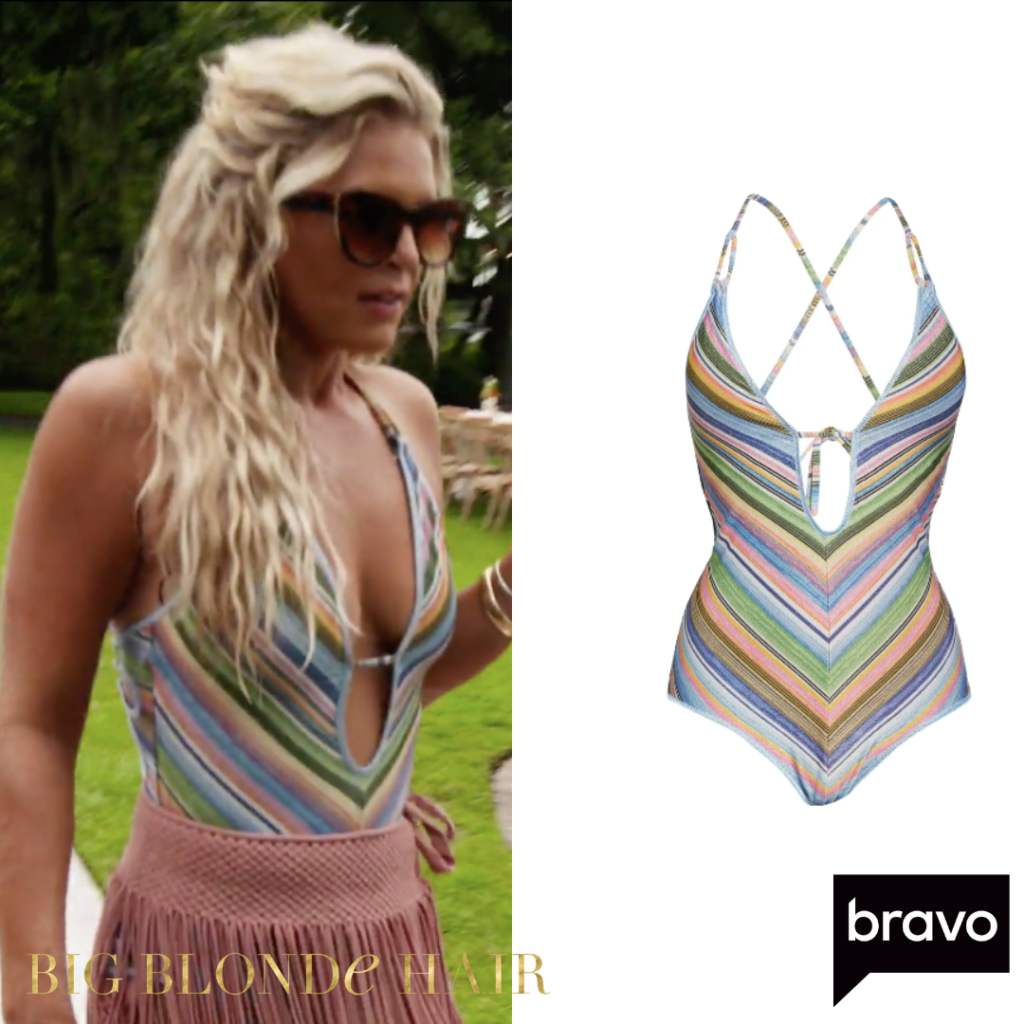
Kyle Richards’ Chevron Bathing Suit

Kyle Richards’ Chevron Bathing Suit

Real Housewives of Beverly Hills Instagram Fashion

While I’m still on the hunt for Kyle Richards’ sunglasses in the photo below (before ya’ll ask 😉 ), I totally have the details on her chevron bathing suit. I immediately recognized it because one Madison LeCroy rocked it in another color way during this past season of Southern Charm. And while Madison’s was sold out at the time of posting, Kyle’s picture perfect one piece is fully in stock for you to post up in on the beach.

 

The Realest Housewife,

Big Blonde Hair


Also Seen on Madison LeCroy

Madison LeCroy's Striped Cutout Bathing Suit

Kyle Richards' Chevron Bathing Suit


Click Here to Shop her Becca Horizon Swimsuit

Click Here for Additional Stock

Click Here for Details on Madison LeCroy’s Suit (Sold Out)

Photo: @KyleRichards18

Originally posted at: Kyle Richards’ Chevron Bathing Suit

Read More

Crucial Retirement Milestones in Your 60s

retirement milestones

As you navigate your 60s, you have several critical retirement planning milestones to work through. While that may be intimidating, the tasks are all manageable, especially if you give yourself plenty of time to learn about your options.

You gain access to valuable benefits in your 60s, and the choices you make can affect your comfort in retirement. You also enter a phase in life where financial decisions matter more than ever.

You’re likely near the end of your working years, although you can certainly work longer if it’s rewarding (and if you’re fortunate enough to have good health). But it’s hard to go back to work and recover from financial mishaps when you’re hoping to leave the work world behind you.

At this stage, it’s important to make the transition out of full-time work as smooth as possible. Getting familiar with the retirement-related events below can help you make smart decisions and reduce the chances of mistakes.

Retirement Account Withdrawals: Age 59 ½

Once you reach age 59 ½, it becomes easier to take distributions from retirement accounts. For example, you can pull funds from traditional IRAs without early withdrawal penalties adding 10% or more to the taxes you owe on withdrawals.

You can retire before reaching 59 ½ , but you’ll want to have a plan for managing taxes. For example, pulling money from Roth accounts or spending from taxable brokerage accounts might help you bridge the gap until you can tap your pre-tax savings. Other strategies can also help you spend from your savings in tax-savvy ways, and a CPA or financial planner can help you explore ideas.

Planning tip: Make an income plan so you know how much you can draw from your savings. You want the funds to last for the rest of your life, and it’s important to include things like taxes, rising costs, and healthcare needs in your estimate.

Enroll in Medicare: 3 Months Before Age 65

Most people become eligible for Medicare at age 65, and it’s crucial to enroll in a timely fashion. If you miss a deadline, you risk paying higher costs for the rest of your life, and you may be without coverage temporarily.

The earliest you can enroll in Medicare is three months before your 65th birthday. It takes time to process your application, and mistakes can add delays, so it’s wise to get the ball rolling as soon as possible.

Planning tip: If you’re still working at age 65, you might have the option to use your employer’s health plan. But things can get complicated quickly. Speak with your health insurance provider as you approach age 65 to find out how to avoid problems.

Apply for Social Security: 4 Months Before Income Starts

You can also sign up for Social Security several months before benefits begin. Doing so can help minimize stress and ensure that you receive retirement income when you need it. The Social Security Administration allows you to apply for your retirement income benefit four months before you want payments to begin, and you might as well take advantage of that opportunity.

Most people can begin benefits as early as age 62. But claiming early results in a reduced benefit, and you’ll have to live with that reduction for the rest of your life. It’s not necessarily the wrong move, and it could make sense when you need immediate income, but waiting to claim is often an excellent strategy.

For example, if you were born in 1960 or later, claiming at age 62 leads to a 30% reduction in your Social Security retirement benefit. If that happens, for every $1,000 you could get at Full Retirement Age (FRA), you’d get just $700. On the other hand, if you wait until after your FRA, your monthly benefit can increase by roughly 8% per year until you reach age 70.

Planning tip: You don’t need to claim Social Security Benefits exactly when you retire. In some cases, it’s smart to spend from your savings or do Roth conversions for a few years before you begin taking Social Security income.

Required Minimum Distributions: Age 72

After you reach age 72, you’re generally required to take withdrawals from pre-tax retirement accounts whether you want the money or not. The IRS provides a schedule for you to follow, and you start with relatively small amounts. As a result, these required minimum distributions (RMDs) add to your taxable income, which prevents you from keeping that money sheltered from taxes indefinitely.

One of the most important things to know about RMDs is that there’s a steep penalty for failing to follow the rules. If you miss an annual RMD, there’s an excise tax that amounts to 50% of what you were supposed to withdraw.

Planning tip: Set annual reminders to be sure you never miss an RMD. The deadline in most years is December 31st, but I often do this for clients in October. That way, you stay invested for most of the year, and if anything goes wrong, you have extra time to fix things. Check with a CPA to verify that you’ll avoid problems on your tax return.

Pension Decisions: Several Years Before Retirement

If your employer offers a pension, review your options and start making decisions long before you retire. For example, you may need to decide when to start taking income and whether or not to add a beneficiary to your pension payments. Those decisions determine your monthly income and could affect your beneficiary’s quality of life.

If you work for certain government organizations, it’s essential to understand if your pension will affect your Social Security benefits. Ultimately, the goal is to understand your total retirement income to get an accurate estimate of how much you can spend each month. Knowing the details sooner rather than later reduces the chances of a letdown.

Planning tip: Customer service representatives with your employer’s pension system are often eager to help you understand your options. Call with questions and attend informational sessions to learn about your benefits.

The Big Picture

The topics above focus on your finances, but the most important thing is that you continue to live an excellent life after you stop working. Money doesn’t buy happiness, but it can be a tool to eliminate problems and buy experiences.

You may be living on a fixed income in retirement, but that doesn’t mean you should feel limited. In fact, Margaret Manning shares numerous insights from the Sixty and Me community that can help make retirement fulfilling on any budget.

If you want to learn more, check out this video:

What milestones (financial or otherwise) are you most looking forward to in your 60s and beyond? Do you feel prepared for all of this, or are there any areas that seem a little intimidating?

Read More