Month: August 2022

‘XO, Kitty”s Anna Cathcart on Inclusion in Media & Filming the Anticipated Netflix Show in South Korea


If you purchase an independently reviewed product or service through a link on our website, STYLECASTER may receive an affiliate commission.

If you watched all three Netflix movies in the To All the Boys I’ve Loved Before, you know who Anna Cathcart is. She stole the show as Lara Jean’s (played by Lana Condor) little sister Kitty. In fact, she became such a fan favorite, that Cathcart got her own spin-off show, XO, Kitty, currently in production.  I caught up with the 19-year-old star over Zoom to find out everything I could about the anticipated Netflix show, how she’s handling her newfound fame and her modern partnership with Lego Dot®.

You teamed up with Lego Dots on a limited-edition poster drop. That’s different from the Legos I’m used to!

“I partnered with the Lego Group to help create three different posters that all have different aesthetics,” Cathcart says. “And all of them are personalizable with Lego dots and Lego dots patches.” She shows me the “Wandercore” poster behind her, a pastel design that would look cute in any dorm room. It’s adorned with these Lego dots, something I, as an elder millennial, had never seen before. They’re not like regular Legos.

“My favorite part about them is there are no set directions,” she continues. “You don’t have to build them in one certain way. You can just keep designing them and then even once you put them on your poster, you can still take off the tiles and redesign them. Because nothing’s permanent.”

She and Meghan Trainor are helping others express their creativity with a huge pop-up in Los Angeles this weekend.

Hosting a pop-up, filming a Netflix show — it’s a lot of pressure! How do you decompress?

“It can definitely be overwhelming,” Cathcart says. “I think social media is a great thing. But it can also cause a lot of stress, especially when it’s a part of your career, when there are certain expectations and it definitely can get to me. I’ve learned to go on Instagram only when I feel like it.” She’s not on the apps 24/7 or they would suck up all her time. (I need to take some of that advice.)

“I’m definitely a creative person,” she says. “I journal a lot and I draw a lot…And just surrounding yourself with good people. I’m best friends with my older sister, and we hang out a lot and just talk and rant about different things. Spending quality time together is definitely a way for me to decompress and feel just calm and on track and know I can continue and keep going.”

Instagram PhotoSource: Instagram

You aren’t very active on TikTok even though you have more than 2 million followers.

“I cannot bring myself to go on this app, because I will be on it for another four hours,” she admits. “And I know I can’t afford to do that.” She was just too busy in the XO, Kitty world to find time, plus she would get in a lot of trouble if she accidentally spilled set secrets.

“So much of my camera were things I’m just dying to post when the show comes out that I have to hold for so long,” she says. “That definitely was a part of it. I think photo dumps are my new favorite thing because there’s so much pressure and you can just sum up like the last few months of your life.”

Speaking of the show, what does it mean to you to be a part of a series that features such great Asian representation?

“Our cast has so much diversity,” she says. “A lot of different ethnicities. Especially because we’re based in Korea, our show is about an international school there, and we have a lot of Asian representation. It’s so exciting to see that happen more and more often…This should be normal. But I love that we are headed in the right direction.”

“I think what’s cool about it as well, is Kitty just happens to be Asian,” she continues. “She’s just a girl who’s living her life. And she’s exploring who she is. She’s in high school and she’s doing her thing. Of course, [being Asian] is a really big part of her. And we do dive into that a bit. lt’s just a beautiful part of her. And that really special type of representation, I love getting to be a part of.”

Cathcart understands how important it is for people to see themselves on TV, to feel understood in media as a whole. “It’s such a magical feeling that you can’t compare it to anything else,” she adds. “I love getting to be a part of that.”

Instagram PhotoSource: Instagram

How was filming in South Korea?

“It sounds maybe dramatic, but I mean, every word of it: it was seriously the coolest thing I’ve ever gotten to do, to be immersed in a different culture, getting to live there,” Cathcart says. “I had been there when we shot the third movie, but that was a couple of weeks when we went to Seoul. This time, I was there for four months. I got to like really see the city and live there and experience it in such a different way which I loved and a lot of the cast as well were local.”

“I’ve been home now for like a month and a half,” she says. “I’m still trying to process what just happened. I can’t even believe that was real life.”

Instagram PhotoSource: Instagram

The beauty and fashion in South Korea are unlike anything else. Was it inspiring?

“The beauty industry there and style is so amazing,” she says. “Everyone, everyone, is just so stylish. Me and my mom would talk about it all the time. We’re walking down the street and go, ‘how does everyone look cool here?‘ Everyone just always looks awesome. I definitely went shopping a lot and tried to get inspiration.” She tells me the cute shirt she’s wearing is actually from Korea.

Of course, she had to get into Korean beauty while she was there, too. “I definitely got some face masks,” she says. “I had never had a facial before but I got a few facials while I was there and it was amazing. I’ve been missing out.”

What’s your beauty routine usually like?

“In general it’s low key,” she says. “I’m pretty natural but [beauty] is so much fun to play with and I love doing my makeup.” She uses a lot of drugstore items and cannot, cannot live without lip balm and/or gloss. She loves Glossier’s Balm Dot Com — but only the clear or mint ones. “That is my favorite because it works on a no-makeup face and makeup days because it works as a gloss but also works as a normal lip balm,” Cathcart adds.

Good taste and a hit Netflix show in the works? This girl is going places.

STYLECASTER | Ashley Benson Interview

Read More

Preventative Health Screenings: Are They Right for Me?

Preventative-Health-Screenings

You’ve probably received them in the mail. Those colorful flyers from companies that advertise a variety of preventative health screenings. I used to think they were scams and immediately tossed the flyers into the wastebasket.

Why Was I Sceptic?

Part of my scepticism came from hearing about a few health screening companies that promoted expensive exams that were completely unnecessary. Some of the tests even bordered on ridiculous.

In addition, there have been concerns that these exams sometimes turn up benign abnormalities. This means that the conditions aren’t exactly normal, but they don’t cause the person any harm. Oftentimes, this results in follow-up testing that’s invasive, expensive, and not necessary.

What Changed My Mind?

Hearing this, you’ll probably be surprised to learn that I actually signed up for one of these exams, and I had it done. So, what changed my mind? This particular flyer offered what is called a vascular screening.

Several years ago, my mom died shortly after going through a surgical procedure known as carotid endarterectomy. It was a necessary procedure because one of the main blood vessels in her neck was becoming blocked.

The build-up of plaque (a fatty substance) in her artery interfered with the flow of blood to her brain, and this put her at a greatly increased risk of a stroke. The surgery was meant to clean out her carotid artery and restore adequate circulation. Unfortunately, Mom didn’t survive.

My Decision

As I approach my 60th birthday, I’m concerned I might follow in my mom’s footsteps and develop this condition, too. Besides the increased risk of stroke, it also places a person at higher risk for dementia.

Today I’ll share my experience with a vascular screening and perhaps help you decide if this or a similar screening is right for you.

I think it’s important to note that since these tests are considered preventative, health insurance typically won’t cover the exams. In my case, the charge for the screening was $75.

My screening experience consisted of the following steps:

Carotid Artery Ultrasound

A carotid artery ultrasound is the test that looks for blockages in the carotid arteries, the condition my mom experienced. A small probe was placed on the front of my neck over the two main arteries that supply my brain.

The resulting ultrasound took pictures of the insides of these arteries to reveal any blockages. I could hear a ‘swooshing’ sound as the test was being done. The technician put a gooey gel on my neck before the procedure, but otherwise, I didn’t feel any discomfort.

Abdominal Aortic Ultrasound

Similarly, the abdominal aortic ultrasound involved placing a small probe on my abdomen to look at my aorta, the main artery coming out of my heart. The ultrasound looks for enlargement or bulging of the aorta which could result in a rupture of the weakened blood vessel wall.

This type of aneurysm is sometimes hereditary, but it can also develop from a variety of other risk factors. While there is no history of this condition in my family, I was glad the test was included, as a ruptured abdominal aortic aneurysm is often deadly. Again, there was no discomfort with this exam.

Ankle Brachial Index

The ankle brachial index test is a bit different than the others because it involves placing blood pressure cuffs on both arms and both legs. There was a bit of discomfort as the cuffs were inflated, but it wasn’t significant, and it only lasted a couple of minutes.

The purpose of this exam is to look for signs of peripheral vascular disease (PVD). This condition results from the build-up of fatty substances on the linings of the arteries.

Over time, PVD increases the risk of a heart attack or stroke. It also frequently causes pain and loss of mobility. My mom suffered from PVD (and I do mean suffered), so this is another condition that causes me concern.

The Good News?

I can happily announce that all of my test results were normal. So, was it worth it for me to pay out-of-pocket for these exams? Absolutely! I walked away with a huge sense of relief that what happened to my mom probably won’t happen to me.

That being said, it also made me more determined than ever to take steps to protect my health and prevent these conditions from developing in the future.

You see, the last time I had my cholesterol checked, it was elevated. That’s a risk factor for developing the build-up of plaque in my arteries. As a result, I’m now working on dietary and exercise strategies to get my cholesterol level back down to normal.

Does this mean that everyone in our age group needs to pursue these or similar exams? Not necessarily. These are a few factors to consider before making an appointment:

  • Consider your personal and family history. Choose the tests that are right for you as an individual.
  • Talk with your medical provider for professional input.
  • Research the diagnostic company you’re considering and check their reviews. Be sure they have a good reputation before you hand over your money.
  • Find out if your health insurance will cover any of these tests.

What do you think about preventative health screenings? Have you ever had an experience similar to mine? Do you feel going through those screenings was worthwhile? Please share your thoughts in the comments below.

Editor’s note: Nothing in this article should be considered medical advice. Always consult a doctor before making any changes to your diet, medical plan, or exercise routine.

Read More

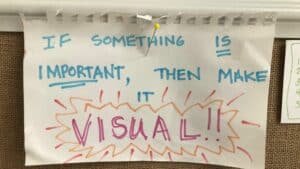
If Something Is Important… Make It VISUAL

visual notes

For years, I have written reminder notes for myself. My visual memory (the ability to recall what my eyes have seen) has always been particularly strong, but I’ve relied on this trait more in my 60s and 70s. Whether it is because I underwent chemotherapy treatment at age 60, or I have more leisure time as a retiree who doesn’t adhere to a rigid work schedule, or my brain is aging, the notes are a big help!

A Variety of Reminder Notes

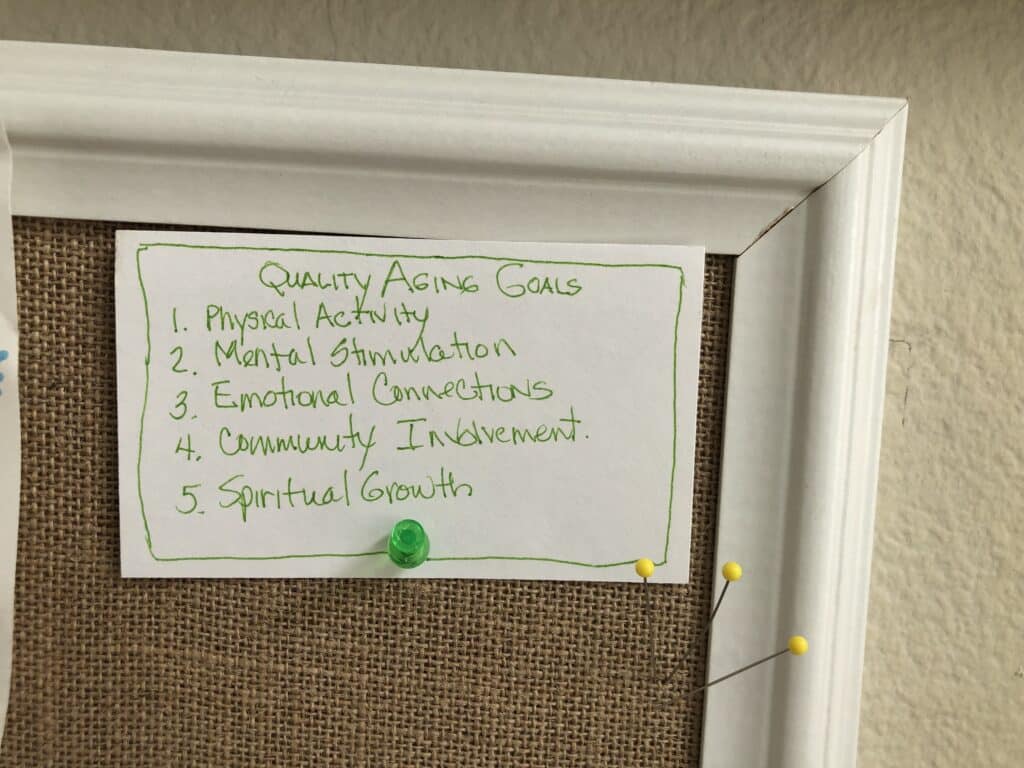
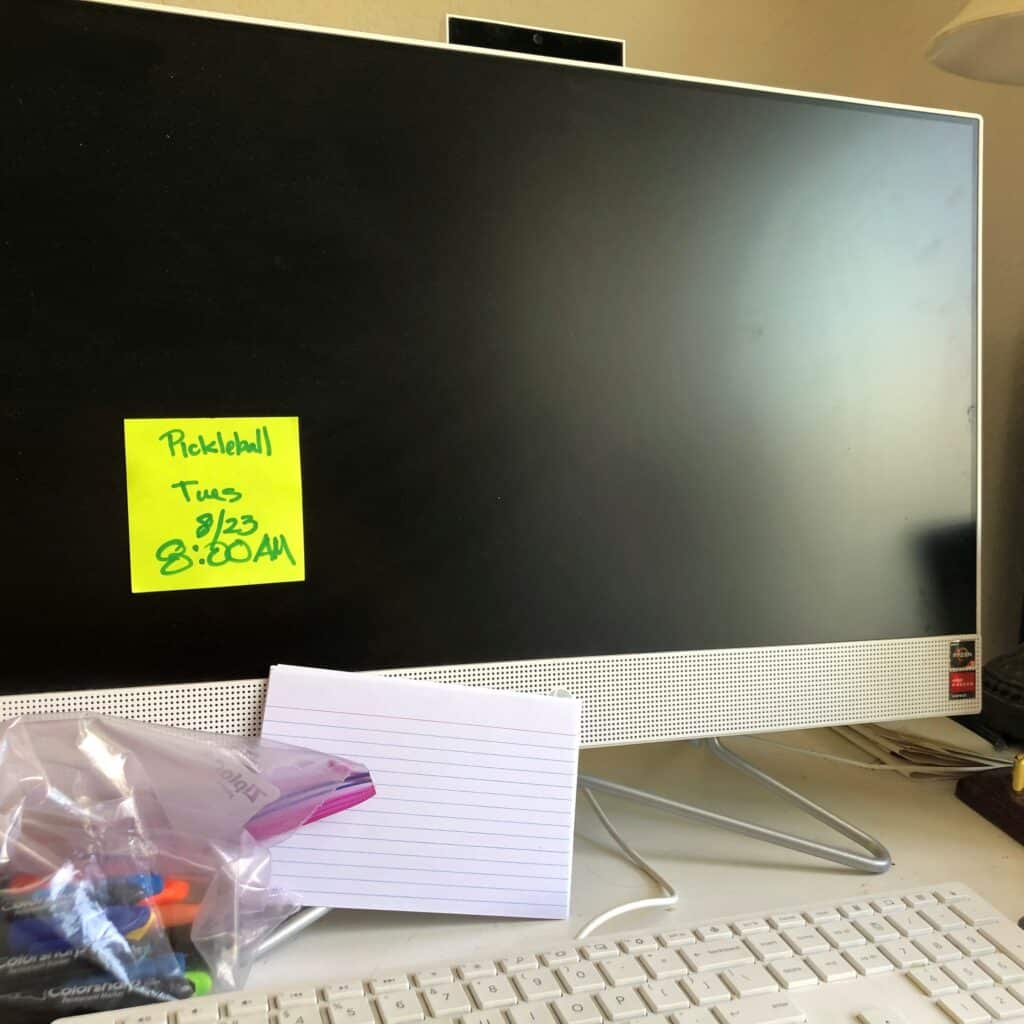
Occasionally, I will post a note on a whiteboard hanging near my desk, or I’ll leave post-it notes on my computer screen, the countertop, or on a mirror. I will even lay a note card on the floor near the threshold from my bedroom to the hallway.

With all these signs placed strategically, I literally bump into them. Is it embarrassing to admit I need these obvious reminders? Yes, it is kind of embarrassing, but I’ve just resolved not to worry about it and create work arounds! They are also decidedly low tech!

Calendar Challenges

Last night I placed an 8.5” x 10.5” whiteboard on the table near the door to my bedroom. It reads “8:00 AM Tues – Pickleball.” Why? Last Friday, I impulsively rushed off to the YMCA to catch a few pickleball games, completely forgetting about a telephone appointment with my doctor. DARN!!!

That missed appointment cost me a fee because by the time I discovered my error and called the doctor, there was no way I could get squeezed back into his schedule. I had even spotted this telephone appointment on my iPhone calendar two days earlier, but I’m impulsive and would usually jump the tracks on a previously laid plan in an instant!

Acknowledging that an impulse of some kind will happen, I know that my chances are much better for making any appointment that is scheduled two days ahead, if I leave a note somewhere in my immediate environment.

Depending on how busy I am, I will scan the calendar for the week ahead and post those important appointments for the week on a small whiteboard or wall calendar adjacent to my desk. The redundancy seems to work:

  1. Enter the appointment in the iPhone calendar.
  2. Check the calendar each morning upon awakening.
  3. And finally, write the event on a whiteboard, post-it note, 4 x 6” card, or a calendar posted on the wall.

Visual Memory

Since I’m visually oriented, I can easily “tune in” to a colorful post-it or a colored felt-pen handwritten message. There are colorful post-it notes in my desk and kitchen drawers and a stash of colored felt-tip markers and blank 4” x 6” index cards on my desktop. The notes and reminders are discarded daily, so whenever I create one, it has some visual prominence.

Even as a college student studying for exams, I always remembered the page layout and ink colors that I used in class as I took textbook notes. When exam time came, I pictured the pages in my mind to begin recalling information. These days, post-its and other notes are an extension of this long-time habit.

Following cancer treatment 11 years ago, if I forgot something, I would panic. The doctors said it would get better and it did. Even now, I can walk into a room and forget why I am there, but I no longer panic.

Don’t Panic… Take 3-4 Relaxation Breaths

Obviously, a panicky reaction does me no good at all, and, in fact, it might delay the recall. I know I can accommodate a lapse in memory with coping strategies. My “Go To” behavior for arriving in a room with no clue, is to take a few relaxation breaths and affirm for myself that whatever slipped my mind will return. And it does, almost immediately!

One thing that I have forbid myself to do is refer to one of these events as a “Senior Moment.” Losing track of a thought, or forgetting a name or detail, is a frequent occurrence for almost everyone. Poor sleep, not feeling well, anxiety, depression, or a myriad of other influences can cause us to lose a train of thought, so the LAST thing I want to do is label it a senior moment!

There is too much ageism in our world already and I’m not going to feed the beast. I’m particularly keen on promoting positive, healthy, happy, or whatever aging and NOT using what I see as an ageist label!

Technology Helps

A few months ago, after forgetting three events in one week, I asked the Alexa application to announce daily at 7:00 AM “Check Your Calendar.” I use Alexa on an Amazon Echo device, which is a “smart speaker” (a Wi-Fi enabled device), and I have one in both the bedroom and the kitchen. There are many alternatives to the one I use.

Because I write the appointments in my iPhone calendar while I’m scheduling them, and I asked Alexa for the verbal reminders, I seem to be doing better lately. If I hear the reminder, I will check the calendar on my phone wherever I am.

Similarly, if I need to transfer the laundry or unload the dishwasher in a timely manner, I ask Alexa to remind me at a specific time or in 30 minutes. I also add my grocery lists into the iPhone calendar on days when I’m going to the store.

Ironically, the week before last, I considered cancelling the Alexa reminder because I had habituated (I thought) that behavior into a daily action. After Friday’s missed appointment, Alexa will continue reminding me!

While I earlier might have suspected these calendaring glitches were failures in the executive reasoning function of my brain, or that Alzheimer’s disease had set in, now I am a little more forgiving.

For years, I watched my elderly father deftly rely on a clipboard with his calendar of daily appointments and lists sitting on the side table next to his favorite chair. He died from Alzheimer’s Disease but remained at home until he was 93. I know he saved himself worry and confusion by being rigorous with using the clipboard.

I coordinated daytime and evening people coming to the house to look in on him. Ultimately, he needed to move into a memory care unit, but while he was at home, hetaught me a lot about just rolling with the aging process with his examples, so “Thanks, Dad!”

“The Kitchen Is Closed”

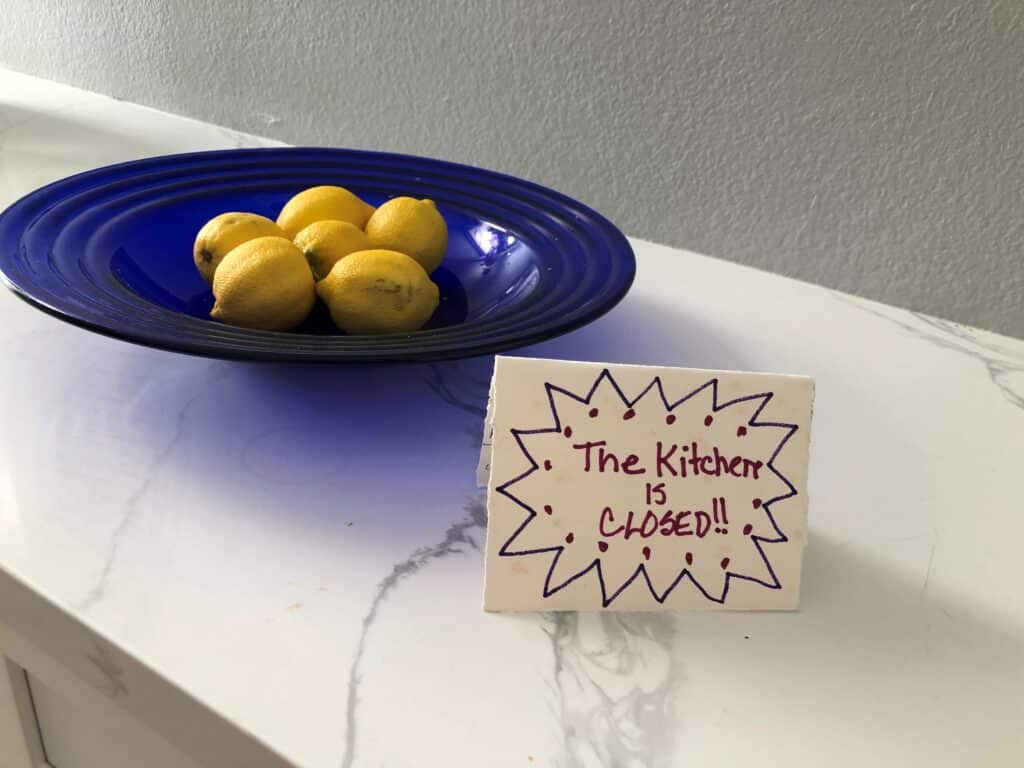
I’ve been following a weight loss program for the last couple of years, and one of the leaders suggested posting little signs or reminders in case I needed them. As someone who used to eat unwittingly to quash anxiety or feelings, I benefitted from making a little tent sign that I keep out on the kitchen counter.

The sign reads, “The Kitchen is Closed” and if I leave it on the kitchen counter, it greets me when I impulsively wander there for a snack. It seemed silly to do this, at first, but it worked. I slowly became more aware of my unconscious eating habits and curbed the behavior.

Does This All Seem Strange?

I suppose it might appear strange, leavingnotes or reminders around, but they work!

What memory tricks or cues do you use to manage your schedule or household tasks? Do you feel self-conscious about it, or have you accepted they are necessary tools?

Read More

How Does the 4% Rule Work in Retirement?

4 percent rule

The 4% rule is a helpful guideline that retirees can use to determine how much money they should take out of their retirement accounts each year.

Adopting the regulation is intended to preserve a consistent income stream while preserving a sufficient overall account balance for future years. Retirees can use that money for various purposes: covering living expenses, settling credit card debt, covering healthcare expenses, etc.

What Is the 4% Rule in Retirement Planning?

The 4% rule states that retirees can withdraw an amount equal to four percent of their retirement savings in the year they retire and then adjust for inflation every year after that for 30 years.

What Are the Advantages and Disadvantages?

Advantages of the 4% Rule in Retirement Planning

There are a few advantages of the 4% rule, and they are as follows:

  • It’s easy to adhere to the guideline.
  • You’ll receive a consistent, dependable income.
  • The 4 percent rule stops you from running out of money.

Disadvantages of the 4% Rule in Retirement Planning

There are a few disadvantages of the 4% rule as well. They are as follows:

  • There is no assurance that your account won’t run out of money. You may run out of cash for emergency expenses, settling credit card debt, paying off kids’ student loans, etc.
  • It isn’t agile enough to adapt to changes in lifestyle.
  • The 4% rule is not responsive to changes in the market.

How Does the 4% Rule Work in Retirement?

The 4% rule is one standard guideline for retirement spending. You add all of your investments, and then during the first year of retirement, you withdraw 4% of that amount. The amount you remove in later years is adjusted to reflect inflation. You should have a very high chance of not running out of money during a 30-year retirement.

If, for instance, your retirement portfolio has a total value of $1 million when you retire. After retiring, you would take out $40,000 in the first year. You would give yourself a 2% raise the following year, withdrawing $40,800, and so on for the subsequent 30 years if the cost of living increased by 2% that year.

When Is the 4% Retirement Rule Not Suitable for You?

Despite several advantages, there are a few circumstances when the 4% retirement rule may not be suitable for you. Here are a few of them.

Enough Money Assurance

The 4% guideline isn’t ideal if you want absolute assurance that you won’t run out of money, and it’s an outdated regulation that also fails to consider current market conditions. If the markets are doing well, you might be able to withdraw more than 4% easily.

Certain Asset Allocation

Because this is the asset mix on which the 4% rule was built, you should avoid adhering to it if your asset allocation is more than 60 percent stocks and 40 percent bonds. If you make alternative investments, your portfolio will perform differently.

For instance, increasing bond investments could decrease investment growth because bonds don’t generate the same returns as equities. Because bond interest rates were significantly higher, this issue is worse.

Change in Spending Habits

Finally, the 4% guideline isn’t the greatest strategy if you anticipate that your spending habits may alter throughout retirement. In the early stages of retirement, most retirees are more active, frequently spending more money and spending more time on hobbies or vacations.

Then, during the middle of retirement, spending declines before beginning to rise once more due to high medical costs in later life. The 4% guideline is not flexible enough to consider these lifestyle changes. It restricts you to a predetermined quantity, which can be insufficient in your younger years and excessive in your senior years.

How Long Will a Retiree’s Money Last Under the 4% Rule in Retirement?

How much of your retirement savings would last before you run out of money? Financial advisor William Bengen responded to this subject in a paper that was released in 1994.

The Journal of Financial Planning accepted his manuscript, “Determining Withdrawal Rates Using Historical Data” for publication. According to Bengen, seniors can spend around 4% of their retirement assets in the first year of retirement without risk. They could increase the annual withdrawals by inflation rate in succeeding years.

Bengen discovered that most retirement portfolios would endure at least 30 years using this straightforward technique, and the portfolios frequently lasted for 50 years or longer.

How Do You Know If the 4% Rule Works for You?

There is a simple rule to determine if the 4% rule works for you, and here it is.

According to the 4% rule, your investment portfolio should comprise roughly 60% stocks and 40% bonds, and additionally, it implies that your expenditure would remain the same during retirement. So, the 4% rule might be appropriate if both of these conditions apply to you and you want to adhere to the most straightforward retirement withdrawal strategy possible.

Many experts feel that the 4% rule “may no longer be practical” for seniors, given market expectations. Do you agree with this statement? Is there a better way to model a retirement planning income “rule” other than the 4% model? What are the benefits and risks? Please share your views with us.

Read More

7 Techniques for Fostering Self-Awareness in Your 60s

self-awareness techniques

From an early age, I often spent time jotting down feelings, musings, and motivations about myself and others. Being self-aware was my way to feel more empowered in a household that was often chaotic.

Writing helped me make sense of my world, and at the same time, it opened the door to self-discovery and self-awareness.

Self-awareness is about knowing and understanding who we are. This encompasses being mindful of our personality, strengths, weaknesses, passions, and desires. It’s also about being able to identify what makes us unique.

By the time we get to our sixth decade, most of us are more or less self-aware, but sometimes it’s a good idea to check in with our self-awareness techniques.

Being self-aware is very important in all stages of life. In my book Writing for Bliss: A Seven-Step Plan for Telling Your Story and Transforming Your Life, I devoted an entire chapter to the subject. Here are some techniques to increase your self-awareness:

Setting Intentions

Setting intentions involves focusing your thoughts on what you want to bring about, change, or manifest in your life. The next step is to surrender to the process.

Perhaps your intention is to write a novel and your plan is to work two hours every morning. Then one day your friend calls, asking you to go shopping with her, but you decline and possibly reschedule because of your intention to write.

Mindfulness Meditation

Mindfulness meditation encourages you to focus on feelings, experiences, and internal and external processes in a nonjudgmental manner. It’s also about being fully present in the moment and being more aware of yourself, others, and your environment.

It’s also about paying attention to the thoughts racing through your mind without obsessing over them. Meditation is one of the best ways to increase self-awareness, calm your mind and body, and connect with what is happening around you.

There are many ways to meditate, and most of them are practiced while seated, but if movement is easier for you, then you can meditate while walking. Most meditations focus on the breath, a mantra, or music.

Creative Visualization

When you practice creative visualization, you close your eyes and use your imagination to manifest what you want in life. This can include satisfying relationships, physical or mental health, financial security, and inner peace and harmony.

For some people, it’s an effective way to deal with psychological or physical wounds because it offers them a way to cope. It can also open people up to new creative energies and increase self-awareness.

Self-Hypnosis

Hypnosis works by altering the triggers in the brain. It has many applications and is often used to minimize self-sabotage issues such as weight gain, fears, and addictions. Its main goal is to increase self-awareness.

While some people might choose to practice self-hypnosis, it’s a good idea to learn the technique from a trained hypnotherapist and then graduate to doing it yourself.

Breath Work

Obviously, we cannot live without breathing. The first thing we do when we’re born is take a breath, and the last thing we do before we die is take a breath. However, most of us take breathing for granted.

To maintain a sense of optimal well-being and health, it’s a good idea to be conscious of your breath because it helps you become more aware of your body.

One way to bring awareness to your breath is to breathe in for a count of seven, exhale for a count of seven, and then hold your breath for a count of seven. Repeat several times.

Recalling Your Dreams

Our dreams are mirrors or doorways into our unconscious minds and our inner worlds. Sometimes they offer us guidance, self-discovery, and growth; and sometimes they can aid in healing.

Our dreams can make offerings to our creative process and help us make decisions and solve problems. Some people claim that their dreams guide them in their waking lives.

To better recall your dreams, before you fall asleep make an intention to remember them. Then, upon waking up, write down everything you remember about your dreams in a journal you keep at your bedside table. Try to record all your images and feelings.

Knowing Your Shadow Side

Carl Jung introduced the idea that we all have a shadow side, which is the unconscious part of ourselves usually hidden from our immediate awareness. Because the shadow is composed of impulses that society views as unacceptable, our conscious minds don’t want to claim their ownership.

Jung said that one of the best ways to understand our shadow qualities is to think about what irritates us most in other people. These might be a sign of our own shadow. Bringing our shadow side into the light is another way to foster self-awareness.

Do you think you are self-aware? What makes you think so? Are you using techniques that help you increase and maintain your self-awareness? What are they? Which techniques help you the most? Please engage in the conversation!

Read More