Month: June 2023

Finding Financial Harmony in Wedding Season

financial harmony in wedding season

In my mind, Spring marks the beginning of wedding season. Although realistically I know weddings can be any month of the year. I remember in 2020, I was talking to a wedding venue owner here in Arizona and asking how he could possibly reschedule 67 weddings that year due to COVID.

His answer: Monday, Tuesday, Wednesday, Thursday, Friday. Rather than put weddings off for a different month or even another year or more, families chose to reserve open dates on the calendar which meant non-traditionally having a wedding on a weekday/night. What a great idea to keep your business on track and keep your clients happy!

Marrying Your Finances

No matter when you got married, whether it was a large or small gathering or you eloped, the question of marrying your finances also comes with the territory of entering a committed relationship. So in an effort to help reduce the horrible statistic that now 60% of marriages end in divorce (and that percentage is higher for second and third marriages), I want to share some food for thought on what I have seen when it comes to co-mingling finances, or not.

Co-Mingling vs. Separate Finances

Money matters can significantly impact a marriage and are right up there as one of the top reasons for divorce. So I want to take a deeper look by using the newest AI fad, ChatGPT, to help us explore the pros and cons of co-mingling vs. separate finances to see what AI comes up with vs what I think couples should do, from a Certified Financial Planner perspective, when it comes to money (and a better chance to avoid money issues). I hope it helps find the right balance that suits each unique relationship.

Co-Mingling Finances

Co-mingling finances involves merging all income, expenses, and assets into joint accounts. I have helped clients consolidate accounts, even years after they’ve gotten married, once they realize the hoops they need to go through if one dies suddenly or ends up in the hospital without having everything either titled jointly, or in the name of a trust or naming a beneficiary or Power of Attorney on an account. What a mess that can be for the survivor!

This joint approach can foster a sense of shared responsibility and transparency. It simplifies bill payments, enables joint financial goals, and promotes a sense of unity. It also forces you to communicate about money, which is vital for a healthy relationship. And it allows for better financial planning as a team which can reinforce trust and commitment.

Separate Finances?

Opting for separate finances means maintaining individual bank accounts and handling expenses independently. According to AI, this approach allows each partner to maintain financial autonomy and privacy and can be beneficial for couples with different spending habits or income levels, which could avoid potential conflicts over money.

I Beg to Differ

I have seen the separate approach lead to distrust, less communication, and a tendency to think in terms of mine/yours vs us/ours. I cringe when I hear decisions tied to income, for example. If one is the main income earner now, does he/she get the most say about financial decisions?

What happens if/when that role reverses (many women out-earn their husbands now, for example), then you switch who gets to make those decisions? When you don’t both seem to be approaching decisions together, with pooled resources, that wedge can add additional challenges and control issues in the relationship in ways beyond money.

Second or Later in Life Marriages

I have seen, however, when it can be advantageous to keep finances separate in cases of second marriages or when one partner brings substantial pre-marital assets or debts. Preservation for legacy reasons to the original families involved can certainly come into play in those situations. That can often mean that assets are kept separate, but not necessarily income and expenses.

Finding a Middle Ground

For many couples, a hybrid approach may be the best solution. Each can maintain separate accounts for personal expenses while establishing joint accounts for shared expenses like rent, utilities, and savings. This approach offers financial independence while promoting collaboration on essential matters. Regular discussions about financial goals, budgeting, and long-term plans are crucial to ensure transparency and alignment with each other.

What Is Best for You?

When it comes to co-mingling vs. keeping separate finances in a marriage, there is no one-size-fits-all solution. It’s essential for couples to openly discuss their financial values, goals, and concerns to find the approach that works best for them.

Whether choosing to co-mingle, separate finances, or a combination of both, the key is to establish mutual trust, open communication, and a shared understanding of how money will be managed. Couples can lay a strong foundation for a successful and fulfilling partnership by finding financial harmony!

A Tool to Help

I have written a Before and After Marriagechecklist for all ages to help foster conversations around these money decisions like separate vs joint finances. We live and learn, so consider sharing or using this tool to improve your own financial harmony.

Let’s Have a Conversation:

What’s been your experience in separate vs joint finances? Any advice to help women with that discussion and decision?

Read More

3 Initial Steps to Take as We Figure Out What’s Next for Us After 50

what's next after 50

So many women email me and tell me that they are ready to take some time each day to do the thing that brings them joy and purpose. Something that they love to do and that is just for them.

And, more often than not, they have ZERO idea what that thing is!

It can be quite difficult to dig ourselves out of the overwhelm and just start doing something! So, I’ve put together 3 steps and things to consider as you embark on this journey.

Carve Out Time for Yourself Each Day to Reflect and Journal

Find a quiet spot where you can be undisturbed for a minimum of 30 minutes – 30-45 is ideal. Pour yourself a cup of coffee or tea and grab your pen and paper and start writing.

There is a myriad of things to journal on, depending on your circumstances. However, if your purpose is to try to figure out what your passion or purpose is at this stage of the game, start with picturing your ideal day and week. Really brainstorm and write it all down.

  • Where are you?
  • Who are you with?
  • What do you look like?
  • Makeup on? No makeup on?
  • Family around?
  • What are you doing?
  • What are you wearing?
  • How are you carrying yourself?

Spare no details. When done correctly, this prompt can take you a couple of journaling sessions to get it all out.

Most importantly, do not censor yourself. Write down everything that comes into your mind. Don’t shed a thought because it seems “silly” or because “that would never happen, so I’m not going to write it down.”

All of your thoughts will provide you with information that will help you to figure out your “thing” at this stage of the game!

The other thing to brain dump is your bucket list. Write down every single thing you can think of. Big. Small. In between.

Anything from going a day without your cell phone to taking a trip around the world.

Take Action

And I mean, real action.

Real action doesn’t mean doing something huge or major. Even a small action step is a step forward. It’s still action.

When I made the decision to start to fade out of my career and start my blog, I did my research. I realized I had no idea where to start or what to do. So, my initial action steps were:

  1. Telling my husband and sons about my plan and my dream moving forward. Now, at first glance, you might say, “That’s not an action step!” But, making yourself vulnerable by sharing your dream and plan is a huge step. It makes your dream real and possible. Most importantly, it holds you somewhat accountable. Now, your loved ones know!
  2. Signing up for a blogging course. I learned step by step how to set up my website. I met others who were doing what I was doing. This propelled me forward.

Often, we can confuse doing research, creating to-do lists, and scheduling, with taking action. And these can be action steps, certainly. But pay attention to whether or not these things are actually becoming a form of procrastination.  

Taking real action brings clarity. And trying something and making a mistake which you can learn from is better than never trying it at all.

Be Aware of Your Internal Barriers

These are sneaky and can prevent you from really being present and doing the things that truly will give you passion and purpose after 50. They often come from negative core beliefs that we have carried with us since childhood. Some common ones in our community of women are:

  • Not ever feeling as if anything you do is quite good enough.
  • Not wanting to do something unless you’re positive that it will turn out absolutely perfectly (which means it won’t ever happen because this is impossible).
  • The world is unsafe.
  • People can’t be trusted.

Really looking at what your core beliefs are and how they are standing in your way can be instrumental in helping you to push through and do the hard things in spite of them. We’ve had these beliefs for our whole lives – they aren’t going away at this point. But being aware of them can help you talk yourself through it and do the things that you really want to do.

Many of us are at a point in our lives where we can carve out a chunk of time to devote to ourselves only. To do that thing that gives us joy and purpose as we move forward. Don’t be afraid to start taking those first steps.

Let’s Have a Conversation:

Are you unsure of what your “thing” is as you move forward in this next phase of life? What might be holding you back from pursuing it? What small, initial action steps can you take to make it happen?

Read More

What Is Negative Space in Home Décor and How to Use It

negative space in home decor

Do you love changing up your home’s décor? Do you get happy thinking about design but want a tip or two to elevate your game?

Even if you yawn at the idea of redoing your space because your skill set and joy lie elsewhere, this information could help you with all the holiday décor that comes around each year, each birthday party you have committed to decorating.

As Simple as Answering a Question

I was recently asked the question: What is the most essential piece of home décor?

At first, I thought this was a trick question. My reflexive reaction was, how could there be one essential universal décor item since aesthetics and design challenges are as varied as those seeking décor solutions?

But since it was a genuine question sincerely posed, I wanted to noodle on it.

It was both a Duh! and Wow moment when I realized there is a universal décor element essential to the success of all design, it’s free, and everyone has access to it.

I had been thinking about this question the wrong way. I went with trunks and armoires, candlesticks, bookends, lighting, and lamps. Paint.

I was thinking about what could be placed when I wondered, should I be thinking about something already there but not yet seen?

Moreover, what makes a collection of items into a lovely vignette, and by contrast, what makes it not work?

The first ah-ha was: What is not put in a space is as powerful as what is.

Negative Space Has Power

This absence is called negative space. Negative space is a universal and essential piece of design. This décor element is as impactful as any object you might place in your space.

Negative space is needed to allow us to see what is evolving and the ability to sense the feelings we are working towards evincing, regardless of the overall style.

It is not only for one style. It is for all. We can be mid-century devotees, have a passion for contemporary rustic cabins, love the formality and elegance of a time gone by, or be entirely eclectic in nature and circumstance; negative space is a design piece that is part and parcel of each successful grouping, vignette and design. It allows us to see what we are placing with clarity.

Working in Groupings

In my style, I gravitate to grouping objects, which also include an individual stand-alone piece. It is the proximity and companionship to the other elements that make the stand-alone part of a grouping.

Each grouping of décor needs to function in concert with all others while retaining its singular contribution. The empty space within and surrounding each object and the collective vignettes requires the same design attention as each separate object.

That I didn’t realize negative space was far more than a concept baffles me. Every day is a school day.

room decor

Where Do I Start?

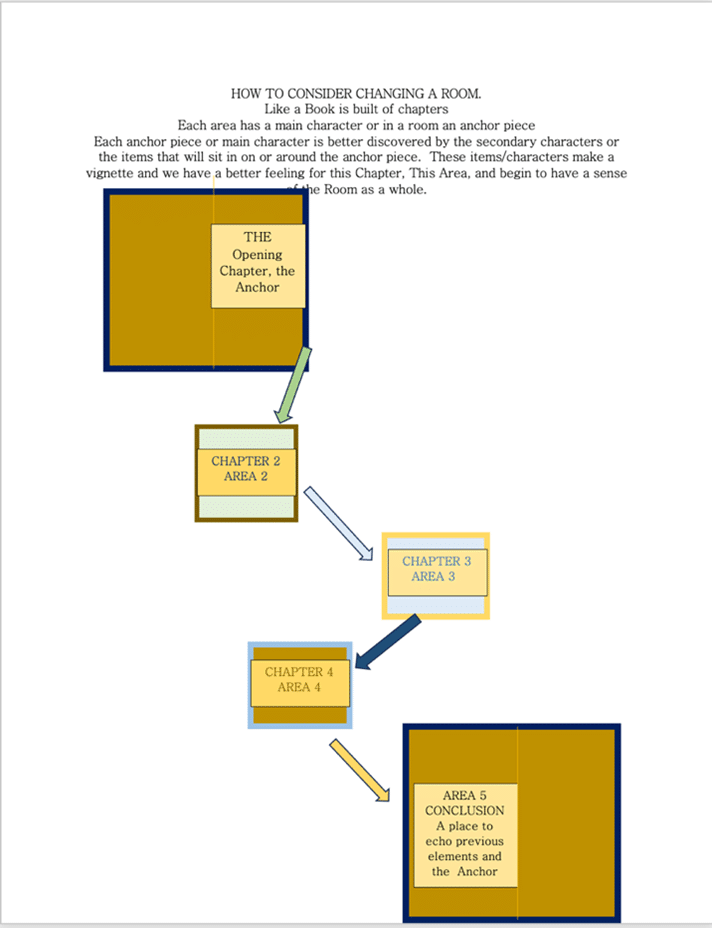
I found breaking down a room into areas helpful. The little chart I made will aid this idea. I think of each area as a chapter in a book. Continuity and connectivity of story and characters can be as thin as a golden thread. Still, that thread weaves throughout the novel, binding it together, making it one book. For us, this is a design story being told visually.

Negative space makes ‘seeing’ easier; there is no competition for eye time. We can observe what is in a grouping without working at it. Each grouping partners with its negative space before the eye travels and rests upon a subsequent décor placement. The thread or through line is that it must be in every area.

Negative space is the visual equivalent of a deep breath. It calms the senses as breath calms our bodies. The visual impact of negative space between objects is visceral. It is not thinking about what we see but about what we feel that makes it so powerful and effective.

I find negative space in paintings and the framing of photographic images compelling. It forces the eye to see what the artist wants you to see. It is oddly amusing. Once you have seen what the focus of the piece is, the absence of anything else becomes observable too.

Many refreshing gigs I have done begin with getting rid of stuff. (I hear the groans of the pain accompanying the word downsize.)

But I am not promoting living in the ubiquitous concept of a modern art loft, painted enamel white with one red chair. Minimalism emerges from a very complex paradigm, but that is not décor.

How Do I Begin?

The best way to begin the process of refreshing a space is to identify what and where is the anchor piece for the entire room.

Starting the refreshing from that place gives the design an identifiable origin – the opening chapter of our design book. It sets the scene.

We build our décor through compilations, the layering of texture and color, tone and mood – the room’s purpose. We work our chapters, one area at a time. We take the thread that begins at the anchoring spot, weave it, and knot it into the next area we want to work on.

It is normal to put up, take down, and put up again or take the thing into another room. We will inevitably change our minds six ways to Sunday to find the balance we seek – a dialogue between the elements that feel right.

Playing with shape, size, texture, and color, I want it to be fun, not stressful. It is an opportunity to experiment. It is an opportunity to name what works for you, what doesn’t, and why. We learn a lot about ourselves in the process.

The Anchor Area

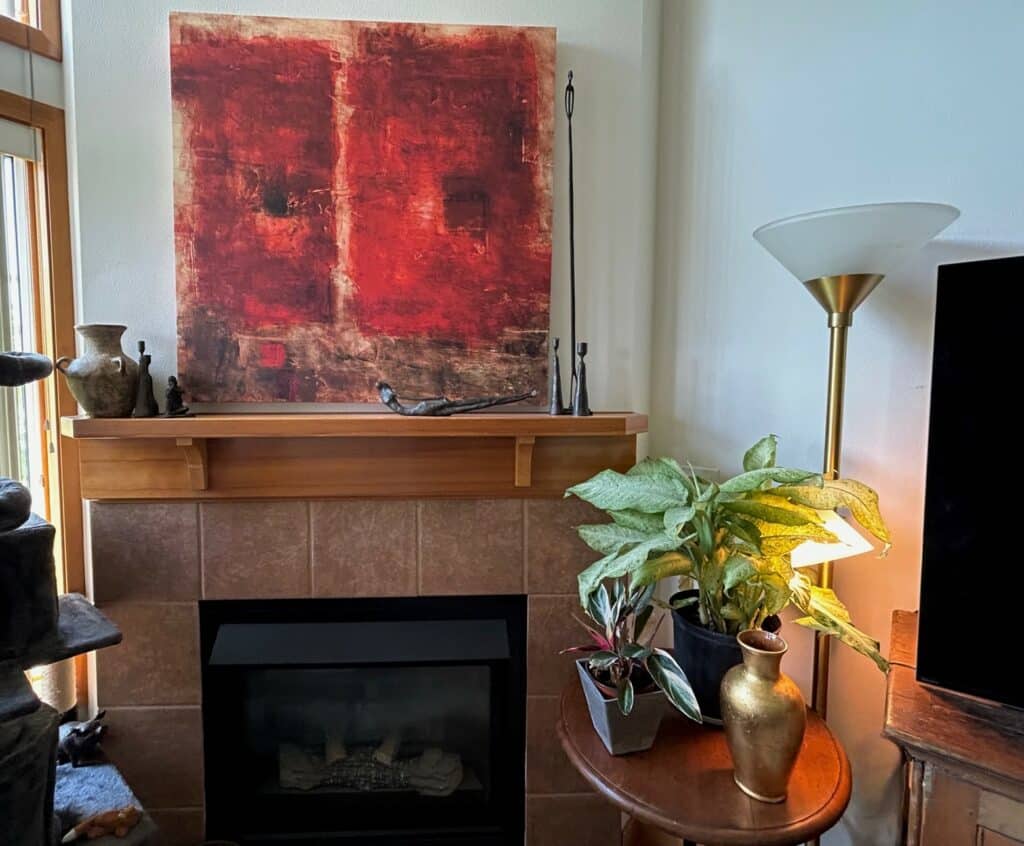
Below is a photo of the anchor area of my small living room. This photo is to illustrate the concept I’m explaining. Each item or overall vignette may not appeal to you, which is okay. But the overall visual is worth a thousand words.

anchor area

The anchor piece often dictates what you can and cannot do. When I moved in, I already knew the fireplace would-be boss. Then I could figure out what furniture fit where, looked best, and felt right, which took four days of pushing, pulling, and swearing.

I had big house furniture going into a small apartment – existential struggle. These were pieces I did not want to give up. It then took many hours dispersed over many days to tweak the smaller pieces into their place.

The satisfying layout of a room is much more challenging to create for smaller spaces than larger rooms with only window sills and a doorway to consider. That’s my story and I’m sticking to it.

The painting is a favorite. It is not nearly as cherry red as in the photo; it is a more rusted red or red-brown. Anyway, the size and color allowed it not to disappear on the tall wall, yet it still allowed enough room to frame it with negative space.

I chose to hang this piece low, just above the mantel because the brown at the bottom of the painting and the brown of the mantel work very well together. It is also the width of the fireplace, unifying the visual and making it a great backdrop. All this came with holding the painting up and dropping it down, holding it up and dropping it down, and then yelling, THERE! We love happy accidents.

Wrought iron, whether as an object or sculpture, is a favorite medium. The wrought iron objects on this mantel are placed in groupings with plenty of negative space between them for me to see each one but feel they are part of a whole vignette.

They are black and thus connect easily to the fireplace; they are similar to each other but are of different heights and depths, which creates a little interest.

When we can see a repetition of color and materials, we see groupings.

I still tweak the spacing. I don’t think I will ever stop. This is the sandbox I love to play in.

The adjacent area I considered was the TV. It is large. You cannot escape it. So it is fortunate that it is a black rectangle and echo of the fireplace. The rustic cabinet upon which it sits adds a rough texture to the sleek TV glass, and it is in the same color family as the mantel and in the painting.

Before placing the table with plants in its spot, I tried many other items but they failed to connect two spaces in a small space and not have it feel crowded. Basically, there was no negative space.

When I had finally maneuvered the furniture into a layout I liked, the small table fell quickly into place. It is a transition piece of wood and black metal, and it is small enough to leave negative space around it. I also introduced a new character – gold – into the design story. Like the lamp behind it, the gold is there but subdued. There is enough space to see it, but it is subtle and gives me the ability to use my favorite golden velvet pillows on the couch later and have it come together.

Things to Consider When Decorating

So here are some things to consider if you have a space you feel needs a change.

  • What is the anchor in the room (generally the most significant piece of architectural presence that cannot be moved)? If, like me, you have oversized pieces from a home being placed in a small apartment, the flow becomes even more essential. The number of bruises received from not paying attention to that is embarrassing.
  • What is in the room that you love, even if it’s only 10” wide, and why do you love it? Or is there something in another room that you love, and it is hidden away? It is great to use something intended for one room and use it somewhere different.
  • What feelings does the room evoke? Chaos or calm, crowded or boring, embracing or neutral? What is it now and do you want to alter that feeling?
  • What do you want to feel when you walk into that room? (When a design works for me, I feel it deep inside my belly.)

Choose to use with intention, design with the wonder of creating and take advantage of the ineffable emptiness, the power of negative space.

I am happy to answer any questions you may have about what you want to do, look at photos and bounce around ideas with you.

Let’s Have a Conversation:

Have you attempted decorating a room, but wondered where to start? Have you considered negative space in your home? What are your anchor pieces that you build your décor around?

Read More

How to Start Candle Making: A Guide for Beginners

Candle making for beginners

If you are anything like me, you are drawn to displays of scented candles… ahem… like a moth to a flame. Have you ever considered making your own candles? The process is calming and almost zen-like, with a kitchen filled with the warm fragrance of melting wax or soy, and the essential oils and botanicals involved.

Creating your own candles also makes you feel marvellously accomplished and self-sufficient. Follow my step-by-step guide and have a go!

What You Will Need to Start Candle making

Wax

Choose beeswax or soy as they are eco-friendly materials. Buy pellets for ease of melting. Paraffin wax is also available, but it is not eco-friendly (and the smell is less pleasing) as it is made from petroleum. Soy is a great choice for beginners because it’s easy to work with.

Wicks

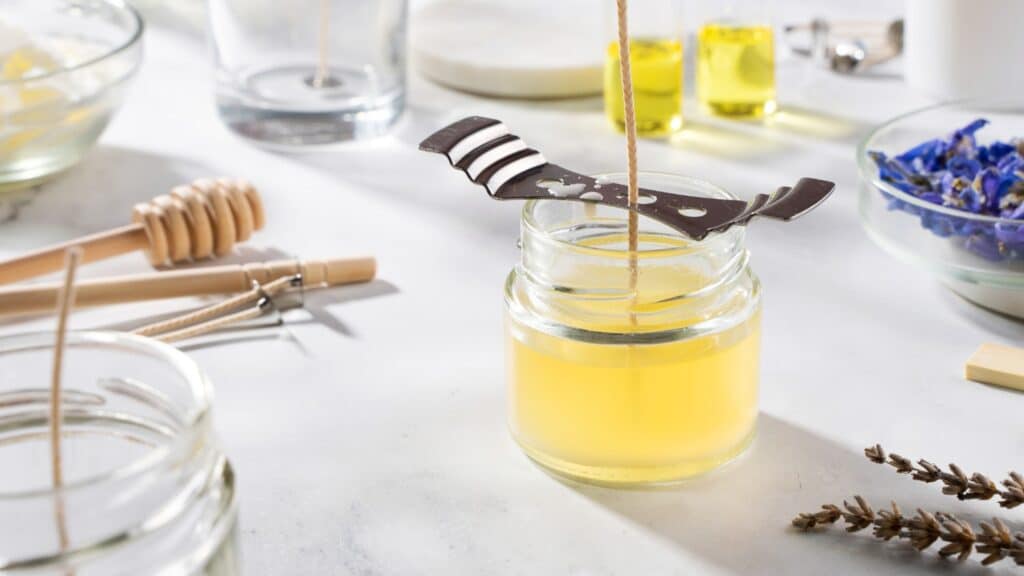
Choose cotton or hemp wicks. If you are starting out with candle making, begin with wicks that are already incorporated into a sustainer (a small metal tab at one end) which makes it easier to place the wick into the container. Commercially available wicks like this come ready to use, coated in wax. You can also buy special tabs to attach your wicks easily to your heatproof candle containers.

The size of the wick you need depends on the size of the container (or mould) you are using to make your candle. Luckily, suppliers have calculators on their websites to help.

Double Boiler

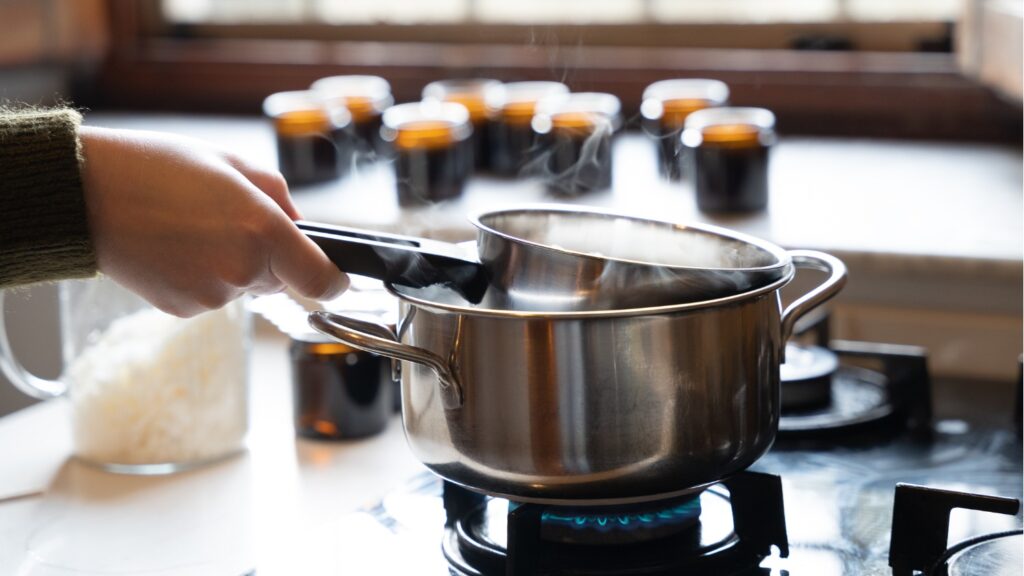
A double boiler is like a curved pan within a slightly larger pan which has water added to gently melt materials. They are also used in cooking and chocolate making. You can use a smaller steel pan inside a larger pan, but a double boiler is safer.

Candle Moulds or Containers

You can make candles in moulds which are easy to use and come in a variety of shapes. I prefer to make my candles in heat proof containers or glass jars.

Fragrance Oils

These are optional but I always use them to add subtle and festive scent blends to my home.

Dye

I love adding a touch of colour to my candles. You can buy liquid or block dyes; whichever you choose is down to personal preference.

Thermometer

You will need a thermometer for measuring the wax’s temperature as you create your candles.

Scales

Scales come in handy for weighing ingredients.

Jug

To pour the melted wax into containers or moulds you will need a jug.

Wick Holders

This handy tool keeps your wicks in place when you are pouring wax.

Of course, if you prefer you can buy candle making kits from many suppliers that give you a handy pack of the things you need to get started.

Step-by-Step Candle Making Instructions

So, here’s how you actually create candles:

Step 1: Do Your Homework!

Before getting started, watch a variety of videos and have a look at some of the many books available from your local bookstore. The more you know before you get started, the fewer mistakes you will make. Doing your homework will help you to stay safe and make wise choices (and therefore save money) when you are buying supplies.

Step 2: Prepare Your Workspace

Choose a clear surface to work on. I work in my kitchen, and lay down baking paper from a roll to catch any drips. You are working with hot wax and a double boiler, so pets and children should be banished from the kitchen!

Gather all your tools and materials together and have everything within reach so that you are not searching for anything at the last moment and getting frustrated.

Step 3: Measure Your Wax

Candle making supplies are measured by weight; containers are sold by volume – basically, the amount of space you have to fill. Melted candle wax is 10% lighter than water. To calculate how much wax will fill a container, experiment.

Pour water into the container you want to use, up to the right level, leaving about quarter of an inch at the top of the container for the wick to stand proud of the wax. Pour the water into a measuring jug to see how much water filled the jar. If our example candle jar contained 10 fluid ounces of water, we need 10% less to fill it with melted wax & fragrance oil mixture – so, 9 fluid ounces of melted wax would fill it.

Check out this handy calculator to help you work out the amount of wax you need. I often accidentally melt too much wax but don’t get stressed about it; I pour any extras into a little takeout food box and use it with my next batch of candles.

Step 4: Melt the Wax

Put a few inches of water in the bottom pan of your double boiler. Place your wax in the top part and heat the water to a simmer. The wax will slowly melt. Test the melted wax with your thermometer. Different waxes have different melting points which you can check with your supplier, but generally aim for around 185°F (85°C).

Step 5: Prepare the Wick

While the wax is melting, prepare your wick. You want it to be around two inches longer than the height of your container. Use a tab to attach the wick to the bottom of your container.

Step 6: Add Fragrance and Dye

Once your wax is melted, you can add fragrance and a few drops of dye if you wish. Do not add too much fragrance oil in your enthusiasm; too much oil can pool and smother the wick as the candle burns and can even be a fire hazard.

Luckily, calculators are available to help you. As a rule of thumb, use a 5-10% fragrance oil to wax ratio. So, if your candle pot contains 16 fluid ounces, use around 1 to 1 ½ fluid ounces of fragrance oil, making up the rest of the mixture with melted wax. Stir gently to ensure even distribution.

Step 7: Cool the Wax

Cool the melted wax to around 130-140°F (54-60°C). This is safer for you, but there’s also a reason in terms of candle making. Pouring at a lower temperature reduces the formation of bubbles and cracks in your candle.

Step 8: Pour the Wax

Position your wick holder across the top of your container and slot your wick into place. Slowly and carefully, pour the melted wax mixture into your container, leaving about half an inch at the top.

Step 9: Let It Set

Allow your candle to cool completely. It can take 24-48 hours for the candle to set completely. Especially with soy wax, leave the candle to cure for a week or two and it will give off more fragrance as it burns.

Step 10: Trim the Wick

Once the candle is set, trim the wick to about ¼ – ½ an inch.

Making candles is such a satisfying craft – and it’s a great way to make unique holiday gifts. If you make candles, we’d love to hear about your experiences and see your photos, so please share them here in the comments and on our Facebook page.

Let’s Have a Conversation:

Have you tried making candles? Did you use beeswax or soy – and what made you choose your wax? What’s the best thing about making your own candles?

Read More

On Book and Film Endings: The Neat Bow and the Ellipsis

fiction endings

Endings are fiendish things.

In the old days, fictional endings were clearly defined, wrapped up, tied with ribbon and fastened in a neat bow. Shakespeare’s endings were unambiguous: tragedies ended in mass death, comedies ended in mass marriage and reconciliation. Even more modern, ‘edgy’ and less easy-to-pigeonhole playwrights like Ibsen and Shaw ended their plays definitively; not to mention Jane Austen and the Brontës.

Nowadays It’s Not So Straightforward

Nowadays art – drama in particular – in an attempt perhaps to imitate life, does not always end conclusively. And that’s okay, because life doesn’t end in a neat bow, it inevitably ends in an ellipsis.

However, a great ending can (almost) redeem a less than perfect product. While a disappointing ending can definitely ruin an otherwise good one. BBC’s TV series Line of Duty’s ending appeared to disappoint practically everyone. The conclusion of Sky TV’s Succession on the other hand – which happened this week, so I’m told – was perfect: surprising, yet it made perfect sense. (I wouldn’t know, not having watched the series, not having access to Sky TV).

There’s the ending that says, “There’s another series coming up,” which is guaranteed to be infuriating, particularly when you know this was not the original intention, which is why the denouement is being artificially withheld from viewers in order to win them back to the new series. This is bound not to work, it seems to me, as where does such a strategy end?

The Best Ending of All Time Has to Be The Graduate

In The Graduate, having gone to the ends of the earth to win the girl, to the point of banging on the stained-glass window of the church in which she is about to marry another, before rushing into the church, grabbing hold of her hand and pulling her out and away and into a passing bus, Dustin Hoffman scrambles with Katherine Ross to the back of the bus where they sit, wordlessly, while the soundtrack plays The Sound of Silence and their faces express a glorious mixture of joy followed by doubt followed by uncertainty and – “What the hell did we just do?” The perfect combination of fairy tale and Real Life.

One of the worst endings, in my recent film-going experience, was Return to Seoul, an otherwise intriguing film about a Korean woman brought up in France returning to her native country in search of her biological mother, who first refuses to see her and then relents, and finally . . . well who knows?

There Are Endings That Tantalise Tantalisingly and Those That End With – Uh?

I don’t mind some ambiguity so long as it leaves the viewer with something to speculate about, rather than thinking, “They simply ran out of ideas.” (Or worse, that I am literally losing the plot.)

Endings in My Own Writing

When it comes to the endings of my own fictional products, and to some extent the non-fictional ones as well, I tend to fall into the old-fashioned category.

Even though I write in series, I have no idea when I finish one book what the next is going to be about, so the idea of withholding anything, or even trying to tempt the reader with a taste of what’s to come, doesn’t arise. When I look back, my books, which I defiantly describe as NOT romantic fiction, tend to end with a reconciliation between Him and Her.

With the latest one however I wanted to do something different.

Having got to within a stone’s throw of finishing the manuscript, I got stuck. I told friends I was one paragraph away from The End. I wanted to go out not so much with a Bang as with a, “Well, fancy that!”

What I eventually came up with surprised me, and to this day I am not one hundred percent sure of it as it heads off in a quite unforeseen direction, though I think it does fulfil the ‘Well, fancy that!’ expectation.

Perhaps there’s a new career possibility for Providers of Satisfying Endings? (And no, I am NOT suggesting AI.)

Let’s Have a Conversation:

What was the latest book or show ending that really surprised you? What about a disappointing ending? Are you a fan of old-fashioned endings or do you prefer uncertainty? What else do you want to say about endings?

Read More