Month: July 2023

Tackling the Fear Zone of “I Can’t”

fear of failure and comfort zone

Have you ever had a great idea about something new you wanted to try or place you wanted to go and then immediately thought, “I can’t possibly do that.”?

We are very creative with our excuses; what are your go-tos? “I’m too old,” “I was never agile,” “What will they think of me…!” are the most common excuses. If they’ve been a constant for you, congratulations, you are at the Comfort Zone.
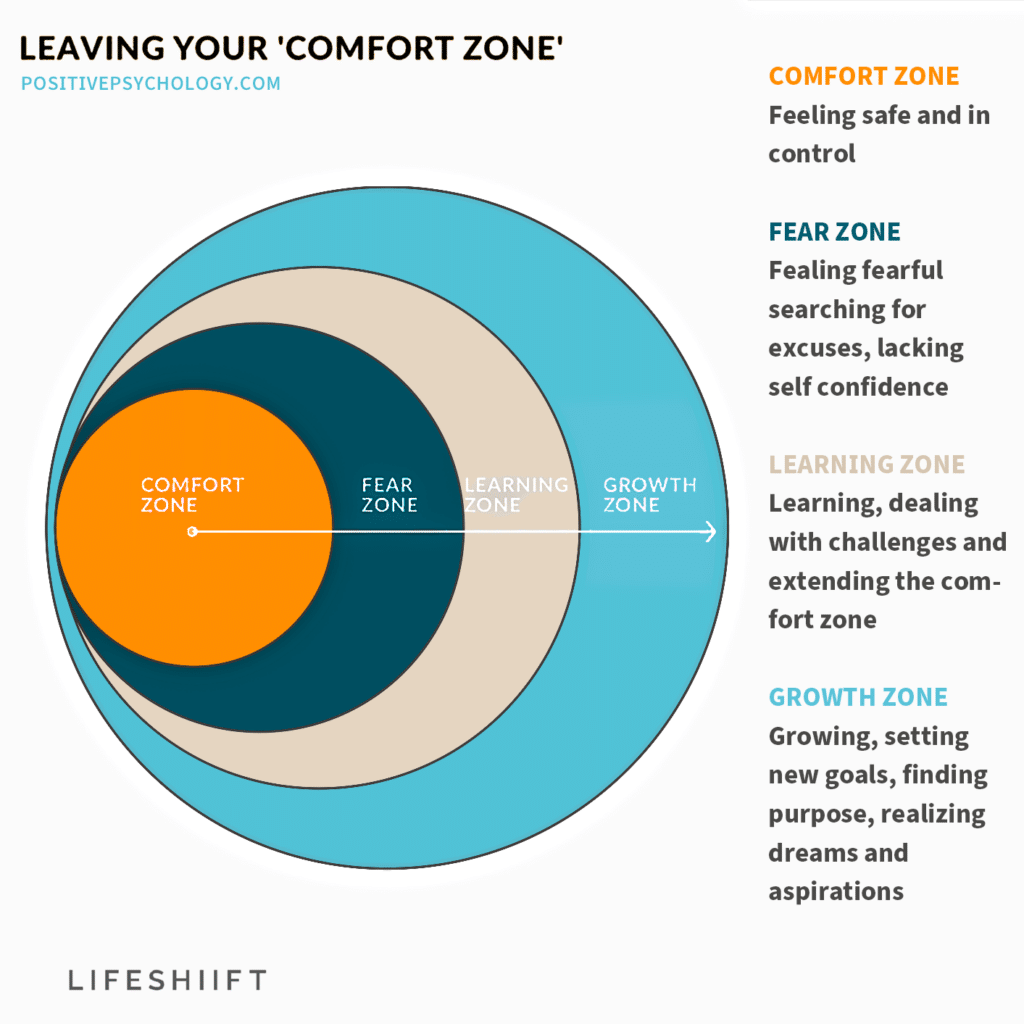
Comfort zone from positive psychology

This graphic from PositivePsychology.com says it all. We do not get to the Learning Zone or the Growth Zone because our fear pushes us back into that Comfort Zone where we feel safe and in control. Often that is what happens when we enter the Fear Zone. So let’s talk about fear.

One of the biggest barriers to growing in your 60s is getting past that Fear Zone (the fear of failure). There is a high correlation between perfectionism and fear which makes learning and growing even more challenging for those of us who have these tendencies. Something that often goes hand in hand with fear of failure is procrastination. Sound familiar?

Five Tips for Overcoming Fear of Failure

Here are five quick tips for dealing with fear of failure thanks to a Positive Psychology blog – How to Overcome Failure: Your Ultimate Guide.

  1. Cultivate a growth mindset – this is all about reframing failure as a path to growth.
  2. Build the failure muscle in a safe space by trying new things like a new hobby such as learning a musical instrument, or drawing. Enjoy the process of failing but failing better each time.
  3. Choose icons – recall famous people who had a great attitude towards failure – a famous one is Thomas Edison who said it wasn’t that he had failed a lot, he just found 10,000 ways not to create a light bulb.
  4. Learn from a toddler learning to walk – they fall and get up and then fall again. What do we do when we see them? We encourage them and help them. Do you give yourself this same encouragement when you stumble and fall?
  5. See failure as a teacher and one step towards growth. When you fail, ask yourself what you can learn from this and how you can do better the next time.

Pushing into the Growth Zone

One great exercise that I have done before is writing my obituary. What is your legacy? Do you really want it to be about how you played it safe all your life? Try it. Definitely an eye-opener.

Another way to getting beyond the Fear Zone is to surround yourself with people who regularly challenge themselves. My late husband really challenged me to do things that scared me. From making a speech in front of a large audience to going on an African safari, he encouraged me to take risks. Sometimes when I experience fear, I ask myself “What would John tell me to do?”

As a culture, we have a lot to learn from failure. If we avoid failure at all costs, we lose our opportunity to do the great things that we can do. This is especially true as we age and think that we are not capable of changing. Wrong!

Now is the best time of our lives as we have the experience and time to do great things or at the very least have lots of fun. The best time to take our space in the Learning Zone and the Growth Zone.

Here is a blog that I wrote about an experience way out of my comfort zone called African Adventure – Fight or Flight Response. This experience pushed me well into the Learning Zone and Growth Zone.

Let’s Have a Conversation:

Are there parts of your life such as your health or your friendships where you stick close to your Comfort Zone? Do you have successful strategies to push past your Fear Zone? Are there people in your life who are great at pushing you beyond your fears into your Learning Zone?

Read More

Do We Purposefully Look for Variety in Our Lives?

variety in life

Variety is the spice of life, so they say.

I’ve heard that saying so many times, I can’t even remember when I first heard it. More importantly, I’m not sure I’ve given it much thought.

But it is worth thinking about. As we settle into our later years, we can easily get into a routine with little change from day to day.

Is that a good thing?

Leaving Work

You would think that the point at which we leave the job that we (often) had for many years would be the point at which our lives would become most varied. No longer the regular commute, with regular hours, seeing the same people from Monday to Friday.

Suddenly, a whole new world opens up. We can travel whenever we like, depending on the work status of our partner and our finances. We can take day trips, see old friends for lunch, take up new hobbies.

A terrific sense of freedom. And every day different. The chance to discover new things.

(The pandemic changed that equation for many of us, of course, so that those who were still at work found themselves managing their own time through working from home. But they were also highly constrained – and, in any case, that is another story.)

Being Retired and Variety

Retiring is a period of change. Nothing new in that proposition. If you have retired, you have doubtless seen many changes in your day-to-day life.

But have you also seen greater variety? Or has it been a period when one regular routine was exchanged for another? Retirement can bring much greater variety, but it doesn’t necessarily do so.

And retirement goes on for a long period these days. It was once the case that we retired at age 60 or 65 or so and were dead by the age of 70. No more. I am 81, which means that age 60 was over 20 years ago. The post-work period lasts a very long time.

So, you may have retired, gone on a cruise (or travelled around by less glamorous means) and then settled back down at home into a dull routine. Or you may be more active than ever all the time.

Only you know whether your current situation is right for you.

Is Variety Always a Good Thing?

We need to be careful in any assumption that variation is a good thing for its own sake.

Some people like to travel and see as much of the world as they can. Some are happy ‘tending their garden’ – both literally and figuratively – in their longstanding home. It just depends on what kind of person you are.

And what categories of your life do you want variety in? Probably not your partner. Having been happily married for 60 years, I am in no position to comment, but I would assume that we seek stability in that department.

Similarly, although we may want to move house in order to downsize or for some other reason (to move to a retirement community? to live near your children? to gain a better environment?), few of us would want to move very frequently.

On the contrary, stability brings comfort and ease. I have lived in the same house for nearly 50 years, so again, I am not one to comment here.

Yet I don’t know about you, but I like to find that every day brings a slightly different pattern in what I will do or who I will see. Waking up every day to exactly the same routine would be a bit dull.

Most of us want other people in our lives, whether only once in a while or frequently. And we want to be stimulated by something or someone.

A bit of difference does add ‘spice’ to our lives.

How to Get Variety

If you are finding that your life has settled down to a somewhat boring routine, what can be done to obtain more variety?

If you are still able and active, do seek out new activities in your area.

There are few places that do not welcome volunteers, although you would usually need to commit to a certain number of hours per week.

Whatever your skills, there is likely to be somewhere that would love to make use of them. Driving? Sorting correspondence? Chatting to lonely people? So many needs to be filled.

Alternatively, there may be groups of people in your area with a common interest (such as walkers or bridge players or any number of other things). Indeed, if not, you could try to start one. Even if it failed, it would be an adventure to give it a try.

Grandchildren are another way of achieving variety. Do you live near enough to see them frequently? If so, do you look after them too much, so that it has made your life too much of a routine? If you can, find the right balance.

If not, do you stay in touch? Have you the means to communicate with them (in my case, this seems to be What’sApp, which I have just about mastered).

Whatever you do, don’t decide that you are just too old.

You are never too old to make some changes to your life.

Let’s Have a Conversation:

Do you have enough variety in your day-to-day life? What activities bring this variety? Would you prefer some changes to your routine? What would you most like to change?

Read More

Sanya Richards-Ross’ Black Laser Cutout Confessional Dress

Sanya Richards-Ross’ Black Laser Cutout Confessional Dress / Real Housewives of Atlanta Season 15 Episode 9 Fashion

Sanya Richards-Ross’ black confessional dress on last night’s episode of Real Housewives of Atlanta had me searching the internet for a laser cutout dress I could wear this summer. This dress could be the perfect dress for a night out or for a cute vacation look. Most black cutout dresses are sold out online so scroll down and grab this look before it’s gone and you’re left in a bad mood like Sanya’s sis!

Best in Blonde,

Amanda


Sanya Richards-Ross' Black Laser Cutout Confessional Dress

Style Stealers


Originally posted at: Sanya Richards-Ross’ Black Laser Cutout Confessional Dress

Read More

Sheree Whitfield’s Purple Cutout Confessional Top

Sheree Whitfield’s Purple Cutout Confessional Top / Real Housewives of Atlanta Season 15 Episode 9 Fashion

Sheree Whitfield looked perfect in her purple cutout confessional top. This is a great closet staple because it can be worn open with a sexier vibe (like Sheree), or it can be worn a little more conservatively with the cutout closed with a simple pin job. Making it a fab work-to-play top. But either way you plan to wear it just make sure you cutout some time to shop it before it’s gone!

Sincerely Stylish,

Jess


Sheree Whitfield's Purple Cutout Confessional Top

Style Stealers


Originally posted at: Sheree Whitfield’s Purple Cutout Confessional Top

Read More

Gray Divorce: Why You Need Financial Advice!

gray divorce money

Although many think that after 20, 25 or even 35 years of marriage it will surely last “til death do us part,” more and more baby boomers are divorcing late in life. Divorcing after age 50, which is being called “gray divorce” is the fast growing segment of divorcing couples and these divorces are usually initiated by the wife.

My marriage ended when I was 50, after 26 years of marriage. Most of my practice is helping couples who have been in very long-term marriages divide their marital estate and determine spousal support. Most of my clients have grown kids, so there is no child support or custody involved. It’s becoming more common for my clients to be in their 70s.

Women See an Opportunity for a Second, Better Phase in Their Life

Longer life spans and the ability to be financially independent after divorce play a big part, particularly with affluent women. At 50+, many women see themselves living 25 or 30 more years, and they don’t want to spend their retirement years unhappy. They may feel they no longer have much in common with their husbands, or they have grown apart after many years.

Sometimes after the children have graduated from college and no longer live at home, one or both spouses find that that was the only thing that kept them together. Women who have been controlled or married to narcissists decide they have had enough and now that their kids are grown, they decide it’s time to get out.

Drug and alcohol addiction often play a part. Women see the possibility of having a second life that fits with how they see themselves today, and decide they no longer want to stay in their unhappy marriage.

But They Can Find Themselves in an Underdog Position

Although female baby boomers were part of the women’s liberation movement and often worked away from the home, statistically, they worked fewer years and earned less than their husbands did. For this generation, employment opportunities were more limited and women were often pigeonholed in lower paying professions.

For “gray divorce” couples, often a “traditional” marriage took place where the husband worked and the wife raised the kids. The wife did not work for a portion of the marriage, often a good portion, and the husband took care of long-term finances. Sound like you?

The effect is that generally women fare worse in a gray divorce. Even if assets are divided 50/50, divorcing women may have a spotty work history or may have lost job skills and yet find themselves having to re-enter the work force to support themselves. Net worth declines as resources are drained to pay the bills.

Women experiencing a gray divorce, more than any other divorcing individuals, need to include a Certified Divorce Financial Analyst (CDFA) to help them sort out their marital estate, which often includes a home, a pension or 401(k), brokerage accounts and IRAs, rental properties, vehicles and possibly a business.

Information on What Your Financial Future Holds Is Imperative

Lifestyles have been maintained much longer and much more is at stake in terms of spousal support. Spousal support is a big worry for many. In North Carolina as well as other states, there is no formula for determining spousal support; it’s based on need vs. ability to pay. That’s where good, thorough budgets are extremely important, not just looking at the present, but also how things will change.

For instance, will you go back to work? When will social security start and how much will it be? Is there a pension or 401(k) and how will that affect your retirement? Should you keep the marital home? If not, do you want to buy a house or condo and how much will the mortgage be? What will it take to qualify for a mortgage? What will all your related living expenses be? These questions take time to research, but having that information during negotiations pays off in the long run.

My clients can see how settlement proposals affect their cash flow not just in the short term, but what it will look like 10, 20, even 30 years into their future. Seeing the long-term effect that a proposed settlement has on cash flow and net worth becomes imperative.

Financial pitfalls are awaiting those who do not closely examine the financial effects of taxes, social security, inflation and appreciation or depreciation of assets. Gray divorces are a financial settlement, and most attorneys don’t have the necessary financial knowledge, training or specialized family law software necessary to properly guide gray divorcing couples.

CDFAs can work with both spouses as a neutral divorce financial planner or with just one spouse as their financial advocate. For instance, my knowledge as a divorce financial planner helps BOTH parties in a divorce, even if I’m hired as an advocate by only one spouse.

During gray divorce, often the wife is at a loss as to how much she can expect in the divorce settlement and whether she can afford to live. She doesn’t know a lot about finance, and she is scared. Does this sound like you?

Let’s Have a Conversation:

Did you divorce after a long term marriage? What were your biggest challenges? What do you wish you had known then?

Read More