
Month: December 2023

Downsizing Dilemma: Why Getting Rid of Books is So Tough

Downsizing-Dilemma

Finally, you have reached the age when you are beginning to think about downsizing. Perhaps you have familiarized yourself with all the practical and even emotional difficulties involved and have decided you are not quite ready to take the plunge.

Is there anything you can do in preparation for the eventual day?

Downsizing Dilemma: Culling Books

Few people reach their 60s without accumulating a lot of things they know they could throw or give away without great loss.

There are the clothes that don’t quite fit, but might do so if you lost those extra pounds that you are working on. There are the gifts that you never use, but have sentimental value because of the friends who gave them to you.

And then there are the books.

Books Take Room

If you like to read, you probably have books all over your house or apartment. Perhaps you sorted through them 10 years ago (or longer) because you had moved then or simply had a fit of eagerness to clean up.

In any case, there they are, in piles here and there – in the living room, by your bedside, in odd corners, including some in the bathroom.

Whatever cataloguing system once existed has probably long lost any cogency. When you are looking for a book you know you own, you get annoyed because it is nowhere to be found.

You have long thought that books don’t take any space, but you know you are kidding yourself. Indeed, for years, you proudly collected books to make your home feel properly lived in and loved. Each addition was like another brick to a house.

Perhaps it is time to cull.

Culling Can Be Painful

Deciding to get rid of books is harder than you might think. There are the books you always meant to read and are sure you will get to one day. There are those you started, but then stopped, and you like to think you will indeed finish them.

There are some you may be keeping for the children or for when you are sick and need something not too demanding. There are a lot of reasons to keep books.

And, if you are anything like me, it is a dusty job. You keep the house generally clean, but how often do you pull out the books one by one? So not only is it an emotionally difficult business to decide to give away books, but it is also a physically unpleasant one. Every reason not to do it.

But go for it, nonetheless.

How to Start Downsizing Your Book Collection

It is possible, of course, to simply go to any shelf and pull out books you don’t really want any more. I would urge you to do it more systematically.

If you have a lot of books, mentally divide them into categories – perhaps something simple like fiction versus non-fiction, but you might have more elaborate sub-categories.

Start with just one. Search your house for all novels, say, and put them in one place. Then, to feel productive, put them in alphabetical order (and remove any duplicates of books you bought a second time, because you forgot you had them in the first place!).

Then begins the difficult part. You know how old you are, and you know how many books you tend to read in a year. You can guess that however good your intentions, there are a set of books you will never re-read or read for the first time. Put them in a separate pile. Then look again and find some more.

Continue in the same vein with other categories. Depending on the size of your collection, this may take a few days. You should find yourself with a few cartons of books at the end of the process.

Dust the shelves, and put the books back in some organised system that pleases you. Offer the discarded books to friends, family, charity shops or even to passers-by. There, you have done it.

The Gains

Believe me, there are gains. In the first place, your rooms immediately look cleaner and tidier. With luck, there are no books piled on the floor, and you may even gain space for that knick-knack you were wondering where to put. Also, you know where your books are, next time you are looking.

Best of all, you will have found many books you didn’t have any memory of buying, but would really like to read – or re-read. My high school English teacher used to say, “If a book is worth reading once, it is worth reading twice.”

Put them on your bedside in an inviting pile. Take one out and pour yourself a glass of wine.

Time well spent.

Let’s Have a Conversation:

Are you downsizing? Do you have too many books cluttering up your rooms? Is letting go of books the most difficult part of your downsizing journey? Please share your thoughts below.

Read More

How to Start Running After 60 in 6 Easy Steps

So you’ve decided to start running. I’m assuming you’re in good physical condition and injury-free. Running is an excellent choice as it is one of the best cardio exercises for burning calories and strengthening the heart.

You’re aware that other women over 60 are running and that they all have good things to say about how they’ve improved their physical and mental health. Bravo to you for listening to us!

What do you do? Should you put on your old runners, a pair of sweats, and head down the road going as fast as you can?

Absolutely not!

This will guarantee that you’ll only run once, and all your good intentions to get in shape will be gone, replaced by a terribly sore and aching body.

Running is so easy, but it does require some planning. Taking the effort to carefully plan your running points you in the right direction towards a successful and continuing running experience.

Here are 6 easy steps on how to start running after 60.

Prepare for Running Success

The first thing you should do is mentally prepare yourself for running. This means acknowledging that you are running for your overall health and fitness.

This acknowledgement means that you will not focus on your running performance. It is important to accept that you are not running to be competitive and that you are not “proving” you are in the same shape you were as a teen or young adult. The running experience should be stress-free and without performance expectations so you can relax and enjoy the exercise.

Next, you need to pick your running outfit. Get a good pair of running shoes and exercise clothing that has no rough seams to reduce the likelihood of abrasion and bleeding. Socks should be out of a wick-able synthetic material to keep the feet dry and prevent blisters. See our Best Workout Clothes For Older Women for ideas.

Once you have your clothing all settled, you need to pick a running route. It should be somewhat traffic-free, scenic and/or interesting, and if possible, start from your front door.

Now all you have left to do is pick a day and a time to start your run, and be ready to start it then.

These preparations put you in charge of the run. They allow you to take ownership of it. This goes a long way in making your run a special time for you to do something important for yourself.

See also: Pushing Ourselves To Stay Physically Fit Without Hurting Ourselves

Focus on Run Format

Your first run should be an “out and back.” You head out for, say, 10 minutes, and then turn around and return to where you started. This will give you a first run of 20 minutes.

Walk for the first 2-3 minutes; walking slowly then faster and faster. Start running slowly and increase only slightly, remembering that it is not a race. Vary walking with running if you find you are getting out of breath.

To check that you are not running too fast, do the talk test. Can you speak without being winded? If not, slow down.

Don’t be disheartened if you find yourself having to walk more than you are running. Each time it will get a little bit easier, and soon you will be running more than you walk.

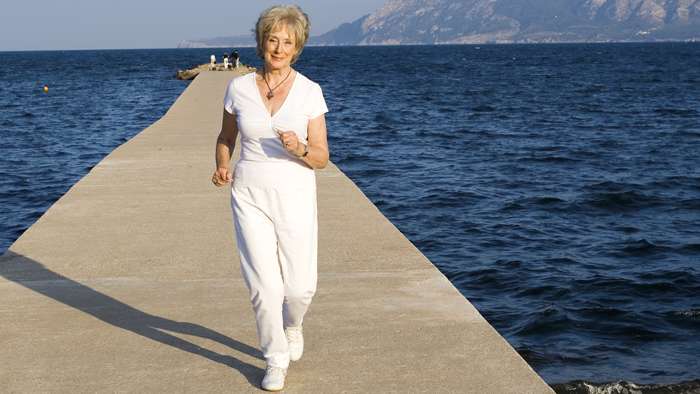
How to Start Running After 60 in 6 Easy Steps - Focus

Pay Attention to Your Running Form

Run like you are a puppet with a string pulling up at the top of your head. Your head should be held high, back straight, shoulders back, and arms swinging by your sides.

Think about your form as you run, and if you find you are squeezing your arms and raising your shoulders, relax into the puppet form. This posture will help prevent injury and reduce fatigue.

Enjoy Your Run

Look around, enjoy your run and the moment. Let go of your day as you run, and you’ll find yourself in a mindful state of focusing on the here and now, your form, and the route scenery.

Let your mind empty of thoughts. You may also find you can focus on a specific problem and maybe even solve it! And smile, nodding to other runners, who may also be beginners just like you.

Cool Down

Once you are back, do a short cool down. This is basically the reverse of how you started. You’ll feel your heart rate lowering and your body relaxing.

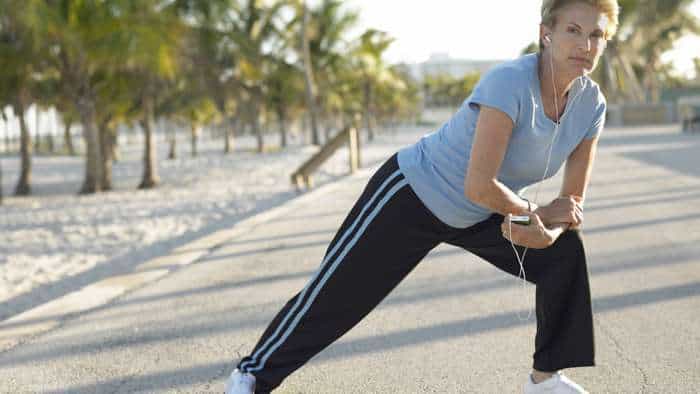
Do some simple body and arm stretches, even if it’s just swaying your body around, lifting your arms, and then hugging one knee then the other. A few simple stretches help the muscles relax and prevents stiffness the following day.

How to Start Running After 60 in 6 Easy Steps - Stretching

Treat Yourself

After your run, treat yourself to a nice warm bath or shower, some fruit, maybe a cup of tea, and listen to relaxing music. Allow about 15 minutes for your body to relax and recover from the exercise. Think about how good you feel.

Give yourself a day or two off after your run before you go out for another. If you are stiff, run for the same time out and back, but if you’re okay, add 5 minutes to the total run time.

Be careful to add no more than 15 minutes a week. A 45 minute run is a good time goal for a regular run. And running about 3 times a week is an excellent way of maintaining overall fitness and feeling great!

It’s all good!

Let’s Have a Conversation:

Have you taken up running after 60? What was your experience? What advice would you give to the other women in our community who may be considering starting running? Please join the conversation.

Read More

Piano Lesson 25: Playing Music Expressively with The Dynamic Six

Playing expressively with dynamicx

Welcome to Lesson 25, where we talk about music dynamics.

NOTE: If you are just joining us for the first time, you can find my previous Sixty and Me Free Piano Lessons on my Author page. You can join our lessons any time and move at your own pace!

Moving Beyond Beginner

As you move beyond the “beginner” stage, one of the ways to make your piano playing more expressive and “musical” is by adding more dynamics. Dynamics have to do with how loudly or softly you play your music.

If you listen to these performances of the pieces Clair De Lune, or Misty, you can hear a great fluctuation in dynamics. Pianists might or might not observe the dynamics written in their sheet music (dynamics are often not marked at all in popular sheet music, leaving it up to the player) and will always add more than is written on the page.

Musicians might also play a piece a bit different, dynamically, each time they play it, according to their mood at the time. Both of these pieces are also performed Rubato, out of time, which you can do in some classical pieces, and some popular ballads, but we will cover Rubato playing in a later lesson. As you can see, there is much beyond the page for the musician to express!

Use Dynamics to Make Your Music Expressive

Today I want to expand your cache of dynamics so that you can begin to increase the expressiveness of your playing. Experiment with the subtle changes of your fingers pressing on the keys as you strive to play more loudly and more softly. Think about how hard you need to press for forte (f) and fortissimo (ff) and how gently to press for piano (p) and pianissimo (pp) as you play.

NOTE: If you have a keyboard, you can only play dynamically if your keyboard is “touch sensitive,” meaning that the volume gets softer or louder the more gently or strongly you press the key. If your keyboard is not touch sensitive with full-sized keys, I would urge you to upgrade now! You can see my suggestions for inexpensive keyboards here, or look for a used keyboard or piano on eBay, Craigslist, or your local Facebook marketplace listings, etc.

Lots of people want to sell their pianos quickly and cheaply, and pianos always sound better than keyboards (if they are in good condition), in my opinion. But a good touch-sensitive keyboard is great too, and much more mobile!

25.1 The Dynamic Six

There are six primary dynamics that we use regularly, and as usual, they are all Italian terms: pianissimo (pp), piano (p), mezzo-piano (mp), mezzo-forte (mf), forte (f), and fortissimo (ff). Here’s what they mean:

pp – very soft

p – softly

mp – moderately soft

mf – moderately loud

f – loudly

ff – very loud

Watch my video in which I discuss THE DYNAMIC SIX, and how loud is loud and how soft is soft.

It is thought that our default dynamic is mezzo-forte (mf), or moderately loud. Beginners often play a little too loudly because they lack finger control, so be sure to practice your exercises faithfully, to increase muscle strength and finger control. Keep your wrist, arms and shoulders loose and relaxed, even when you are playing forte (f).

25.2 Eine Kleine Nachtmusik, p.74

I love Mozart’s dynamic Eine Kleine Nachtmusik, translated as, A Little Night Music. This is his 1st movement, the Allegro, which means it is to be played fast! But not right away. Start slowly then you can play it faster after you are able to play it smoothly at a slow tempo.

In my demonstration video, listen to the way I change my dynamics as marked in your music. I fluctuate between forte and piano, but the changes are kind of subtle, not too jarring. Never pounding the loud notes, always hearing each soft note.

25.3 Auld Lang Syne

I have also posted some free Auld Lang Syne sheet music for Sixty and Me subscribers to play at the stroke of midnight on New Year’s day (or anytime)! Visit the Sixty and Me page here, then scroll to the bottom left to print Auld Lang Syne.

Passion Practice

  1. Exercise #4 – Play in B-flat and F with each hand. Try playing Exercise #4 using a metronome set to 3/4 time, at whatever tempo you can play it without pausing.
  2. MORE DYNAMICS, p.73. Follow the directions for copying the six dynamic symbols for added brain power and memory boosting. Then fill in the letters for the Musical Mind Game below.
  3. Eine Kleine Nachtmusik, p.74 – Watch my demonstration video 25.2 noticing the dynamics, then play it slowly with the dynamics as written.
  4. Chord Calisthenics #4, Appendix viii – Play the minor triads from C-minor to F-minor as whole notes, with each hand, then play them in the opposite order, from F-minor to C-minor. Try using a metronome and hold each chord for 4 beats at around 70 bpm. Record yourself to make sure you are staying on the beat!
  5. Auld Lang Syne or review – play Auld Lang Syne slowly until you can play it at a steady rhythm. There are no dynamics noted on this song, so which dynamics will you use? It’s up to you. Alternatively, you can review Did You Ever See a Lassie on p.62.

Let’s Have a Conversation:

Do you like playing with the different dynamic markings? What is your dynamic? Do you better enjoy playing piano (p) or forte (f)? Are you feeling some increased finger control since starting your lessons 11 months ago? What other improvements are you seeing in your playing? Celebrate your progress! Soon we will begin your second year of lessons!

Read More

The Single Thing That You Can Do to Combat Overthinking

overthinking

I saw a meme a few months ago that I posted on my Facebook page, and it resonated hugely with my community. It said, “It’s like no one in my family appreciates that I stayed up all night overthinking for them!”

We all laughed about it, because for many of us, it’s true! We often find ourselves lying awake at night thinking about every possibility that could happen in any given situation and how we might react.

Many of us are also what I fondly call “control freaks” and with that comes overthinking. And I include myself (sometimes a little too proudly) in this incredible group of women.

What, Exactly, Is Overthinking?

Overthinking can mean many things to many different people. For the purposes of this article, overthinking is the act of thinking about something or many things to the point where it:

Why Do We Overthink and Why Is It a Problem?

Our brains are wired to make us cautious and concerned about any deviation from the status quo. Change and newness can register as danger in our brains and we start to think about any and all negative possibilities.  This is often our brain doing its job to keep us safe. Status quo is often safe. But not always ideal.

There’s no problem with a “little” overthinking. But, for many of us, it can turn into a constant state of being – one which, at times, can become counterproductive and even harmful.

Physical Effects

Overthinking typically results in anxiety which can, in turn, cause physical symptoms including elevated blood pressure, stomach upsets, headaches, and insomnia.

Emotional and Lifestyle Effects

The anxiety that is caused by overthinking can, in some people, lead to depression. In addition, many of us who repeatedly weigh all of the possible “what ifs” in any given situation are doing this at the expense of doing other enjoyable activities. Or, even worse, not allowing themselves to live in the moment and feel the joy in an activity or experience that they are participating in!

Okay! So What’s the One Step I Need to Take?

The answer is simple: ANY action step.

If you are wondering whether or not you can kick a soccer ball and make a goal, here’s your answer. You will NOT make a goal if you never kick the ball. That’s a given.

So, we need to stop worrying about what “might” happen while we sit there and do nothing – and just do SOMETHING!

I work with women who are looking to redefine after 50 and some examples of first action steps (depending on what it is you are looking to do) might be:

  • Tell loved ones of your plan or dream – this is a scary one for many but a great first step. It makes you accountable and it makes your dream real!
  • Find a community of people who share the same interests or are doing the thing that you might be interested in doing;
  • Schedule time each day to work on the thing – put your phone away, set your timer, and do it.
  • Guided reflections – take a look at where you’ve been, what you’ve loved about it and haven’t liked about it, and what you dream of doing moving forward. Journal on it.

What Do I Do When I Continue to Overthink?

Those thoughts will continue to sneak in, even while you move forward and take action on whatever your “thing” might be. After all, we’re over 50. We’ve been overthinking and wanting to be in control for a very long time! It’s not as if this way of life is just going to disappear with a single action step.

Ask yourself (and journal on it) “What’s the BEST thing that can happen if I do this thing or stop doing that thing or take this step?” Allow yourself to visualize what that best thing really looks like. In detail.

For example, imagine that your dream is to write a book. Ask yourself, “What’s the BEST thing that can happen?” Picture what your life looks like as a writer. Do you get up early each day and get your coffee and sit outside and write? Imagine yourself talking to publishers or taking a class on self-publishing. Picture yourself speaking to book groups. What are you wearing each day? Who is around you?

Write all of this down and look at it and add to it as you think of new details. When those sneaky overthinking voices come calling, take a minute and channel this vision.

Your vision of the BEST that can happen as you continue to take action steps on your “thing.”

Vincent Van Gogh summed the importance and effectiveness of taking action with this quote: “If you hear a voice within you say ‘you cannot paint’, then by all means paint, and that voice will be silenced.”

Let’s Have a Conversation:

Do you tend to overthink? Do you have an idea of what your “thing” is, and is overthinking preventing you from moving forward? What might be a good first action step for you?

Read More

Too Old? Humbug, I Say!

at 60 we are not too old

Several days a week, I visit the local Dunkin’s. My purpose of going is to purchase a coffee roll for a loved-one unable to go themselves. I ask for the Senior discount because I’d rather give the workers the extra tip. When I ask, I smile and say, “I’m an Oldie but goodie.” The response is a chuckle or grin.

I mean it. I’m old but not obsolete, and neither is anyone reading this article.

60 may not be the new 40, but hope, inspiration, and zest, could provide dazzling opportunities in second, maybe third, flowerings of life.

Openness

Consider fickle plants. Years ago, I left a job to pursue a self-employment path. My colleagues gifted me with a braided Ficus tree, a finicky specimen that prefers stillness over movement. Well, it endured a ride to my condo, and one cannot help maneuvering the pedals of brake and gas while driving. My friend and I delivered the tree to the second floor, and the haughty greenery seemed to settle into its new home.

Uh-uh.

Within a couple of weeks, the recent visitor became insolent and dropped her leaves. Every single one of them with an Oomph.

My response? I waited for her to bloom again, and I continued to wait. Unfortunately, the plant remained in its naked state, and soon, I decided enough and cut her up.

After my undertaking, many people informed me the Ficus might have flourished again if forbearance persevered. Would the second showing be less glorious? Perhaps, but who knows?

I learned my lesson, and many years later, patience prevailed for my beloved orchids. They rewarded me with second and even third showings.

Why am I discussing plants? For Baby Boomers and generations following us, this couldn’t be more significant.

As I wrote in my last article, The Miracle of Living Now, medical innovation provides greater opportunities for health and wellbeing. But, there’s more, as the December 19th edition of the Wall Street Journal points out in an essay, Golden-Year Grooves. The article discusses the musicians who continue rocking and rolling like it’s 1999.

Rocking and Rolling

The WSJ reports that Brenda Lee’s 65-year-old song, Rockin’ Around The Christmas Tree, hit number one on the Billboard Hot 100. Although she’s not dancing around the world stage, her song is prompting others to do so. Not only that, many of our aging singers are.

Did you see that photo of 77-year-old Dolly Parton singing in youthful attire? Most of us wouldn’t get away with it, but she could, and she did. This year, she released a new album of rock classics that landed on the Billboard Album Chart at number three.

Peter Gabriel, now 73, emerged after 20years with his first LP.

In 2023, Bruce Springsteen, Elton John, and Madonna remained in demand for their concert appearances. Two septuagenarians and a sexagenarian, how about that?

The octogenarian Bob Dylan, now 82, won’t let his younger peers outdo him, as he continues touring.

Not to Be Outdone

The realm of movies and streaming also continue providing opportunities for aging adults. Although older women are still in the backseat, changes are happening. Harrison Ford, age 81, Sylvester Stallone, age 77, Kevin Costner, almost 69, Helen Mirren, 78, and Meryl Streep, age 74, are just a few of those not stopping.

Once upon a time, these older adults would’ve been long gone.

Some might scoff, saying they have the means and the money. I concur. However, rather than envy or dismiss, I prefer to see them as trailblazers and role models for the rest of us.

I revisit the theme of my mother, who retired at 70, but one year later, she returned to employment. At age 81, her body riddled with cancer, worked until they closed the program, and she left this earthly life months later. People challenged her desire to work in the twilight of her life, and she planned on using Betty White as an example.

She left nine years ago, and I bet these celebrated changes are making her smile from afar. I miss her, but I embrace her spunk and desire as encouragement for my own endeavors.

I hear her say, “You go, girl,” and with tears pooling, I smile back and blow a kiss.

Letting Go

Are there some things we need to relinquish?

You bet. Last summer, I attended an event that required more formal wear. I still owned this 25-year-old gorgeous coral two-piece dress and tried it on. Snug, but I could get away with it. I showed my husband. He looked at me and agreed it fit, but he stated what I knew. Too old for that dress. My eyes roamed to my once-upon-a time defined but now less sculpted, crinkled arms, laughed, and told him he was right.

I accept certain changes that reinforce 60 isn’t the new 40. Fatigue sets in sooner. Forgetfulness happens more than at 40, and my feet hurt, preventing me from walking on the treadmill like a roadrunner. All of this requires modifications, but as long as I have a working mind with ideas rolling around, I will continue. If someone says I’m too old. I’ll take a page from Dickens’ Scrooge.

Humbug.

Let’s Have a Conversation:

Are you an oldie but goodie? Do you believe there’s some venture awaiting your unwrapping and exploration? Anything or anyone holding you back? I invite you to share.

Read More