Month: March 2024

How to Combine Eyeshadows to Create Fun and Gorgeous Looks

how to combine eyeshadows

When I do one-on-one Zoom makeup consultations, I often hear women say, “I always wear neutral eyeshadow colors because I’m a little scared to step outside my comfort zone and combine different eyeshadows. I’m afraid I’ll look like a clown! But I’d love to change up my look.”

I can definitely understand the feeling of looking at an eyeshadow palette like the one you’ll see in the video and feeling absolutely intimidated by the thought of incorporating any of these colors into your makeup look. Because, after all, when we look at an eyeshadow palette like this, how do we know what eyeshadow colors to combine and which colors to put where so we’ll look polished and not garish?

But combining different eyeshadow colors into our makeup look can bring us a lot of joy, and it can also be a lot of fun. As one woman commented after watching one of my videos:

“I’m in my late 40s and have started experimenting with colorful eyeshadows only recently. I am working on trying to feel less self-conscious when I go out in public because the vibrant colors that I’m drawn to bring me so much joy. Plus, it feels great to explore the more creative side of my personality.”

And the good news is that we don’t have to dive right in and use lots of bold color. Instead, we can take baby steps to see what will work best for us.

Since there are no rules in makeup, we can create any kind of look that we love. But there are some guiding hints we can take from color theory that can help us feel far more comfortable combining colors. Applying the science of color theory to our makeup color selections can help us create beautifully harmonious looks.

So let’s take a look at seven different eyeshadow combination possibilities that can give us some helpful guidance if we want to experiment with some new eyeshadow looks.

Combination #1

The first of these seven different combination possibilities is to combine a color you don’t normally use with neutral colors that you’re already comfortable wearing. And one great way to pick a great additional non-neutral color for your eyes is to pick a complementary color from the color wheel that will make your eyes really “come alive” and “pop.”

Complementary colors on the color wheel are those colors which are opposite each other. So on the color wheel I’ve included in the video, you can see that there are some beautiful pink or purple tones across from green which could look gorgeous on those of you with green eyes.

The complementary colors across from blue on the color wheel are warm shades of brown, copper, peach or orange. And when you locate brown on the color wheel, you can see that various shades of blue are the complementary colors opposite brown. And although grey is not on the color wheel, pinks, purples and bronze shades can really make grey eyes pop.

So now that we know a color that will make your eye color pop, we can take baby steps to incorporate this color into your neutral eye look. As you can see in the video, I have on a neutral brown eyeshadow look on one eye. And since a great complementary color for my brown eyes is blue, I’m going to apply a beautiful deep blue called “Pool Party” from Colourpop’s “Cabana Club” eyeshadow palette.

Try These Baby Steps

One of the ways you can take baby steps to add this color to your neutral look is to apply the blue in small, strategic doses rather than applying it on a large area of your eyes. So in the video I’m going to demonstrate all the baby step ways we might add this beautiful deep blue color to our neutral eyeshadow colors. You certainly won’t apply this color in all the ways I’ll be sharing with you, but I’m going to demonstrate each of these different ways you can add a complementary color to a neutral eyeshadow look.

The first way is to add this new color as eyeliner. Another way to add this color in a small, strategic dose is to apply and blend a small amount of the complementary blue color on the outer corner of the eye. A third option is to apply just a touch of the color above the crease and blend it in thoroughly.

A fourth way is to use a light version of the color as an inner corner highlight. In the video I’ll take the lightest blue color from the NYX Ultimate Vintage Jean Baby palette and mix it with some of the white to lighten it and then apply it on the inner corner of my eye.

A fifth way is to add a touch of the navy color to the bottom lash line. And a sixth way would be to apply navy blue mascara. So those are all the ways you can add an additional complementary eyeshadow color to a neutral eyeshadow look.

Be sure to check out Elise’s YouTube channel which specifically focuses on makeup tips, techniques, and product reviews for those of us 50+. Don’t forget to subscribe!

Combination #2

The second way to combine colors is to combine different shades of the same color by using light, medium and dark shades of that color. So you could apply all green eyeshadow going from very light green to a deep green or a light lavender that moves into medium or deep purple. This is called a monochromatic eyeshadow look.

You can apply these shades anywhere on your eyes, but it can be especially fun to go from light to dark colors across the eyelid or from light to dark across the crease area. Some examples of monochromatic eyeshadow palettes are these three from Colourpop: “High Tide,” “Blue Moon” and “Orchid You Not.”

Combinations #3, #4 & #5

The third way is to use all cool colors or all warm colors. The cool colors on the color wheel are on the left side and the warm colors are on the right side.

The fourth way is to mix a warm with a cool tone. This gives a little pop to the eye area and is one of my favorite ways to add more interest and dimension to an eye look. In the video I’ll add a warm color to some cool and neutral colors I’ve already put on my other eye from my Juvia’s Place Warrior II palette. Then I’ll add in a pop of orange from this palette by placing a small amount of orange just above my neutral brown crease color in the center of my eyelid.

The fifth way is to combine analogous colors. Analogous colors on the color wheel are those colors that are next to each other such as blue and green, yellow and orange or purple and blue.

Combinations #6 & #7

The sixth way is one we’ve already touched on earlier and that’s to use eyeshadow colors that are complementary to our eye color such as pink or purple for green eyes or peachy warm tones for blue eyes. Or, you could simply put two complementary shades together on the eyes such as blue with a touch of orange or green with purple.

And the seventh way is to apply triadic colors. Unlike colors that sit next to or directly across from each other on the color wheel, triadic colors are equidistant on the color wheel. When you join these colors, they form a triangle. Triadic colors would be red, yellow and blue or green, orange and purple.

I hope this article and video gave you a little inspiration to try out some new looks with some fun, interesting new colors. After all, color can bring us great joy and really add some fun to not only our makeup application, but also to our lives since there’s definitely a relationship between colors and emotions. There’s even the term “dopamine dressing” to describe the mood boosting benefits of wearing certain colors. So I hope you pull out those less often used palettes, have some fun and play with color.

Here’s a guide on choosing makeup colors: HOW TO CHOOSE THE BEST LIP, CHEEK AND EYESHADOW COLORS THAT WILL HELP YOU GO FROM GOOD TO GORGEOUS.

Let’s Have a Conversation:

Are you open to exploring makeup combinations that are a little more bold than your usual neutrals? Have you tried a combination that works especially well for you? How did you put it together?

Read More

Have You Heard of the Handgrip Dynamometer Strength Test? It Can Influence Your Future!

handgrip dynamometer

Throughout our lives we participate in various health/medical screenings to see if we have, or are at risk for developing, certain health conditions or diseases. We participate in screenings for our blood pressure, glucose levels, cholesterol values, body weight and composition, eyesight, posture, etc.

As we age, there seems to be an increasing number of recommended screenings such a colonoscopy or mammogram, to name but a few. These screenings not only identify risk for or the presence of disease but increase our own relevant awareness of our state of wellness.

More importantly, important health test values should serve as powerful intrinsic motivators to cause us to act in meaningful ways to reduce our risk or achieve a level of control of a health condition.

Have You Heard of the Handgrip Dynamometer Strength Test?

Handgrip Dynamometer

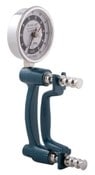
A screening that most individuals have not heard about or participated in is the handgrip dynamometer strength test.

The test simply requires that a person squeeze, with as much force as possible, a handle type devise (see below) that measures pounds or kilograms of force they produce with their grip.

The unique and important thing about a handgrip dynamometer strength test is that multiple studies have validated its use as a simple, reliable, and inexpensive assessment of overall strength and a valid future predictor of physical disability, mobility limitation, and certain diseases.

What Does the Research Actually Show?

  • Because the pull of a muscle on its attachment to a bone stimulates the laying down of bony matrix, producing a thicker and more dense bone, muscle strength is related to bone mineral density. Consequently, a systemic review of literature has confirmed a relationship between decreased grip strength and the increased incidence of hip fractures.
  • Weak grip strength has shown to be a strong predictor of all-cause mortality in community-dwelling populations.
  • A reduction in grip strength is a significant predictor of cardiovascular mortality for men and women.
  • For individuals admitted to a hospital with chronic obstructive pulmonary disease, there was a significant difference in mean grip strength between patients admitted to the intensive care who died compared to those who survived.
  • Low grip strength in mid-life is a strong predictor of mobility and personal care disability in early old age.
  • The risk of falling over a period of one year is significantly greater among both men and women whose grip strength is below the 25th percentile.
  • The association between grip strength and the combined rate of hospital admission/death over a 10-year follow up period was examined showing a significantly greater risk of any emergency admission/death with individuals with low grip strength.

Several researchers evaluating the effect of grip strength on a variety of health outcomes recommend that grip strength measures are a “useful indicator of overall health” and as a biomarker of health status.

Further, they state that there is “adequate evidence to support the use of grip strength as an explanatory or predictive biomarker of specific outcomes such as generalized strength and function, bone mineral density, fractures, falls, nutritional status, disease status and comorbidity load, cognition, depression, and sleep, hospital-related variables and mortality”.

Considering the predictive ability of this simple test, hand grip dynamometry measured strength should be considered as a vital sign, useful for screening middle-aged and older adults, and the data presented as a motivational stimulus to help at risk individuals begin or increase a strength training program for a future greater quality of life.

Where Are Handgrip Dynamometry and Other Strength and Balance Tests Administered and Appropriate Intervention Follow-up Provided

One organization is the American Physical Therapy Association. It has developed a preventive care program titled Annual Physical Therapy Visit. This initiative is designed to optimize movement and promote health, wellness, and fitness by allowing physical therapists to perform screening of elderly individuals to identify health risks and determine appropriate recommendations.

The screening consists of:

  • An interview with assessment of physical activity, smoking and alcohol use, nutrition, sleep, health history, social determinants of health.
  • Resting vitals – heart rate, blood pressure, pulse oximetry.
  • Movement screen evaluating how participants move, if movements provoke symptoms, and identify impairments for further revaluation.
  • Physical function tests including handgrip strength, static balance, gait speed, sit-to-stand performance.
  • Consultation – the assessment results are used to identify fall risk, sarcopenia and frailty, deficits in function, need for physical activity plan, cardiovascular concerns, and social determinants of heath.
  • Referral Protocol – based on the results of the Annual Physical Therapy Visit screening and a well-designed rubric, appropriate referral can be made for physical therapy intervention, referral to another healthcare provider (physician, social worker, occupational therapist, nutritionist, smoking cessation program, cardiac or pulmonary rehabilitation), or community program (YMCA, Fit for Life, Local fitness clubs/organizations, CrossFit, Silver Sneakers, etc.).

Bottom Line

If a person does not know if they have a risk factor (e.g., high blood cholesterol), they are unlikely to engage in an intervention to reduce that risk factor.

Because a low handgrip strength score is consistently associated with a greater likelihood of premature mortality, the development of disability, an increased risk of complications for prolonged length of stay after hospitalization or surgery, and certain diseases, why not consider getting your handgrip strength tested by a local physical therapist or other professional trained in administration of the test and follow up interventions?

Transitioning into or experiencing older age can be more enjoyable, meaningful, and of a greater quality with a body that has the strength and mobility to allow you to go and do with more vigor and capability.

Whether or not you have a handgrip dynamometer strength test, I hope you can see that the benefits that can come from resistance training are many. And the really cool thing is that it is never too late to start a strength training program. When will you begin yours?

Let’s Have a Conversation:

When was the last time you went for a medical screening? What was the screening about? Have you heard of the handgrip dynamometer strength test? What do you think this screening will show for you?

Read More

8 Steps for Decluttering Your Mind

decluttering your mind

Spring cleaning has been viewed as a tradition and ritual for thousands of years, with the earliest roots found in Jewish, Middle Eastern and Chinese cultures.

For these cultures, and now here in the United States, spring cleaning corresponds with the end of winter and the dawning of the new spring season, which we are now entering.

Springtime is the natural cycle of revitalization and renewal of nature, which we are inherently a vital part of. What if this tradition was turned inward and you spent some time clearing out beliefs, stories, and emotions that no longer serve you?

What would this look and feel like?

In this article, and the accompanying video, we are going to answer these questions as we explore how to do spring cleaning for your emotions with eight steps to declutter your mind.

A Season of Inner Renewal

With a gradual uptick in temperature outside, coupled with the vibrant colors of nature blooming, spring initiates a natural stirring within people to refocus and renew their lives.

To make the most of this season of renewal, it must happen from the inside out. For what is the point of cleaning up your home if your emotional state remains a mess?

That is why this time of year signifies more than just a transition from the cozy confines of a blanket, and a warm cup of tea, to outdoor adventures in nature.  

While traditionally associated with the home, spring cleaning is more than tidying up your living space. It is about embracing the immutable law of nature, which is change.

To make the transition of change easier and more fun, it is time to go inward.

Ushering in a New and Better Life

Although spring cleaning is traditionally associated with tidying up and decluttering physical spaces, it can also be applied metaphorically to declutter your mind.

To guide you through this process, here are eight proven steps to declutter your mind and promote mental clarity:

Identify Mental Clutter

Awareness is the first step in decluttering your mind. Take some time to reflect on worrisome thoughts, limiting beliefs, and unhealthy emotions that occupy your mind. Notice any recurring patterns or negative self-talk, especially outdated stories that are no longer serving you.

Practice Mindfulness

Engage in mindfulness techniques such as meditation or deep breathing exercises. These practices help you become more present and observe your thoughts without judgment. Practicing mindfulness is also an essential part of letting go of unnecessary mental clutter.

Journaling

Journaling your thoughts, worries, and emotions brings clutter out of the mind and into a physical space where you can tangibly observe them. This allows you to externalize internal dialogue, gaining a new perspective on your emotions. It can also help identify patterns or areas of focus for personal growth.

Prioritize and Let Go

To let go of unnecessary emotional baggage, you will want to assess your mental priorities. To do so, identify what truly matters to you and allocate your mental and emotional energy accordingly. Recognize that it’s impossible to control everything. Learning to let go of what you can’t control and no longer need, can free up mental space.

Set Healthy Boundaries

Establishing healthy boundaries in your life protects your mental and emotional well-being. Say no to commitments that overwhelm you or drain your energy and say yes to what makes your heart sing. This helps prevent mental clutter and creates space for activities that bring you joy and fulfillment.

Practice Self-Care

Engage in activities that nourish your mind, body, and soul. This can include exercise, spending time in nature, reading books, laughing more, pursuing hobbies, or connecting with friends and loved ones. Self-care is about loving yourself enough to declutter your mind by engaging in relaxation and positive emotions.

Challenge Negative Thoughts

Notice negative self-talk or limiting beliefs and actively challenge them. Replace negative thoughts with positive and affirming statements. Practice self-compassion by reminding yourself daily that you are worthy and deserving of love and happiness.

Seek Support

Reach out to trusted friends, family members, or professionals if you need support in decluttering your mind. Sometimes talking through your thoughts and emotions with someone else can bring clarity and perspective.

Not a Once-a-Year Activity

Just as physical clutter accumulates over time, so does mental clutter.

Decluttering your mind is an ongoing process that requires regular attention. Therefore, this is not just a once-a-year activity.

By incorporating these steps into your daily routine, you can gradually create a more peaceful and focused mental space, allowing for greater clarity, improvement of your well-being, and a more fulfilling life after 60.

Remember, when you declutter your mind you instantly make room for new desires and dreams to blossom into a beautiful new life. For this reason and more, spring cleaning for your mind is an act of self-love.

I invite you to join me in the video where I will share additional insights on decluttering your mind, including three journal prompts to help you integrate what you are learning.

Let’s Have a Conversation:

Have you noticed too much mental clutter? What are you doing to accomplish inner renewal?

Read More

Claim Your Inner Selfie

inner selfie

Social media is the land of the selfie, and I’m sure there are entire research disciplines devoted to figuring out that phenomenon! I’ve never been a fan, but recently have been contemplating the concept of an inner self.”

During a celebration of life for a dear friend, I watched the highlight reel of his life and wondered, Are these the photos he would have chosen for himself? Aside from images illustrating a life well-lived, were there other photos that he would have chosen to reflect the most important aspects of ‘self’ – who he was at his core?

Self-image is often forged early in life and gradually morphs as experiences either reinforce or diminish the connection to self. Significant life events may also “rock you to your core,” making it difficult to see a clear pathway back to one’s best self.

When was the last time you really felt connected to self? You know, that feeling of energy or flow that fuels joy in your life – regardless of challenges. The feeling that you are connected to your core values and are truly known by others?

You may know exactly what I mean or maybe it has been so long you’re not sure you would recognize the feeling!

What Is an Inner Selfie?

Try this. Think of a picture of yourself (past or present) that you really love – one that makes you think, “Yes, there I am!” Something about it reflects who you are at your best, or who you want to be. 

Think of it as an inner selfie!

If you can’t find one – imagine what it would be and why. Maybe it reveals an internal thread of your best self that runs through every role you take on in life – at work, home, and in the community.

Maybe it reflects the energetic, joyful person you want to be or the life you want to live.

Here’s One of My Inner Selfies

The photo above reflects my drive for a sense of freedom and adventure, a passion for exploring new paths, confidence in my ability to lead the way, and a lifelong kinship with wild places and spirited horses.

Each of these qualities have shaped how I experience both my personal and professional roles in life. 

As a mom I took my boys camping, fishing, and horseback riding. In a favorite Mother’s Day card my adult son thanked me for taking him fishing “every time he asked”!

When riding with friends I seldom stay on the trail, opting instead for bushwacking through the trees looking for new trails or scenic vistas that might be just over the next hill.  

Professionally I’m also driven to create new pathways to overcome common challenges. It’s so much a part of how I work that the Emerson quote, “Do not go where the path may lead. Go instead where there is no path and create a trail”is prominent on my website!

What Do You Envision as Your Inner Selfie?

So, what about you? What would your inner selfie express about you? Does a photo exist, or can you envision what one would look like? Consider for example:

  • What consistent threads run through your life no matter what role you’re playing?
  • Has your ‘core-self’ changed or remained the same through life challenges and changes?
  • If it has changed, are you happy with that change; and if not, can you create a pathway back to your best self?

The concept of an inner selfie can help you remain connected to your core values and more clearly illustrate your best self to others.

Currently, how well do people in your life truly know you? Consider how you ‘show up’ in all aspects of your life and how most people would describe you to others. Are you happy with that description, and would it match how you would describe yourself?

Do Others See You as You See Yourself?

Be aware that as your interactions with others change over the years, how they view you compared to how you view yourself can become quite different.

For example, recently while our family was exploring some mountain property, I took a side trail and got back to the group a little later than everyone else. When I returned, one of my boys was hollering MOM!!, and the other had gone to look for me. They were worried, and I was completely baffled.

I’m healthy, fit, and quite competent in the mountains (thank you very much), so what made them think I was at risk? After some discussion, it boiled down to my age of 66! What? After all our outdoor adventures together and years of pushing back against ageist expectations, they were worried because of my age. Seriously?

Apparently, neutralizing ageism is like an endurance event combined with a contact sport where you can get hit at any time, even by your own teammates!

Contemplating this experience, I realized that while I continue to lead mountain adventures with my friends of all ages, interactions with my boys are much different – focused instead on interacting with grandkids aged 3–6 years old. Of course, that’s part of who I am as well, but it’s clearly time I took my adult sons on a bushwhacking adventure they won’t soon forget!

It Takes a Lifetime

Being true to self is a persistent life challenge. But, having a clear image of self and being aware of how well we project that to others can help! Consider posting an ‘inner selfie’ (complete with how it reflects your best self) someplace you will see it daily. Then contemplate specific ways to ensure your interactions with those you care about consistently reflect the most important aspects of who you are at your core. Inner selfies – pass it on!

Visit Brilliant Aging for more information about living your best life at every age!

Also read, SMALL CHOICES CAN TIP THE WELLNESS SCALE.

Let’s Have a Conversation:

What would (or does) your inner selfie look like? Have your adult children or others close to you underestimated your abilities simply due to age? If you have lost a part of ‘self’, can you think of ways to get it back?

Read More

Are You Ready to Take a Break – from Alcohol?

take a break from alcohol

Many of us start drinking during our 20s and 30s – to socialise and have fun. As we get older, some of us switch to using a glass (or two) or wine in the evening to relax or to relieve stress. The evolution from “socialising” to “self-medicating” has begun.

Alcohol is insidious – it creeps up on us and many of us find that we have become daily drinkers. However, we live in such an alcogenic culture that it just feels normal. Not having a drink when socialising is far more likely to be noticed!

Here’s the thing, though. Alcohol is a toxin, and we owe it to our amazing bodies and brains to take a break now and then. It could be time to ask yourself this question:

Could I go for 66 days without a drink?

Here Are 8 Reasons Why You Should Try

30 Days Is Not Long Enough

Many of us have done a Dry January but 30 days is just not long enough to experience the benefits of sobriety. Whereas 66 days of sobriety will boost your health, improve your looks and give you a glimpse of just how awesome alcohol-free living can be!

We Need to Make Sure We’re Not Addicted

Alcohol is a drug, and we need to take regular breaks to ensure that we are not becoming dependent. 20% of social drinkers will become dependent over the years. Alcohol is insidious and sneaks up on us which is why an annual “dependence-check” makes so much sense.

A Break from Alcohol Has Slimming Benefits

66 alcohol-free days will certainly have an impact on your waistline. Of course, wine is full of sugar, and it also leads to unhealthy snacking. Even more important to know is that because alcohol is a toxin your body will focus on metabolising it first. In fact, every drink will put your fat burning mechanism on hold for at least 24 hours. For more info listen to this podcast.

Your Looks Will Improve

A break from booze will have a positive impact on your looks. You will lose that puffiness in your face, your skin will clear and your eyes will sparkle. The average US woman spends $300 a month on beauty treatments. The global wellness economy is estimated to be worth $4 trillion. We are on an endless quest for wellness and vitality and youth. Yet ditching alcohol is the best beauty treatment of all – and it’s free!

A Challenge Is More Socially Acceptable

“Alcohol is the only drug we have to justify not taking,” sounds harsh but is true. If you tell your family and friends that you have given up drinking, they may well ask you why on earth you would do such a crazy thing. Whereas tell them you are doing a 66-day alcohol-free challenge as a health kick they could well leave you in peace – or even join you! 😉

Better Sleep Is Certainly a Bonus

To feel rested, we need 7 cycles of REM sleep. Drinkers usually get 2 at the most. The resulting fatigue builds up over the years, especially if you drink a glass (or two) of wine every evening. Ditch the drink for 66 days, and you will sleep like a baby and begin to feel fabulous — who knew?

You Will Experience the “Domino Effect”

After a significant period of sobriety, your mind will clear and your energy and motivation will come flooding back. You may well start reviewing and changing other parts of your life – your eating plan, your exercise program, your career and your relationships.

Enjoy Spring and Summer More Fully

We’re (finally) coming into Spring and Summer is not far off. Wouldn’t you just love to start the summer feeling happier, healthier, slimmer and full of energy!

Why 66 Days?

There’s been a neuroplasticity revolution taking place over the last couple of decades, and this is great news for us 60+ ladies.

Gone is the outdated idea that our brains stop evolving in our mid-20s. The latest science is telling us that our brain is constantly rewiring itself. You’ll wake up with a different brain tomorrow to the one you have today.

How fabulous is that!

In fact, one study done on 57-72 year-olds discovered that their brains gave birth to between 500 and 1,000 new neurons in their hippocampus alone – every day!

The science is also showing us that 66 days is long enough to change a habit and build a new neural pathway.

If you want to see the research which led to the 66 day principle then here it is.

Building New Habits

Our brains have been wired for survival so we like to take the easiest route to whatever result we want. That’s why we may find ourselves pouring that glass of wine rather than going for a run if we want to wind down and relax.

To build that new habit of not drinking for 66 days we have to create a new route – a new neural pathway.

Here’s an analogy to illustrate the process:

Imagine you’re trying to get from Las Vegas to Los Angeles. Route 1-15 is going to be the fastest route.

What if you pulled over to the shoulder and began driving on the sagebrush? The goal may remain the same (Los Angeles) but you’re taking a less efficient route. It’s going to take more time and be more painful.

However, if you took that sagebrush road again and again, day after day tire tracks will form and you’ll gradually be able to pick up speed. That’s exactly what happens in our brains as we build a new habit – we build a new neural pathway. If you continue with your new habit, it will eventually become like a superhighway!

So, yes, changing your habits is hard in the beginning but once you’ve built that new neural pathway, you’ve changed the game and there’s no better feeling than to look back at your superhighway and know that it didn’t get there by accident – it was built by design!

Try the 66 Day Experiment!

Now you’ve read the science and understood the theory – are you ready to put it into practice?

Are you ready to go for 66 days without uncorking that bottle of wine?

Even if you are just looking to cut down, then take a 66-day break and you will find it SO much easier to drink within the low-risk levels of one and a half bottles of wine (or six beers) a week.

If you are thinking about making alcohol-free living a permanent lifestyle then you will find it SO much easier after 66 days.

At Tribe Sober we’ve been running our #Sober66 Challenge twice a year… for years. Many of our Challengers feel so great after 66 alcohol free days they decide to keep it going.

Join Tribe Sober’s Annual #Sober66 Challenge!

If you’d like a bit of support to get through the 66 days then join the Tribe Sober #Sober66 Challenge and you’ll get online, community and audio support for 66 days from the day you sign up.

The Challenge begins on the 20th March so sign up today!

Let’s Have a Conversation:

How many years have you been drinking? Do you drink consistently – a glass or two of wine most evenings? Have you ever tried to take a break to test your dependence? Have you noticed an impact on your looks after a taking a break? Did you lose weight? Do you ever worry about your drinking? Are you aware of the health dangers of alcohol as you get older?

Read More