
Author: Admin01
4 Ways to Nurture Friendships as We Age

Friendships matter more than ever as we age. They boost our health, give us joy, and remind us we’re not alone. But knowing that friendships are important is only half the story. The real question is: how do we nurture them now that our lives look different than they did in earlier decades?
In our younger years, friendships often came easily. We met people at school, through work, or while raising families. But after 60, those built-in circles often change. Retirement, moving, or family responsibilities can leave us feeling less connected.
That means friendship takes a little more effort and intention. And that’s okay. With some care and thought, friendships can continue to thrive, and even surprise us, in this stage of life.
Here are four ways to nurture meaningful friendships as we age.
1. Be Intentional About Friendship
Friendship doesn’t just “happen” anymore. If we want it, we have to take steps. That might mean picking up the phone to call an old friend, sending a message just to check in, or suggesting a coffee date.
These gestures may feel small, but they tell people we value them. And over time, these consistent acts of reaching out strengthen bonds.
Being intentional also means making time. We’re all busy, even in retirement. If friendship is a priority, it deserves a place on our calendar, just like appointments or errands.
Each week, without fail, I schedule emails, messages, and video chats with my dear friends. This keeps us current with each other, and part of one another’s lives. We talk about the simple things we’re up to. We laugh at our crazy lives, share joy in each other’s accomplishments, and most importantly, empathize through our challenges. We’re there for each other’s happy days, and for the hard ones too.
I truly believe that these efforts help keep our friendships alive. Whether I’m at home in Ottawa or on Koh Lanta makes no difference, as my dear friends are scattered around the planet. By being intentional and staying committed, we remain part of each other’s lives.
2. Join In and Stay Open
New friendships are always possible, but they often come when we step outside of our routines. Joining a club, taking a class, volunteering, or attending community events are all ways to meet like-minded people.
The key is openness. Not every conversation will lead to a close bond, but being willing to talk, listen, and show interest can open the door. Sometimes friendships grow slowly, from casual chats that deepen over time.
It can feel uncomfortable at first, especially if you’re shy or introverted. But small steps, like sitting with someone new at a gathering or saying yes to an invitation, can create opportunities for connection.
A few years ago, I was at an event and loved a seahorse sculpture that was on display near the drinks area. I inquired about it and was introduced to the artist. I could have simply told him how much I enjoyed the creativity with the beach garbage and Christmas lights, but I went a step further.
I asked if I could meet with him to learn how he figured out how to shape the piece. This led to an unexpected friendship with another garbage artist, sparking the birth of my own giant sculptures. If I had only offered a compliment and walked away, I would have missed that chance.
That experience reminded me how simply reaching out, with curiosity and openness, can lead to friendships we never expect.
3. Tend to Old Friendships
While it’s wonderful to make new friends, nurturing old ones is just as important. Lifelong friends carry our shared history. They remind us of who we were, and who we still are.
Distance doesn’t have to end these connections. A phone call, a video chat, or even a thoughtful email can keep bonds alive. Social media can also help us stay in touch. It’s great to post photos and show others how we’re doing. But video is key, as nothing replaces hearing someone’s voice or seeing their smile.
Tending old friendships takes effort, but it’s worth it. These relationships provide continuity and comfort, especially during times of change.
4. Surround Yourself with Positivity
Not every friendship is nourishing. Some relationships can drain us, leaving us feeling diminished instead of uplifted. As we grow older, it becomes even more important to be mindful about who we spend time with.
Choose friends who support you, encourage your dreams, and accept you as you are. Constructive feedback is valuable, but constant criticism or negativity is not. Surrounding yourself with positive, caring people builds your confidence and joy.
And remember, friendship is about quality, not quantity. Even one or two supportive, kind friendships can make life feel rich and connected.
Wrap Up
Friendship as we age looks different, but it can be just as rewarding, and sometimes even more meaningful. By being intentional, staying open, tending old bonds, and choosing positivity, we can create friendships that add depth, joy, and resilience to our lives.
It’s never too late to reconnect with someone from your past, or to meet someone new who will become part of your future. Friendships don’t fade with age; they grow richer when we give them the care they deserve.
Click for free access to my Substack, Retired Way Out There, where I publish a bi-monthly newsletter and handouts.
Let’s Have a Conversation:
What do you find the hardest with making new friends? Have you tried reaching out to an old friend you hadn’t heard from?
Read More
How to Make a 3D Paper Pumpkin

Paper crafts are a wonderful way to make decorations for your home. This article offers two interesting paper pumpkin designs. Enjoy and share your craft ideas!
Vintage Book Page Pumpkins
These 3D vintage book page pumpkins are easy to make and add a touch of class to your Halloween decor. When books are damaged and would otherwise be sent to landfill, what better way to honour them than by making them part of your seasonal decor?
Old manuals and out-of-date textbooks work well as they have reached the end of their useful life. Ask friends to save them for you or contact thrift stores who would otherwise throw away old, damaged books – because you can give them a new lease of life!
Note: All images are courtesy of Enter the Wildwoods.
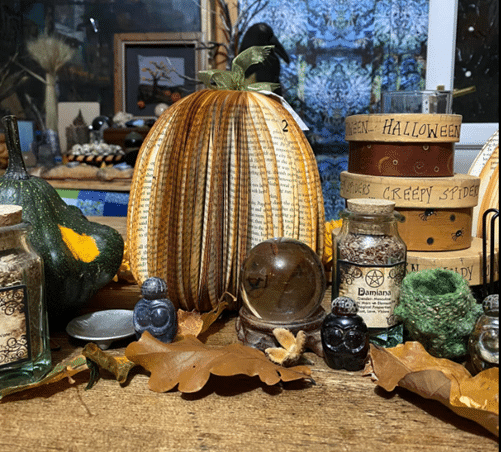
Materials You Need
- Old paperback book (or a hardback book with the cover removed)
- Craft knife suitable for paper crafting
- Scissors
- Orange watercolour paint
- Orange chalk or pastels
- Green ribbon (optional)
- Green craft paper
- Permanent marker
- PVA glue
- Two large paper clips or pegs
- Short twigs (to use as ‘stalks’)
- Hot glue gun and glue or Krazy glue
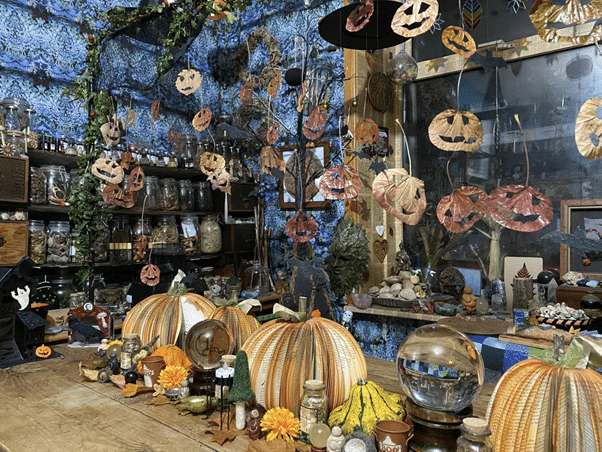
You can make pumpkins of different heights and widths – in fact, for a good table or mantel display this is very effective!
What to Do
- With the book closed, draw a curve from the top to the bottom of the book with the permanent marker. When this curve is cut, and the book is opened fully you will have a 3D circular pumpkin.
- Personal preference comes into play here. I use scissors but many people like to use craft knives to cut into the paper. If you are using a paperback book, cut the marked curve. Then, using the already cut cover as a guide, cut through the layers of pages. I like to use scissors to cut through several pages at once.
- Keep cutting until you have cut all of the pages along the curve, including the back cover.
- Now comes the fun part! I decorate the pages by stroking chalk or pastel across them, to give an orange tint. Now and again (again, according to preference) use orange, yellow or even olive-green watercolour paint to colour-wash a page to add variety. When you paint a page, remember that it will be damp so leave the book propped open to dry so the pages do not stick together.
- Cover the front cover in a layer of PVA glue – use a thin coat so the glue does not run.
- Open the book so the pages fan out and stick the front cover to the back cover. Use the paperclips or pegs to hold the covers together as the glue dries.
- Cut simple leaf shapes from green paper.
- Using a blob of glue from a glue gun or a blob of Krazy glue, attach your stick ‘stalk’ to the centre of your pumpkin, so it sticks up vertically.
- Glue your leaves to the stick for effect.
- You can add a green fabric ribbon to the stalk on some pumpkins for extra effect. Alternatively, curl green parcel ribbon and tie it to the stalk to look like tendrils. The important thing is to customise these pumpkins to make them your own!
Read more about the glories of Autumn here: THE AUTUMN QUEEN, A FABLE.
Paper Strip 3D Pumpkins
This simple craft (you can even do this with the grandchildren!) uses strips of paper to make gorgeous 3D paper pumpkins that can be used as place settings, table decorations, or even Halloween greeting cards with a twist!
Materials You Need
- Orange craft paper
- Green craft paper
- Green paper for leaves
- Scissors
- Bradawl or knitting needle to make holes in the paper strips
- 2 split pins per pumpkin
What to Do
- Cut paper into strips. They don’t have to be the same width or colour – in fact, variation makes your pumpkin more interesting. But they do need to be the same length.
- Arrange your strips in a circle, where strips meet in the middle. Pierce the ends of the strips carefully with the knitting needle/bradawl and poke the closed split pin through the hole so that the ends of the strips are joined as shown in the photo below. When all the strips are in place, open the split pin to secure the strips.
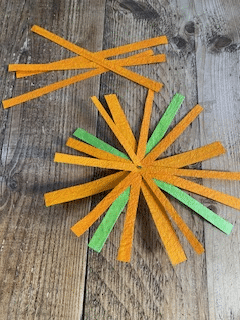
- Pierce the other end of the strips carefully with the knitting needle/bradawl. Draw each strip up and poke the closed split pin through the holes again. Open the split pin to secure the strips. Your pumpkin is starting to grow!
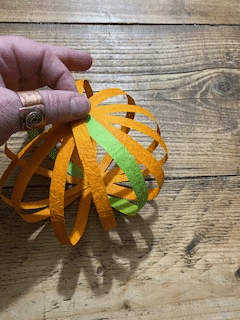
- You can add as many strips as you like, and vary the colours. Experiment and play with your designs. You could use patterned or textured paper, for example. As a variation, you can write phrases on the strips before you add them – maybe a favourite autumnal poem, or some of your own writing. You could also write words you associate with Halloween, or the names of guests at your party!
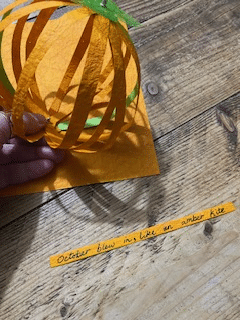
If you have a go at making your own 3D paper pumpkins, we’d love to hear about your experiences and see your photos, so please share them here in the comments and on our Facebook page.
Let’s Have a Conversation:
Have you ever made your own paper crafts or book crafts? Do you make your own Halloween decorations?
Read More
How Teaching French Taught Me More About Confidence Than Any Self-Help Book

Apparently, we’re more afraid of public speaking than we are of death.
It’s absurd when you think about it – but fear has never been rational. It slips under the door, whispering warnings that keep us small. Whatever our age or achievements, it still has the power to press pause on our potential.
I started paying closer attention to fear after watching astronaut Chris Hadfield’s TED Talk What I Learned from Going Blind in Space.
He opens with three piercing questions:
- What’s the scariest thing you’ve ever done?
- What’s the most dangerous thing you’ve ever done?
- And why did you do it?
Those questions stayed with me long after the video ended. They made me realise that fear itself isn’t the enemy – avoidance is. Every time we choose to act despite fear, we widen the boundaries of who we believe we are.
So why bring space and fear into an article about learning French?
Because after more than 10,000 hours of teaching, I’ve realised that every French class is a small experiment in courage. You don’t just learn verbs – you learn visibility. You learn how to be seen trying.
When we step into another language, we step into uncertainty. And that’s where confidence is born – not from affirmations or self-help mantras, but from exposure, laughter, and the quiet discovery that what you feared wasn’t fatal after all.
Myths That Hold Us Hostage
If you’ve ever frozen mid-sentence in a foreign language, you’ll recognise this: the body’s tiny revolt against being judged.
Over the years, I’ve heard the same myths replayed by people from all walks of life:
- “Confidence means being fearless.”
- “Other people are just naturally good at this.”
- “If I make mistakes, I’ll look foolish.”
- “It’s too late to start now.”
None of these are true. But they sound convincing because we’ve rehearsed them for decades. We tell ourselves the confident ones are a separate species – braver, louder, younger, luckier. In truth, they’re just further along the same path.
I’ve watched people with dazzling careers and complex lives whisper their first French sentences like confessions. What they really fear isn’t grammar; it’s exposure – the belief that being seen in progress is the same as being seen to fail.
But confidence doesn’t arrive before you act.
It follows the act.
You speak, you survive, and your nervous system updates the story: I can do this.
And from that small rewiring, a new self begins to form.
Confidence Isn’t a Personality Trait – It’s a Skillset
We talk about confidence as if it’s an inherited gene – something you’re either born with or chasing forever. But in practice, I’ve seen it behave like a muscle: buildable, repairable, sometimes sore, but always capable of growing stronger.
Confidence has three moving parts:
- Permission – the willingness to be imperfect in public.
- Practice – the repetition that turns hesitation into habit.
- Perspective – the ability to treat mistakes as data, not disaster.
Every learner sits somewhere inside that triangle. Some of us need permission first – to know it’s safe to try. Others need perspective – to see that missteps are not verdicts, just feedback. All of us need practice and feedback. And once those three start to feed each other, confidence stops feeling mysterious and starts behaving like what it truly is: a learned behaviour.
You don’t “find” confidence.
You build it – through repetition, safety, and connection.
What I Learnt About Confidence at The French Room
Over time, I’ve realised that my classes are less a language lab and more an incubator of courage – a place where we can safely allow ourselves to become braver.
There’s David, a retired lawyer who felt a quiet tension each time he deferred to his wife in French conversations. She had studied French at university, he had not. His turning point came when he realised, “he was already someway down the track of fluency.”
There’s Nikki, returning to France to judge international dressage competitions, who discovered that “perfection was the very thing holding me back.” The moment she let the language flow, her professional confidence reawakened – steady, grounded, and real.
There’s Nicky, who moved to France to begin her retirement and from the outset has seen learning French as being her way of belonging. “From our first conversation, I knew I was in the right place,” she said.
There’s John, who began by looking for an in-person class but settled into The French Room for the friendships. “When I finally told a story in French and people laughed, I felt part of the group.” That simple moment of shared laughter became his definition of fluency.
There’s Louise, whose twin boys were born in France and who studies to keep that part of their identity alive. “It stopped being rules and started being choices,” she told me – a reminder that confidence is what happens when structure turns to freedom.
There’s Steve, whose joy and generosity have helped shape the very culture of The French Room. “It’s not just about my progress – it’s about being part of something bigger.” His confidence now lifts others every time he logs in.
And there’s Jane, who studied for 25 years but froze each time she spoke. “I knew the rules, I understood the structure – but when I had to speak? Total panic.” The day she finally spoke freely – a string of sentences, perfectly ordinarily – it felt like pushing a boulder over a mountain.
Each of them came to learn French, and each is redefining what it means to be confident.
You can read more about their journeys on The French Room’s Student Success Stories page.
What Self-Help Books Get Wrong
If self-help books could bottle what happens at The French Room they’d talk less about mindset and more about muscle memory.
Confidence doesn’t start in your head. It starts in your body – in the moment you risk embarrassment, discover you’re still standing, and decide to try again.
The transformations you’ve just read about show that courage can be taught, and confidence can be rebuilt at any age.
What Really Builds Confidence
After years of watching people transform, five truths stand out:
Exposure Beats Introspection
You can’t think yourself into confidence. You have to step into it.
Community Regulates Courage
We borrow bravery from each other. The nod, the grin, the shared mistake – that’s where it grows.
Structure Creates Safety
Predictability allows risk. A trusted routine gives us permission to stretch.
Progress Needs Proof
Small wins – the conversation understood, the phrase remembered – are the evidence your brain needs to believe you.
Language Is a Mirror
How you speak to yourself in another tongue reveals how you treat yourself in life. Learning a language teaches us to replace judgement with grace.
These aren’t just classroom lessons. They’re blueprints for living.
The Quiet Alchemy of Confidence
Every time you speak before you feel ready, you’re performing a tiny act of rebellion against fear. Every time you listen without judgement – to yourself or someone else – you widen the world a little.
Because maybe confidence doesn’t begin when fear ends.
Maybe it begins the moment you speak – voice shaking, accent imperfect – and the world keeps listening.
You might also enjoy Courage Over Perfection: Why Taking Action Matters More Than Getting It Right.
Please Join the Conversation:
So let me leave you with three questions – cousins of those Chris Hadfield once asked about danger and space, but grounded in the everyday courage we practise right here on Earth:
- What’s the smallest brave thing you’ve done this week – and what did it teach you about who you are?
- When was the last time you acted before you felt ready, and discovered readiness was never the point?
- And who, simply by waiting or smiling while you found your words, reminded you that confidence is something we build together?
Read More
What Does It Really Mean to Achieve Optimal Health?

If you’re a woman over 50, you might secretly believe that “optimal health” just isn’t available to you. Maybe that ship sailed in your 30s – before the knee pain, the hot flashes, the extra weight that doesn’t budge, or the prescriptions that now fill your bathroom medicine cabinet.
When you picture someone who’s optimally healthy, she probably looks younger, thinner, or more fit than you feel right now. But what if that version of health isn’t the real goal? What if optimal health in midlife and after looks completely different – and it’s still 100% available to you?
The Problem: Why “Doing Everything Right” Still Feels So Hard
If you’re in midlife or after, you’ve been around the block. You already know what you should be doing to care for your health. You’ve read the books, done the diets, joined the programs – yet you still wrestle with cravings, inconsistent energy, and the disappointment of setting a goal to start exercising only to have it fall apart a few weeks later.
And that constant fatigue? It’s no wonder your energy and sleep in midlife feel unpredictable. The illusion of “optimal health” tells us we should spend our free time making healthy meals, counting steps, or chasing a smaller body. But who has free time? Between work, family, and everything else, health can start to feel like another job. Maybe the problem isn’t you. Maybe it’s the unrealistic version of health you’ve been sold.
Why Traditional Solutions Don’t Work
Here’s the truth: most of the popular diets and fitness apps weren’t made for women with busy schedules and lots of demands on your time. They’re designed for the general population – not for women whose hormones, metabolism, and stress levels have changed. These plans tell you to eat less and move more, but they ignore what’s really going on inside your body.
After working with hundreds of women, I can tell you that achieving optimal health is not about willpower. You don’t need another diet to “fix” you – you need something different that actually fits your life. That’s where a non-diet health approach comes in. When you learn to ditch diets in midlife, you stop fighting your body and start working with it. And that’s when health stops feeling like punishment – and finally becomes possible again.
Redefining What “Optimal Health” Really Means
Here’s the thing: optimal health isn’t a six-pack, a perfect diet, or a number on a chart. It’s your best health given your real circumstances. For most women in midlife, that means working with the body you have – not the one you had 20 years ago, and certainly not the one Instagram tells you to chase.
Your knees might ache. You might be caring for aging parents or leading a demanding team at work. You might only have 20 minutes for yourself some days. That doesn’t mean you’ve failed. It means your version of “optimal” will look different – and that’s exactly how it should be.
When you have peace with food and your body, when you build a healthy relationship with food that doesn’t rely on guilt or rules, everything changes. Optimal health becomes freedom. Confidence. Self-trust. It’s knowing you’re doing what’s right for you – and letting that be enough.
The Path Forward: Building Health That Fits Your Life
What is possible today? What does your best health look like today? Not 10 years ago, not what the internet says – but in this exact season of your life. It’s a powerful question to ask yourself, because the answer won’t look the same for everyone.
For most women, it’s not about pushing harder – it’s about building healthy habits for women over 50 that work with your changing body, not against it. Things like: staying hydrated, eating enough protein and fiber, getting good sleep, managing stress, moving your body regularly, and finding joy. These are the quiet foundations of real health – the things that help you balance hormones naturally and stay steady, even when life is busy or unpredictable.
And the best part is that none of it requires perfection. When you shift from rigid tracking to sustainable, shame-free habits, you stop obsessing about food and start living again. You reclaim the energy and mental space for your relationships, your career, and the things that truly matter. That’s what aging with vitality really looks like – not fighting time, but learning how to feel good in it.
When Health Becomes Partnership
One of my clients recently lost over 80 pounds in our work together, and was later diagnosed with a prolapsed bladder. She was heartbroken – angry with herself for “waiting too long” and convinced she’d failed her body. And while I couldn’t undo the diagnosis, what we could do together was change how she saw herself.
Through our conversations, she began to notice everything her body had carried her through – the stress, the sleepless nights, birthing two babies, and the years of putting everyone else first. She started treating her body as the loyal partner it had always been, not the enemy she had to fix.
That’s what I help women do – learn to care for their bodies with the same kindness and respect they’ve shown everyone else for years. Because when we stop trying to fix our bodies and start listening to them, that’s when everything begins to feel easier.
Your Next Step Toward Optimal Health
If you’re ready to stop guessing and start creating your version of optimal health in midlife and beyond, I’ve got you. My free 8 Basic Habits Guide & Checklist will show you the small, consistent actions that truly make a difference. These are the healthy habits for women over 50 that simplify your routines, support your hormones, and actually fit into your real life – no guilt, no overwhelm, no perfection required.
Start feeling better today. Download your guide 8 Basic Habits Guide & Checklist.
Let’s Have a Conversation:
When you think about optimal health in midlife and beyond, what does it look like for you – not what you’ve been told it should look like?
Read More
