Author: Admin01

You Are the Irreplaceable Original

You Are the Irreplaceable Original

“Be yourself; everyone else is already taken.” – Oscar Wilde

At 67, Clare realized that she’d been asking herself the wrong question her entire life.

Fall was settling into Oregon, the morning light filtering through Douglas firs where the first leaves were beginning to turn. The season here held a quiet grace, so different from the dramatic autumn of her youth in Alaska. For an instant she felt again the expansiveness of watching the moving spectacle of the Northern Lights.

Life Transitions Based on Marriage Experience

Five years had passed since the end of her marriage to John – a long relationship that had dissolved slowly when she finally accepted their philosophical incompatibility. He always spoke convincingly of change but expected her to mold herself to his vision of their life.

She had married twice. Her first had ended when she and Tony acknowledged they had committed to each other prematurely. They were too young and inexperienced. Not having yet developed the skill of resilience, he in particular, and she, too, had resented being inconvenienced by having to make adjustments for the marriage.

In her marriages, Clare had believed her partners shared the values she held close and had tried to live by, the ones she had taught her children: honesty, conscientiousness, and flexibility. She believed strongly that personal growth throughout life is essential – that when people stop learning, they become, no matter what their physical age, brittle and old.

Being thoughtful by nature, she didn’t see these endings as failures; no – though there is sadness when couples cannot find common ground – they were necessary signals that she needed to deepen her perception of herself and others.

A Clash of Perceptions

A realization had struck her yesterday afternoon at the coffee shop where she liked to take a book and spend an hour or so journaling. She’d been reading at a corner table when she overheard a mother complaining about her son’s career decision.

“He was pre-med at Stanford, but he threw it all away to become a park ranger,” the woman said, her voice pitched with disapproval. “All that tuition money down the drain.”

Her friend resignedly nodded in agreement: “At least you tried.”

A fierce heat bloomed in Clare’s chest, a protective shield against the mother’s words. Her hands tightened around her cup, and in her mind, she conjured a defiant response.

“What if he’s doing exactly what he wants? What if he’s following his own star, not letting his dream slip away by conforming to your selfish trajectory of his life?”

Being Responsible to Yourself

Sitting here now, a bigger question arose: How much conforming had she herself actually done? We must all adapt to an extent to live together, but that should not require distorting ourselves.

In the quiet aftermath of this questioning, Clare felt a more profound responsibility welling in her. Not the responsibility to loved ones – a dedication she had shown in her life – but the obligation she owed to her own existence. She was the only person in the history of the world who could be Clare Norton. Not an approximation, not a version shaped by external desires, but the irreplaceable original.

The question wasn’t whether she was happy, successful, or admired. The question was simpler and more urgent:

Am I being the Clare only I can be?

Knowing Yourself Helps with Relationships

She thought of her two daughters, each caught in her own wrestling with the tangled knot of modern life. She pictured Dana, 34 now, still seeking approval from her father that would likely never come, her voice strained during their Sunday phone calls. Then she saw Danielle at 28, who’d sent a photo from her latest research station in Sitka – windblown hair, mud-stained boots, a small figure against the vast sky.

Danielle had chosen her own path, but Clare wondered if her daughter was using that independence to avoid the vulnerability of more intimate connection, the way she changed subjects whenever anyone asked about her interests outside work.

Perhaps being herself was the primary way she could truly guide them now.

Are We Brave Enough?

Clare walked to the window, watching a squirrel scurry, gathering stores for the winter ahead, wondering if Ashland would get snow this year.

She would not waste this gift of a singular life.

The question that mattered wasn’t whether she was good enough, but whether she was brave enough. Clare understood that being herself was the one responsibility that belonged to her alone.

Let’s Have a Conversation:

Do you know yourself? What have your learned about yourself that you didn’t know when you were younger? How did you learn it? Do you interact with others based on what you know about yourself now?

Read More

4 Tips for Transitioning from the 60s to the 70s

Four Tips for Transitioning from the 60s to the 70s

I found Sixty and Me at 63, and the voices of women around the world carried me gracefully through my 60s with wisdom and great ideas. Now, I’m turning 73 this month and noticing interesting things as I’ve entered my 70s. For each of us, the journey is a bit different because we each have unique trajectories with our interests, our health, and our families.

As I look at friends who are also in their 70s, I see that everyone has health challenges. My friend told me the senior version of the children’s song, “Head, Shoulders, Knees, and Toes,” is “Back, Shoulders, Hips, and Knees.” And another friend pointed out that we begin visits with our contemporaries with an “organ recital” as we elaborate on the recent acquisition of a hearing aid, dental implants, or newly replaced hips or knees. My father, who lived until 93, used to say, “I am glad I am here, I am glad I am anywhere!”

Might as well laugh about it!

So, I came up with a few tips for myself and to share with you about transitioning from the 60s to the 70s.

Adjust Expectations

Recently, some friends joined us for a trip to Yosemite, the spectacular national park with its valley of ancient rock formations. We didn’t hike because my husband’s knee could not take it. We didn’t go in a boat, because my friend gets dizzy. So, we took walks in the valley, found hidden places along the river, and dipped our toes in the crystal-clear water.

We planned to eat in the early evening, so we took a rest on a bench to get a second wind. I did not mind because I adjusted my expectations. That way, I wasn’t disappointed and was able to get the most joy out of the experience.

We can change our expectations to match our energy levels, and even select locations so we won’t get stuck in traffic or have trouble finding parking. It’s a joy to adapt and find new ways to enjoy life.

Indulge Yourself

Many of us spent years meeting the needs of our parents, our children, significant others, and co-workers. Now, we can take time to indulge ourselves.

I am very picky about pillows; not too firm, not too soft. Also, I buy 1,000-piece jigsaw puzzles and enjoy the hours putting them together. I grow milkweed, collect Monarch butterfly eggs, watch caterpillars hatch and grow fat, and make a chrysalis. Eventually, a beautiful butterfly emerges.

Oh yes, and I watch more TV and Netflix series; I prefer that to going out at night. Many indulgences cost very little money but offer pleasure and comfort. It’s a liberating feeling to prioritize our own needs and find joy in simple pleasures.

Let Go of Things You Have Done in the Past and Find New Pastimes

At one time, I took a guitar with me everywhere. I loved singing with others. When I was a school principal, kids thought I was the music teacher because I would come into classrooms to sing with them. Then I had vocal cord surgery twice, and it left me with scar tissue, a raspy voice that cracked when I sang higher notes. So, now I sing along with music in the car, and that part of my life has changed.

But, when I retired, I was able to pursue my love of writing that had been stagnant since my high school teacher wrote, “I can’t wait to see you in print” when she graded my essays. She would have had to wait over 50 years, and sadly, by then, we had lost touch. Now, writing brings me so much excitement. It’s a relief to let go of past pursuits and embrace new ones, opening up a world of new experiences and excitement.

Compartmentalizing

Sometimes, the problems of friends and family or conflicts in the world that are beyond our control keep us up at night. Compartmentalization involves creating mental boundaries to keep different aspects of life separate and distinct. For example, we can compartmentalize to keep the problems and stresses of the world from impacting our home life. We can choose not to be bombarded 24/7 with horrific images and news items with seemingly unsolvable problems.

By compartmentalizing, we don’t have to feel everything around the clock. By compartmentalizing, I can get up in the morning and feel joy as I water my garden, knowing that compartmentalizing doesn’t make me a bad person. We can do what we can for the people we love, help others, and work to improve the world without feeling guilty.

Let’s Reflect:

Have any of you noticed changes moving from the 60s to 70s? How do you manage your expectations?  What do you indulge in that makes you feel good? What have you let go of, and what have you taken on? Do you have anything to share about compartmentalizing?

Read More

What To Wear at a Retreat – Outfits to Inspire You

retreat outfits

Sometimes we simply need to get away from it all and take some time for ourselves. Retreats and spas are great ways to unwind and practice mindfulness.

Are you heading out to a retreat? Will this be your first retreat? A retreat can be anything from a weekend getaway at a luxury spa to a week-long silent meditation in a remote forest.

Although you’re not going to a fashion show and don’t need to dress to the nines, you still need to wear appropriate clothing while you are there.

Here are a few outfit ideas that are appropriate for retreats and that may inspire you. The items shown are listed below the outfit but look in your closet to see if you have anything similar that you can use to put your own outfits together.

Read more: What to Wear on a Boat – Outfits to Inspire You.

Dress for Comfort

First of all, let’s remember that the main thing to consider when putting together your clothing for a retreat is comfort. Depending on what type of retreat you are going to you may be doing some yoga or other type of exercise and you may be doing some meditation that is typically done sitting on the ground or on a small cushion. This requires clothes that have stretch and don’t dig into your skin.

What to Bring

Bring clothing and essentials depending on the climate of the location of your retreat.

Make sure you ask the retreat if they provide things like towels or other accessories needed for your stay.

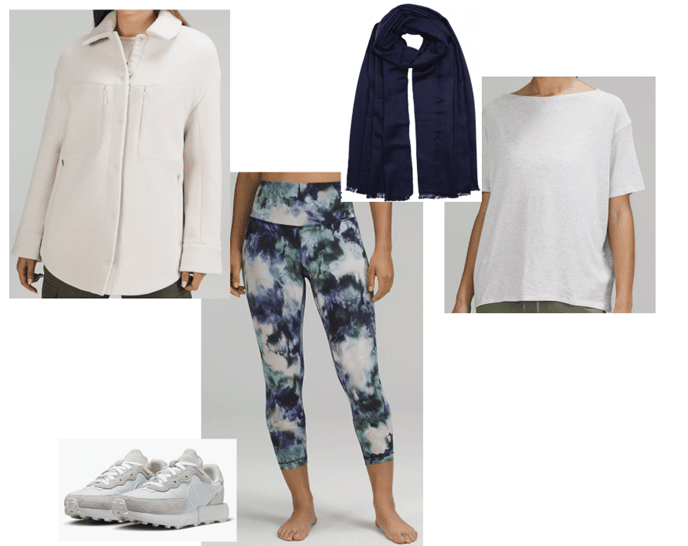
Tie-Dye Dreams

Tie-Dye Dreams

These fun tie-dye cropped leggings from Lululemon look great with a white t-shirt and navy accessories. Remember to purchase your leggings in the proper size, even size up if necessary. Nothing is more uncomfortable than leggings that are too small.

iniber High Waisted Yoga Pants with Pockets

Love Curved-Hem Crewneck T-Shirt

Always Effortless Classic-Fit Jacket

Nike AL8 Runners

M&S Ombre Pleated Scarf

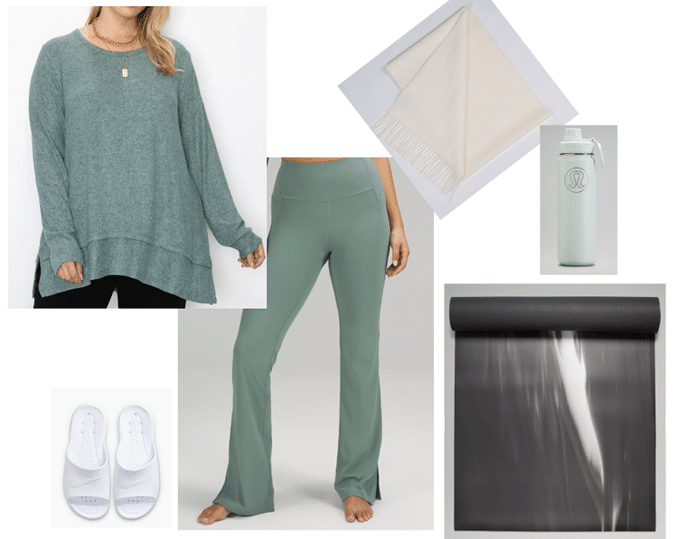
Soft Moss

Soft Moss

Matching your top and bottom creates a softer look and may make you look taller. Moss green is a relaxing and soothing color and is great for retreats or yoga practices. Here the top is heathered and the bottom is solid, creating a textured look.

Wunder Under SmoothCover High-Rise Bootcut Pant 34″

Under Armor Twist Tech V-Neck Short-Sleeve Top

Nike Victori One Slider

Back to Life Sport Bottle 24oz

The 5mm Mat Made With FSC-Certified Rubber

Alpaca Collections Eco Boucle Baby Alpaca & Silk Scarf

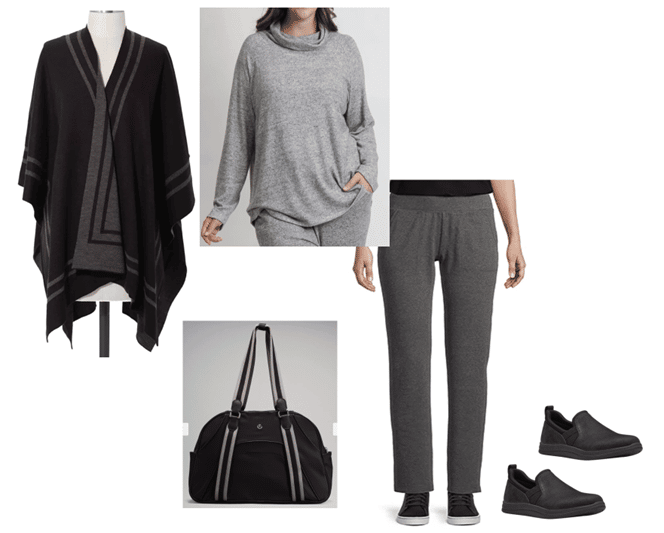
Casual Black & Gray

Casual Black & Gray

You can never go wrong with a black & gray outfit. Heather gray is synonymous with relaxed and casual. Ruanas (or open-front ponchos) look great, are super easy to wear, and are an excellent choice for a retreat.

Textured Knit Ruana

ID Ideology Plus Size Essentials Long Sleeve T-Shirt, Created for Macy’s

St. John’s Bay Workout Pant

Clarks Cloudsteppers Breeze Bali Slip-On Shoe

Daily Multi-Pocket Tote Bag 20L

What Should You Avoid Wearing at a Retreat?

Packing for a retreat isn’t about impressing anyone; it’s about creating ease for yourself and respect for the shared space. Here are a few things best left out of your retreat bag:

Restrictive or Tight Clothing

Whether you’re sitting cross-legged on a cushion, stretching into a yoga pose, or simply lounging in a group circle, tight waistbands or structured fabrics can become uncomfortable quickly. Choose pieces that move with you, not against you. Even jeans, unless they’re ultra-soft, can start to feel constrictive during long periods of stillness or movement.

Noisy Fabrics

That stylish windbreaker or swishy track pant may work at home, but in a quiet meditation room, every rustle can be distracting. Opt for soft, silent materials like cotton, modal, bamboo, or jersey that won’t draw attention every time you shift positions.

Strong Perfumes or Fragrances

Many retreats, especially those focused on mindfulness or healing, have fragrance-free policies. Even light perfumes or scented lotions can be overwhelming in shared, enclosed spaces and may trigger allergies or sensitivities in others. It’s best to stick with unscented skincare and hair products while you’re there.

Read more: 100% Fragrance-Free Hair Product Brands for Women Over 50

Flashy Jewelry or Accessories

Dangling earrings or clunky bangles can be noisy and visually out of place in a setting designed for calm and presence. A simple pair of studs or a meaningful pendant may be fine, but leave the statement pieces at home. Minimalism tends to match the tone of most retreat environments.

Busy Patterns or Loud Logos

While there’s no need to dress in head-to-toe neutrals, overly bold prints or large brand logos can feel jarring in a group aiming for inner quiet. Choose soft colors and gentle patterns that won’t dominate the room.

High Heels or Hard-Sole Shoes

You’ll likely be walking between sessions or practicing grounding activities like walking meditation. Loud, clunky shoes can be distracting and uncomfortable. Bring slip-on sneakers, soft-soled flats, or supportive sandals instead.

Keeping your wardrobe simple and mindful not only enhances your own comfort, but it also supports the peaceful atmosphere your fellow retreat-goers are seeking.

Read more: Casual Outfits for Women Over 60 That Don’t Sacrifice Style.

Let’s Have a Conversation:

Are you going to a retreat soon? What type of retreat do you prefer? What will you be packing in your bag? Tell us about it in the comments below.

Read More

Want to Write Your Legacy Story? Here Are 3 Easy Steps to Get Started Today

legacy story

Does crafting your legacy story sound daunting? It doesn’t have to be. I’ll share a few ideas for starting small! Whatever you create will be a gift to your family, your friends and, most importantly, to you.

My mother didn’t like to talk about her past. When she died, the memories of her experiences and the lessons she had gained from life died with her.

I wish I’d asked more questions years ago before dementia crept in and leached away part of her formerly intelligent, engaged mind. Even a little bit of her legacy, written down, would be a treasure today.

Don’t Wait to Write Your Legacy Story

You may be thinking, “But, I’m going to be around for a while,” and I certainly hope that you will be. But life comes with no promises.

And part of the magic of working on your legacy story is that it can prepare you to make the most of the life still ahead of you.

If the word legacy sounds intimidating, don’t make it so big. Tell yourself, “I’m just drafting a letter to myself that I might share with a friend.”

Starting on your legacy story can help you:

  • Embrace how much you’ve learned from life.
  • Offer a gift of your learning, experience and values to others.
  • Tell someone how much they have meant to you and give a blessing.
  • Recognize what’s most important as you navigate the road ahead.
  • Get a million dollars for the screen rights. (OK, this may be hopeful… but you might make a digital legacy story that mixes photos and words or have someone help you record a short video.)

Writing Is a Small Gift to Others

Imagine what it would be like if you had a letter from a favorite aunt or friend offering a story from her life and a few truths she’d learned along the way. Chances are, you’d treasure it forever.

As you start out writing, don’t try to be comprehensive. We’re not talking memoir or trying to sustain a coherent narrative across dozens of pages. Let’s start small, with one specific memory, vignette or scene you remember.

In a podcast interview, storyteller and counselor Juliet Bruce suggests:

“Ask a person not to remember, not to talk in generalities, but to ask story questions about their lives. ‘What was your wedding day like? What music played around the birth of your child?’ Get people into their senses, their sense memories, and whole beautiful stories of decades emerge.”

Try to Be Specific

Think about one memory, event or scene. Write for a few minutes. That’s all. If you want to send it to a friend or family member you can add how much they mean to you or a blessing.

As you become more fluent writing up memories, you can reach out to someone with whom you’d like to reconcile. Share about a good experience with them, and then offer a short apology for your part in any misunderstanding you might have had.

You may not fix the past, but your whole-hearted blessing to another could open the door to a renewed relationship. It’s not too late to try!

Writing Is a Small Gift to Yourself

We often think of a legacy story as one that is passed down to another generation. But that’s not all it can be. You can write for your eyes only, acknowledging choices you made and discovering your own meanings from life events.

  • What different paths have you followed?
  • What twists in the road have brought you to where you are today?
  • Who have you loved?
  • Where have you visited?
  • What has your family given you?
  • What successes have you had and what mistakes have you learned from?
  • What values do you see underpinning your life?
  • What threads or themes have been with you throughout your life?

Don’t judge, just notice and appreciate as you would the life of a beloved friend.

A good friend of mine wrote her legacy story in the form of a metaphoric legend, using the archetype of the “Hero’s Journey” as background to her work.

She wrote about her calling, challenges, events and people she met along the way. She described the monsters and muses who had accompanied her. She discovered a few themes that traversed her varied experiences.

Most of all, she had fun with it. Then she shared it with her family and friends. Her story helped launch engaging conversations, and she gained some creative insights about the future she hoped to create.

How to Get Started with Stories

Here’s one way NOT to start: don’t ask, “What’s my legacy story?” That question is too big and vague. That’s why it’s more useful to start with memories of specific incidents and people who have moved you.

Your heart is a better storyteller than your head working alone. You want to engage your feelings and senses rather than your editorial brain – the one that likes to polish and puff up a ‘good story’ about your life.

While you may have a sleek version of a story you’ve used for job interviews – or when someone actually listens to you for more than five minutes at a party or networking event – your legacy doesn’t need shine.

Your life, as you have lived it, is plenty interesting without extra gloss. In fact, part of what makes your legacy story interesting is finding out where you have a few warts hidden, and how you may have screwed up, fallen (metaphorically), skinned your knee and recovered.

Juliet Bruce, mentioned above, uses the Hero’s Journey formula of challenge and redemption in working with clients.

She said, “Using the Hero’s Journey paradigm people find that their lives were not a waste, in fact, they were very beautiful lives no matter how ordinary they were. They made choices that were the best choices they could make in the moment. They endured, they carried on, and they made it to this age.”

That’s what your legacy story can do for you: reveal what is fundamental and good about you and help you celebrate that whatever mistakes you made, you lived a life of dignity and worth.

Just remember, don’t wait. Your story matters – and there’s someone longing to hear more about it… That person might even be you!

Let’s Have a Conversation:

What do you think about writing your legacy story? Have you started on such a project? If so, what are the highlights so far? If not, what’s holding you back from making a start? Please share your thoughts in the comments below.

Read More