Author: Admin01

Brave in a New World: Dealing with Grief and Recovering from Loss

Dealing with Grief

The loss of a mother at a rather early age was very traumatic.

At 17, this is the time you need love, guidance and direction about life and you do not know who to trust. So you must learn to trust yourself and your instincts and in your life decisions – good, bad, right or wrong.

It took me 20 years to get through the grief of the loss of my mother. During this time, I learned to laugh to keep from crying.

I would say that grieving is a very individual process and people need to do whatever works best for them. You must first understand that you have had a loss and that grieving is part of the process. Eventually, one will find that they gain a certain amount of independence and a different identity as a result.

I don’t think that there’s a limit as to how long one should grieve. Each situation is different, but it is important to allow yourself to grieve. No one ever imposed a timetable on my grieving process, but maybe that’s because I never took the time out to actually grieve the loss of my mother.

Dealing With Grief After 60: How to Regain Hope After a Loss

There is a saying that time heals all wounds, but I believe that time alone doesn’t heal anything, it’s what you do with the time that will help you to heal. Time is one of those constants in our lives, but it is an intangible. We cannot see it, hear it, touch it or smell it, but we trust that it is there with us every step of the way. It is not unlike our shadow: always with us.

Time pushes us forward whether we like it or not. We cannot pause it even though when we are grieving, there are many times we will long to do that – just to give ourselves a breather, some relief from the excruciating pain of grief and loss.

Could This Go On Forever?

Initially, after loss, we do not see time as our friend. We may wonder how long we will feel numb, depressed, anguished and in a fog. Could this go on forever? Will there ever be a time when we will feel relief from this aching despair?

But time gives us an opportunity to go through a natural healing process. We pass through invisible stages as we move forward. Sometimes, you might feel like you have a handle on your grief and then a song or a picture, or seeing someone who looks like the one you’ve lost will trigger a deep and abiding sadness. You might even begin to feel that you’ve taken ten steps backwards.

A “New Normal”

However, as time goes on, comfort will come with clarity of mind. As you begin to be able to think more clearly, staying focused on your recovery, you will find that you’re enjoying life more and not just being numb in it. You will eventually begin to get beyond the sad thoughts and embrace your “new normal” as you begin to reawaken and look at life in fresh new ways. Learn more about life after loss here.

One aspect of my recovery, which helped me to move forward, was the fact that I had a diverse community of friends. I had friends of various ages from many cultural backgrounds, and I found this to be critical to my recovery. Because I had managed to cultivate different friendships over the years, I didn’t find myself stuck in place, trying to construct a social life. I’d had one all along that I could now tap into when I needed it the most.

My longtime friends were there with support and love, while my newer friends provided opportunities for me to get out and have fun. Many were full of energy and offered fresh ideas which allowed me to not feel like a dinosaur in the 21st century. I learned from them as they supported me.

Life After Death

I soon began to see that small flicker of light at the end of the tunnel become larger. Without my noticing, I had begun to feel less numb and more alive. It was a gradual process, but at some point, I began to feel more and more sanguine. In fact, the emptiness I had felt had now become a place of hope and an opportunity to create a new path or “thing” in my life as I began to believe that there could be “life after death.”

The key here is to never give up on yourself. I never gave up on the fact that I could get through the sadness, the crying, the mourning, and the hollow feelings. I could experience life without my life being tinged by sadness. This took many, many, months and years to achieve, but I did it and you can too.

A year or so after my husband passed away, a former colleague of mine lost her husband suddenly. I stopped in to pay my respects and she asked how I’d gotten from the early stages of grief to the present. I told her that I started mourning right away. She wanted to know what she could expect. I asked her how she felt at that moment, just hours since her husband had passed. She said she felt numb, and my reply was that this was stage one.

So here was a woman who was about to grieve consciously, like me. Doing so doesn’t necessarily lessen the grieving time; it just keeps you aware as you begin the grieving journey. When there is that flicker of light at the end of your grief tunnel, you will recognize that as hope.

Have you had to deal with grief or a loss in your life recently? When did you begin to feel hopeful? How has life changed for you since your loss? What is your new normal? What new things have you discovered about yourself since your loss? Please share in the comments below.

Read More
Make Stretching a Part of Your Daily Routine: Your Mature Body Will Thank You!

Stretching-Daily-Routine-Mature-Body

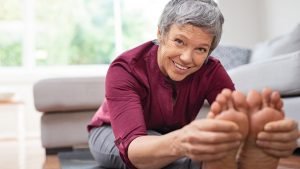
Do you remember doing calisthenics in your gym class? You might recall the part where you had to try to touch your toes by bending over from a standing position or while sitting on the floor with your legs extended.

You probably did these stretches at or close to the start of the class or after playing field hockey or some other sport.

The theory behind all that stretching was that it was a good way to avoid muscle cramps or pain after exercise. In reality, stretching to maintain or increase your flexibility as you enter your 60s and beyond is very important for your health.

This is true whether or not you regularly exercise. Many boomers make it a point to try and walk 10,000 steps a day or eat healthier foods but ignore stretching.

Stretching to maintain flexibility is especially important for boomers since joint flexibility tends to decrease as you age. There is some evidence that after 71 men show an accelerated decline in both upper and lower bodies, while women tend to have a constant rate of decline in the lower body.

How much of a decline are you looking at? Well, flexibility may decline by up to 50 percent in some joints. Since the decrease is very gradual, you may not even notice it until you need to do something that requires good flexibility such as bending over to pick up something you dropped.

The Benefits of Stretching and Staying Flexible

The first thing to keep in mind is that good flexibility is necessary for almost all your daily activities – from the most mundane, such as getting out of bed and self-care, to more complicated tasks such driving and dancing.

For example, some flexibility is required when you reach for something on a high shelf or turn the steering wheel. If you’re not flexible, both of these everyday tasks could be challenging and even threaten your ability to live independently.

Another very important benefit of stretching and staying flexible is the reduction of falls. Stretching may help with balance. After the age of 60, the number of falls tends to increase. In fact, falls are responsible for a high rate of disability and even death if you are over 65 years old.

With almost 70 percent of falls resulting in death among boomers, it’s important to do whatever you can to not become a member of this group!

Other benefits of stretching and flexibility include:

  • Increased blood flow, which can help you better control your blood pressure;
  • Reduced muscle tension, which can help you feel less tense and stressed;
  • Better muscle coordination;
  • Higher energy levels;
  • Improved mood by aiding the release of “feel good” endorphins;
  • Improved posture which can help reduce back and arthritis pain.

Stretching 101

Even though healthcare professionals recommend stretching every day, if you’ve not done any stretching for a while, your best bet is to ease into it by starting slowly. A couple of times a week is a good start.

Also, be sure to talk with your doctor to ensure that you’re in good enough health and shape to start including stretches in your daily routine. Actually, this is also a good idea for any physical activity you may be thinking about.

Before you begin, you need to know that there are two kinds of stretching. One is called dynamic since you’re using movement to stretch your muscles. Some examples of this type of stretching are swinging your arms, doing shoulder circles, and swinging your legs or doing half squats.

The other form of stretching is called static, because you are not moving any body parts at all. You basically ease into the stretch and hold it for 30 seconds or so while breathing.

Good examples of this kind of stretching are touching your toes to stretch your back and crossing one leg over the other leg’s thigh to stretch your hips. Be sure to warm up before doing static stretching. Some walking in place – or around the block – is good for this.

If you enjoy spending time with like-minded people, consider participating in classes that focus on flexibility. These include yoga, Pilates, Tai Chi, and even walking. You can improve your flexibility and make new friends at the same time.

Nutrition and Flexibility

You can enhance your flexibility and ability to do stretching exercises by making sure your body is getting enough of the right nutrients.

Stretching involves your joints, bones, and muscles, so it makes sense to eat foods that have the vitamins, minerals, and other nutrients they need to function at their best. Include the following in your diet as a complement to your stretching:

Plenty of Water to Keep Hydrated

Set a goal of at least eight glasses of water a day and keep it handy when you do your stretching and other exercises. Water helps to lubricate your joints and helps nutrients get where they need to be in your body.

Foods with Anti-Inflammatory Properties

Anti-inflammatory foods include:

  • green leafy vegetables such as collard greens, spinach, and kale;
  • nuts, such as almonds and walnuts;
  • fish, especially salmon and tuna;
  • fruits, including berries, oranges, and cherries;
  • spices, including cinnamon, ginger, and turmeric.

Foods That Support Connective Tissue

Don’t undermine the importance of foods that help maintain your bones as well those that promote collagen production such as fish, red, green, and orange vegetables, berries and garlic.

By watching your diet and adding stretching exercises to your daily routine, you can help ensure that you enjoy good flexibility and all its benefits at any age.

How often do you stretch and what kind of stretches do you do? What kinds of benefits have you experienced as a result of stretching? If you don’t stretch, have you thought about it or is there a reason you don’t? Tell us all about it. Please join the conversation.

Disclaimer: This article is not intended to provide medical advice. Please consult with your doctor to get specific medical advice for your situation.

Read More

Are Your Hands Aging You? 4 Simple Ways to Reverse the Clock

aging hands

Few body parts go about revealing your age quite like your hands, and while one glance at them can make you fondly reflect on all the hard work, family-raising, and adventuring you have done in your life, they can also be a source of regret or pain.

Don’t miss this quick guide to understanding how and why your hands age and what you can do to turn back the clock.

Why Do Hands Change as You Get Older?

In addition to the natural wear and tear your hands experience over the decades, other factors can change the look of your hands as you age:

  • Sun exposure can result in sun spots, also called “liver spots,” on your hands and arms.
  • Your skin finds it harder to lock in moisture when you get older which can contribute to wrinkles, dry, flaky patches, and a loss in elasticity.
  • As your soft tissue volume reduces with age, including collagen and fat in your hands, your veins and bones naturally become more prominent. Your hands are one of the most visible places where this happens.
  • Your nail bed doesn’t hold your nail plate as strongly as it once did which can lead to an increase in nail brittleness and breakage.

Other changes in your hands that you may experience over 60 include decreased grip strength, tremors, joint inflammation, and pain (typically associated with arthritis).

Dark bruising may also more readily occur on your hands as you age, even from a small impact, because your skin is thinner or if you take blood-thinning medications like aspirin.

Luckily, there are plenty of steps you can take to improve both your hand function and appearance!

What Can Make My Hands Stronger?

Want to make sure you don’t have any problem opening jars, texting, driving, or tossing the ball with your grandkids as you get older? Then work at making your hands and forearms stronger now.

You can use simple tools like stress balls, grip strengtheners, even tennis balls to squeeze to the tone and strength you need in your hands and arms. Hobbies like knitting, sewing, crocheting, playing musical instruments, and cooking can also help you maintain strength and dexterity in your hands.

If you experience any pain in your hands and wrists as a result of using them, check with your doctor to make sure there isn’t a more serious underlying cause.

Sometimes your hands can simply get sore from overuse. Chronic pain and discomfort that could affect your independence, however, should be addressed sooner rather than later.

What Can Make My Hands Look Younger?

Turn back the clock and prevent future damage to your hands with these helpful ideas:

Wear Sunscreen

The American Academy of Dermatology Association shares that applying sunscreen to your hands every day can help prevent excessive wrinkling later on.

Your hands get more sun than you realize, especially when you are driving. Get into the habit of applying sunscreen (SPF 30 or higher) when you head out of the house and save yourself from unsightly sun spots later in life.

Moisturize

In addition to staying adequately hydrated yourself, make sure your skin gets all the moisture it needs to retain its youthful elasticity and prevent dryness or wrinkling. Applying lotions before bed with retinol or glycolic acid in them may help address wrinkles you currently have on your hands too.

Protect Your Hands

Cleaning, gardening, working outside… your hands come into contact with not just the sun but harsh chemicals that can strip your skin of its natural oils.

Make sure to wear gloves, preferably with a breathable cotton lining, to protect the skin on your hands from damage that could take long time to repair.

Eat for Your Skin and Nails

Consume a balanced diet rich with nutrients that support healthy skin and nails as you age, like Omega-3s, B vitamins (including B7 – biotin), vitamin C, antioxidants, and protein.

If you have existing sun spots, super prominent veins, or mild joint deformity, talk to your doctor or dermatologist about conventional treatments like chemical peels, laser treatments, and filler injections.

These could both improve the look of your hands as well as make you feel more confident and functional.

What changes have you noticed in your hands after age 50? What steps do you take to prevent sun spots and wrinkles on your hands? Please share below!

Read More

Ariana Madix’s Snake Print Top

Ariana Madix’s Snake Print Top on Instagram

Vanderpump Rules Instagram Fashion 2020

Ariana Madix’s snake print top on Instagram is not only super cute with it’s multicolour pattern, puff shoulders and button front, but will cost you less than $100. That is only if you click “add to bag” on this one, because we have a feeling that like what appears to be the case with Ariana, the polka dot version may just slither it’s way in there too.

Fashionably,

Faryn

Ariana Madix’s Snake Print Top

Ariana Madix’s Polka Dot Top

Click Here to Shop Her AFRM Bodysuit in Snake Print or Polka Dot

Photo #1: @DanicaDowww

Photo #2: @SarahElizaOfficial

Originally posted at: Ariana Madix’s Snake Print Top

Read More

Kenya Moore’s Tuxedo Jumpsuit

Kenya Moore’s Tuxedo Jumpsuit on Watch What Happens Live

Watch What Happens Live February 17, 2020 Fashion

Kenya Moore’s tuxedo jumpsuit on Watch What Happens Live is yet another one piece that the Atlanta beauty has worn on this show that costs a pretty penny. While the last one she wore cost $2600 and this one is one sale for a little over 1k, which I’m sure you rich b*tches will be happy to hear. As for the rest of us, there are some amazing Style Stealers that will leave us looking clubhouse chic for far less cash.

The Realest Housewife,

Big Blonde Hair

Kenya Moore's Tuxedo Jumpsuit

Click Here to Shop her Galvan Jumpsuit

Originally posted at: Kenya Moore’s Tuxedo Jumpsuit

Read More