Hair care

Latest

Why You Should Commit to the Carry-On and Tips for Making it Easy

Why You Should Commit to the Carry-On and Tips for Making it Easy

The world is divided into two different kinds of people: overpackers and underpackers. If you fall into the first category, don’t turn away yet! Give me a few minutes to try and convince you that there is a better way to travel.

As you might already suspect, I am an underpacker. My measure of a packing fail: Coming home with even one thing in my suitcase that I did not need, use or wear during my trip. I do fail sometimes, but not often anymore.

Here’s how to pack lighter – all lessons I learned the hard way.

Start with an Attitude Change

It helps that I don’t really care how I look. I don’t mean I would travel in ripped or dirty clothes. But I don’t need to be the glammed up center of attention. In fact, when you’re traveling, the more you can blend in, the better. You’re less likely to be targeted by pickpockets and local scammers.

Spend a little time researching what the locals wear and try to pack like that. This is the lesson I learned when I wore my electric blue winter coat to Romania, a former Soviet block country where there were two colors of winter coat: grey and black.

So if you simply must be a fashion plate, try to pare down the clothes to a capsule wardrobe of items you can mix and match and pieces that will do double duty.

Use a Packing List

These printable packing lists will give you a feel for the things you’ll need. If the list includes something you don’t think you’ll need, don’t pack it. If there is something missing, make a note on the printed sheet so you don’t forget it.

Check the Weather Forecast

I make this recommendation because I live in Chicago. We like to say, “If you don’t like the weather, wait 10 minutes.” Here, the calendar might say May, but the thermometer might say March. Or July.

So check the forecast for your destination. It will tell you whether to pack a raincoat, sunhat, shorts, or sweaters.

Start Packing Early

If you have a spare bed, room, couch or some other spot to hold the things you want to pack, start a week early and put everything on the bed that you think you might want on your trip.

Then walk away.

Come back the next day and look it over. Is there anything missing? Is there anything you think you might not need on the trip? Make adjustments accordingly.

Then walk away.

Come back the next day with the intention of making choices. If you have two pairs of pants on the bed, take away one pair. If you have four shirts, take away two. And so on, until you have cut in half the things on the bed.

Then walk away.

The next day, it’s time to pack. Start with the pieces of clothing you absolutely MUST have with you.

If you run out of suitcase before you run out of clothes to pack, you get to make a choice: Leave something else behind or pay $40 or more to check a bag.

Buy Packing Cubes

I resisted buying this travel essential for years. Now I can’t believe I ever traveled without them.

Packing cubes are flexible pouches with a brilliant zipper system. You pack them with the clothes you want to take, and zip them shut. Then – this is the brilliant part – you zip a second zipper to compress the insides flat. (Think of it like your expandable suitcase, when you open that second zipper, it gives you an extra inch or two of suitcase space. When you zip it shut, everything inside is compressed.)

As a bonus, the clothes you lay inside the packing cube are much more likely to stay wrinkle free. I don’t know why. But it’s true.

Stick with One Basic Color

When I head to a Caribbean resort, that color will be white. But most of the time, it’s black – black pants, a black skirt, a black dress. Then I add color in the tops I will wear with the pants and skirt. Finally, I pack a few scarves and funky costume jewelry to dress everything up or down and add more color.

Wear the Heavy Stuff on the Plane

There are plenty of TikTokers and travel hacker influencers who will tell you to wear layers and layers on the plane to save suitcase space. Or to pack a pillowcase with your stuff and pretend it’s a pillow, not a suitcase, so it doesn’t count as a carryon.

While that might be useful info for travelers on uber-budget airlines that charge for anything that doesn’t fit under your seat, you really don’t have to go that crazy. Just use a little common sense.

If, for example, you’re flying from Florida to Colorado, you know you’ll need your winter coat, hat, gloves, hiking boots and heavy jeans. Wear the jeans and hiking boots on the plane, stuff the hat and gloves in the coat pockets and carry the coat on the plane rather than packing it in a suitcase.

I do this anyway because I’m always chilly on a plane. I’m always surprised when I see someone boarding a flight in shorts and flip flops. I would be blue by the time I landed!

Think Layers, Not Bulk

Thin layers are always the right answer, no matter where you are. Even a Caribbean vacation requires preparing for chilly evenings or overly air-conditioned restaurants. Layers are the answer to staying warm and packing light.

Make the Best Use of Your Under-Seat Bag

Finally, remember that you get not one, but two things to carry onto the plane – a bag that goes into the overhead and a smaller bag that fits under the seat in front of you.

Don’t waste the space in that second bag!

My go-to is a roomy backpack because I travel with a lot of electronics – laptop, Kindle, phone, ear buds and all of the cords and accessories they require. But those only take up two zippered compartments. That leaves two more compartments for other things – makeup bag, an extra pair of shoes, etc.

The other thing that works for me is a big striped bag that is super flexible. I can cram a lot into it and still stuff it under the seat. The downside of that is it is heavy to carry, unlike my backpack which easily distributes the weight across my shoulders.

Practice, Practice, Practice

I know. This isn’t easy. Especially if you’ve always been an overpacker. But practice will make perfect. Try it on your next quick weekend trip. That will give you a chance to see how it feels to only pack what you’ll need for 2-3 days, how much you like being able to lift that light carry-on bag and how happy you are not worrying about whether your suitcase will show up at the other end of your flight.

Just remember to pack one more thing: a credit card. That way, if you find you truly can’t live without something for a few days, you can head to the store to buy it.

Let’s Have a Conversation:

Are you an overpacker or an underpacker? What’s your favorite packing hack? Share with us in the comment section below.


Uncategorised

Latest

Rachel Zoe’s Black Cutout One Shoulder Dress

Rachel Zoe’s Black Cutout One Shoulder Dress / Real Housewives of Beverly Hills Instagram Fashion July 2026

Whatever Rachel Zoe wears I’m automatically searching the internet for it and/or also something similar. And thankfully we found both for this black cutout one shoulder dress that she shared on IG stories recently. Because a dress like this is always a must-have Cult classic. 

Sincerely Stylish,

Jess


Rachel Zoe's Black Cutout One Shoulder Dress

Photo + Info: @rachelzoe


Style Stealers

!function(d,s,id){ var e, p = /^http:/.test(d.location) ? 'http' : 'https'; if(!d.getElementById(id)) { e = d.createElement(s); e.id = id; e.src = p + '://widgets.rewardstyle.com/js/shopthepost.js'; d.body.appendChild(e); } if(typeof window.__stp === 'object') if(d.readyState === 'complete') { window.__stp.init(); } }(document, 'script', 'shopthepost-script');
Turn on your JavaScript to view content


Originally posted at: Rachel Zoe’s Black Cutout One Shoulder Dress

Skin Care

Latest

How to Make Your Own Essential Oil Blend for Mature Skin (Recipe)

A Basic Essential Oil Blend for Everyday Mature Skin Care

With all the wonderful natural facial serums on the market today, it can be a little overwhelming choosing the correct formula with safe, non-toxic ingredients, all at a reasonable price. The good news is that it’s easy and fun to make a quality product on your own using the miracle of nature – essential oils. 

When I started working with skincare formulas in 2003, one of the first products I was excited about making was an essential oil-based facial serum. My skin needs were changing, and a moisturizing oil made perfect sense for dry, maturing skin.

I decided to work with four wonderful healthy aging essential oils I had discovered: Lavender, Frankincense, Rose Geranium, and Carrot Seed.

The natural and highly effective nature of essential oils makes them perfect for skincare. When blended for their various properties and used with a carrier oil that matches your skin type, you can create a serum tailor-made for your skin.

What Are Essential Oils?

Essential oils are the essence of plants. Hidden away in many parts of the plant, like the flowers, seeds, and roots, they are very potent chemical compounds. They can give the plant its scent, protect it from harsh conditions, and help with pollination.

The benefits of essential oils on humans are diverse and amazing. Lavender flower oil, for example, contains compounds that help soothe skin irritation and redness, while the scent reduces feelings of anxiety and stress.

The beautiful Rose essential oil is hydrating to the skin and sometimes used to treat scarring, while the scent is known to help lift depression. 

There are many essential oils to choose from for specific skincare needs. I have used a myriad of different combinations but keep coming back to the tried and true blend from my very first serum.

The four essential oils used are the workhorses of skincare for mature skin, as well as being wonderfully uplifting for mind, body, and spirit. 

The Base Oil Blend Formula

Here’s what you’ll need:

Bottle

1 oz. amber dropper bottle. You can find those in pharmacies or online.

Base (Carrier) Oil

As a base, you can use one of the oils below or a combination of several that meet your skin’s needs:

  • Jojoba oil is my base oil of choice. It’s incredible for most skin types: it’s extremely gentle and non-irritating for sensitive skin, moisturizing for dry skin, balancing for oily skin, ideal for combination skin, and offers a barrier of protection from environmental stressors. It also helps skin glow as it delivers deep hydration.
  • Rosehip oil smooths the skin’s texture and calms redness and irritation.
  • Argan oil contains high levels of vitamin E and absorbs thoroughly into the skin leaving little oily residue.
  • Avocado oil is effective at treating age spots and sun damage, as well as helping to soothe inflammatory conditions such as blemishes and eczema.
  • Olive oil is a heavier oil and the perfect choice if your skin needs a mega-dose of hydration. Just be aware that olive oil takes longer to absorb and leaves the skin with an oily feeling. This may be desirable for extremely dry, red, itchy skin.

Essential Oils

  • Lavender essential oil is very versatile and healing. It helps reduce inflammation, kill bacteria, and clear pores. Its scent is also calming and soothing.
  • Frankincense essential oil helps to tone and strengthen mature skin in addition to fighting bacteria and balancing oil production.
  • Rose Geranium essential oil helps tighten the skin by reducing the appearance of fine lines, helps reduce inflammation and fight redness, and offers anti-bacterial benefits to help fight the occasional breakout. The scent is also known to be soothing and balancing.
  • Carrot seed oil is a fantastic essential oil for combination skin. It helps even the skin tone while reducing inflammation and increasing water retention.

The Recipe

Let’s start with a simple recipe:

  • 1 oz. Jojoba oil (or carrier oil of your choice)
  • 10 drops Lavender
  • 10 drops Frankincense
  • 10 drops Rose Geranium
  • 10 drops Carrot seed oil 

Place the essential oil drops in the amber dropper bottle then fill with Jojoba/carrier oil. It’s that simple!

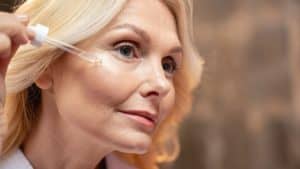
Applying Your Homemade Serum

Use this serum morning and evening as part of your regular skincare routine. Serums work best when applied after cleansing your face. You can cleanse with Coconut Oil or a mixture of oils for enhanced hydration (we will cover this in the next article) or use your regular facial cleanser.

Essential oils will not interfere in any way with your normal skincare products.

Keep in mind that the serum is concentrated. Use only a pea-sized amount, work it into your fingertips, and apply evenly over the face without tugging or pulling.

If your skin feels tacky, reduce the amount on the next application. Your skin should feel soft, not oily. Follow with your regular moisturizer if you like. 

Making your own facial serum is fun and rewarding! I look forward to hearing your thoughts and ideas on essential oils and making personalized serums and skincare.

What facial serum do you use? Have you made one yourself? What is your favorite essential oil for skin care? Please share your thoughts with our community!

Rachel Zoe’s Black Cutout One Shoulder Dress

Rachel Zoe’s Black Cutout One Shoulder Dress / Real Housewives of Beverly Hills Instagram Fashion July 2026

Whatever Rachel Zoe wears I’m automatically searching the internet for it and/or also something similar. And thankfully we found both for this black cutout one shoulder dress that she shared on IG stories recently. Because a dress like this is always a must-have Cult classic. 

Sincerely Stylish,

Jess


Rachel Zoe's Black Cutout One Shoulder Dress

Photo + Info: @rachelzoe


Style Stealers

!function(d,s,id){
var e, p = /^http:/.test(d.location) ? ‘http’ : ‘https’;
if(!d.getElementById(id)) {
e = d.createElement(s);
e.id = id;
e.src = p + ‘://widgets.rewardstyle.com/js/shopthepost.js’;
d.body.appendChild(e);
}
if(typeof window.__stp === ‘object’) if(d.readyState === ‘complete’) {
window.__stp.init();
}
}(document, ‘script’, ‘shopthepost-script’);


Turn on your JavaScript to view content


Originally posted at: Rachel Zoe’s Black Cutout One Shoulder Dress

Read More

Melissa Gorga’s Crystal Embellished Mini Dress

Melissa Gorga’s Crystal Embellished Mini Dress / Real Housewives of New Jersey Instagram Fashion July 2026

This is going to be an easy post for me to write because all I have to say is that we’ve seen this crystal embellished mini dress three different times now on some of our Bravo babes. First on Alicia Carmody, then on Ariana Madix, and now we’re seeing it on Melissa Gorga. So you know the drill….. 

Sincerely Stylish,

Jess


Also Seen on Ariana Madix

Ariana Madix's Silver Crystal Studded Dress on Love Island USA Season 8 Episode 1

and Alicia Carmody

Alicia Carmody's Crystal Embellished Dress on WWHL
Melissa Gorga's Crystal Embellished Mini Dress

Click Here to Shop Additional Stock

Melissa Photo: @melissagorga / Ariana Photo: @loveislandusa / Alicia Photo: @bravowwhl


Style Stealers

!function(d,s,id){
var e, p = /^http:/.test(d.location) ? ‘http’ : ‘https’;
if(!d.getElementById(id)) {
e = d.createElement(s);
e.id = id;
e.src = p + ‘://widgets.rewardstyle.com/js/shopthepost.js’;
d.body.appendChild(e);
}
if(typeof window.__stp === ‘object’) if(d.readyState === ‘complete’) {
window.__stp.init();
}
}(document, ‘script’, ‘shopthepost-script’);


Turn on your JavaScript to view content


Originally posted at: Melissa Gorga’s Crystal Embellished Mini Dress

Read More

The Four Agreements in Dating: A Mindset Makeover

The Four Agreements in Dating A Mindset Makeover

During more than a decade of online dating, I got some valuable help through regular visits with a therapist. During those visits she recommended some books to help me cope with the stresses of online dating, of which there were many! One of those books was The Four Agreements by Don Miguel Ruiz. It focuses on four simple yet powerful agreements to live by.

The agreements are with yourself. These agreements helped me tremendously as I applied them to my online dating.

The First Agreement

Online dating, especially in the beginning, can leave you with a dizzying array of thoughts swirling in your head. All the choices can be confusing and exhausting. The first agreement provided me with a pathway to sorting through all those thoughts. Focusing on clear and honest communication helped me direct my energy in a useful and productive way.

The First Agreement says, “Be impeccable with your word. Speak with integrity. Say only what you mean. Avoid using the word to speak against yourself or to gossip about others. Use the power of your word in the direction of truth and love.”

I found this agreement helpful in both written communication and in face-to-face interactions. I was honest with others about myself, especially about some financial struggles that I was facing. The reaction I got told me a lot about the other person, whether they responded with kindness and compassion or judgment and criticism about my problems.

Also, I never bad-mouthed my ex-husband, and when I heard others speaking horribly about their exes or family members, that was my cue to say good-bye. I encountered many men whom I would call “Bitter Bob.” These were men who were generally angry about their ex and how their divorce went down. They were all too eager to criticize their ex. Bye-bye Bitter Bob!

I also met many “Mean Ones,” “Bullies,” and “Harassers” while riding the online dating rollercoaster. None of them came even close to being impeccable with their word. They were all too eager to spout hateful rhetoric. As soon as I heard their negative talk, I would say, ‘So long!’ As my mother would often say, “Good-bye to bad rubbish!”

As I stayed true to my word and to the agreement, it became easier and easier to spot the bad ones and walk away. As time went on, I became less tolerant with those who spoke negatively about others by complaining or criticizing. Of course, if I caught someone in a lie or suspected they were lying, that would also be my signal to say good-bye.

I slowly broke the habit of constantly giving people the benefit of the doubt. I’d move on quickly. I tried hard to love myself and not judge myself for my mistakes or inadequacies. I strove to find peace and happiness in my life by being honest and impeccable in my words and actions. I wanted to find another with the same mindset.

The Second Agreement

The Second Agreement says don’t take anything personally. This was so important for me to keep in mind when I’d meet the rude, lewd, and otherwise distasteful ones, such as those that ghosted me, or the haters who raged on the phone, or the various freaks and weirdos.

The Second Agreement says, “Don’t take anything personally. Nothing others do is because of you. What others say and do is a projection of their own reality, their own dream. When you are immune to the opinions and actions of others, you won’t be the victim of endless suffering.”

In the beginning of my online dating journey, it was difficult to not take the words and actions of others personally. I was astonished how many people I encountered were unhappy or hateful, and seemed to take it out on me. Were there really that many lousy men in the online dating world? Turns out, yes, there were! So, it became important for me to protect myself from the rude, disrespectful, and abusive ones by developing a thick skin.

I refused to let anyone’s bad behavior get to me. Once I accepted that what others said and did reflected their own reality, not mine, then online dating became a whole lot easier. When someone began spewing anger my way, I’d think to myself, ‘This is their problem, not mine. How could they possibly be angry with me? They don’t know me. I just met them!’

That mindset helped me tremendously in the online dating world. I was able to avoid being baited and engaging in arguments, such as disagreements over politics. I refused to try to soothe someone spinning out of control. I admit I did get frustrated at times, such as when I would have a run of bad dating luck, but I would not let individual encounters get to me. Once I learned to not take anything personally and move on quickly, online dating became more emotionally manageable. I felt more in control and happier.

The Third Agreement

The Third Agreement advises you to not make assumptions. This agreement was so helpful to me, especially when I made my decision to start doing background checks on people.  

The Third Agreement says, “Don’t make assumptions. Find the courage to ask questions and to express what you really want. Communicate with others as clearly as you can to avoid misunderstandings, sadness, and drama. With just this one agreement, you can completely transform your life.”

When I began online dating, I assumed everyone else online was looking for the same thing as I was, a meaningful relationship. I got a rude awakening early on when I realized someone was trying to scam me. As time went on, I was able to spot more scammers and imposters, but I didn’t want to be skeptical about everyone and always assuming the worst, so I took to heart a quote from Ronald Reagan when he talked about adversaries; “Trust but verify.”

If something didn’t feel right, I wouldn’t hesitate to do a Google search or background check on someone, vetting tactics that are becoming more common. While getting to know someone, I’d ask a lot of questions. That part wasn’t hard because I worked in TV news and documentary production. Interviewing people was part of my job. It also helped that I’m a naturally curious person. I tried not to pry too much, but I did ask questions.

Communicating clearly can be tricky, especially when exchanging emails and messages. That’s why I always recommend that if you’re interested in someone, speak to them as soon as possible and keep the communication flowing. While speaking to others on the phone, I would often learn that what the guy on the other end really wanted wasn’t a meaningful relationship, but instead a casual fling. No thanks!

Don’t assume to know what someone else is thinking or what their viewpoints are, nor should you assume they know what you’re thinking or what your views are. Speak up. Don’t hold back your feelings and emotions. And of course, follow up by meeting as soon as possible. Do not drag out the process!

The Fourth Agreement

The Fourth Agreement urges you to do what my mother always said to me: “Always do your best.” That’s how I was raised, to always put my best foot forward when presenting myself to anyone, and to strive to do my very best in everything I undertake.

The Fourth Agreement says, “Always do your best. Your best is going to change from moment to moment. It will be different when you are healthy as opposed to sick. Under any circumstance, simply do your best and you will avoid self-judgment, self-abuse, and regret.”

In dating, doing my best meant being considerate of others, treating others with respect, having honest intentions, taking care of myself, and dressing nice. Those who showed up late, or didn’t call when they said they would, or arrived on a date looking disheveled or unkempt did not score points with me. As time went on, sometimes I would give someone a second chance to improve their behavior, but three strikes, you’re out.

By reading The Four Agreements and having regular meetings with my therapist, I gained more confidence in my ability to navigate the dating landscape. It was reassuring to learn that no, I wasn’t going crazy, and that yes, everything would be all right!

Let’s Have a Conversation:

Which one of the Four Agreements resonates the most with you and why? Have you applied the Agreements to your dating life?

Read More

Florida – Navigating Paradise

Florida – Navigating Paradise in retirement

For many years, people have dreamed of retiring to Florida and enjoying their “golden years” in the sunshine. With miles of sandy beaches, warm weather, and beautiful waterways, it’s easy to see the appeal. Florida also has no state income tax, which can help Social Security and retirement income go further.

When most people think of Florida, they picture Miami, Fort Lauderdale, or Palm Beach. And there is no doubt that life in South Florida can be vibrant and enjoyable. However, it is also the most expensive part of the state, particularly for retirees.

If you are considering a move, it may be worth exploring areas further inland or to the north. Cities such as Jacksonville, Gainesville, Pensacola, and Largo have seen population growth in recent years and can offer a more affordable lifestyle for retirees.

Things You Should Consider

1. Weather

After years of cold winters, Florida’s year-round sunshine sounds like a dream. However, how hot is too hot? As we age, it can become more difficult to adjust to high temperatures and humidity. This process, known as heat acclimatization, results in our body becoming less efficient at cooling itself. We may not sweat as quickly as we once did, and blood vessels may not expand as well to release heat. Also, seniors are also more vulnerable to dehydration, often not feeling thirsty until they are already low on fluids.

Certain medications for blood pressure, heart conditions, allergies, depression and fluid retention can also affect hydration and temperature regulation. Chronic conditions such as asthma, diabetes, arthritis, and heart disease may also make hot weather more challenging.

While many retirees enjoy an active outdoor lifestyle in Florida, the timing is crucial. Early mornings and evenings are the best times to be outside in the Florida heat and humidity. Midday heat in summer months can be intense, and temperatures can feel extreme due to humidity.

Many older residents find themselves adapting their routines to avoid these conditions just as people in colder climates avoid snow and ice. Floridians often avoid the hottest part of the day which can easily reach over one hundred degrees.

2. Allergies and Respiratory Health

Florida can be challenging for people with even mild asthma or allergies. The warm, humid climate allows plants to grow year-round, meaning pollen seasons are longer and often more intense than in other states.

Common allergens include oak trees, pine trees, ragweed, grass and weeds. These can contribute to symptoms such as runny nose, itchy eyes and difficulty breathing making you feel below par most of the time.

Humidity also creates conditions that encourage mold growth, which can be particularly problematic for people with asthma or respiratory sensitivities.

If you are renting or buying a home, it is important to check carefully for signs of mold as remediation can be expensive and exposure can significantly affect your health and wellbeing.

Using HEPA air purifiers indoors, keeping air conditioning filters clean, and monitoring daily pollen forecasts can make a meaningful difference. Staying hydrated and keeping windows closed during high pollen days is also helpful.

Coastal areas such as Sarasota, Naples, Clearwater, and St. Petersburg often benefit from sea breezes that can help reduce pollen concentration compared with inland areas.

3. Condo Costs, Insurance and HOAs

The tragic Surfside condominium collapse in 2021 had far-reaching consequences for Florida’s housing market.

In response, the state introduced stricter inspection and maintenance requirements for condominiums, particularly those that are three stories or higher and older buildings reaching certain age thresholds.

These changes have revealed long-standing maintenance issues in many older buildings that were not properly funded through reserves.

As a result, many homeowners have experienced:

  • Significant increases in monthly condominium fees
  • Large special assessments for repairs
  • Greater financial pressure on buildings with deferred maintenance

For retirees on fixed incomes, these sudden increases have sometimes been difficult and resulted in foreclosures as condos with special assessment fees and increased HOA fees have made buying these homes undesirable.

Buyers are now more cautious preferring newer buildings over older condominiums and even preferring single family homes inland than on the coastal areas. The market is currently being flooded with older condos for sale at what seems like a good price. Tread cautiously and hire a professional to ensure there are no hidden surprises and that the title search has been conducted properly.

Another major factor in buying a home is insurance. Florida has seen rising insurance costs with fewer providers willing to insure older or what they call high-risk properties at all. This has added further pressure on homeowners’ associations, which pass costs on to residents stretching an already tight budget.

Final Thoughts

Florida remains one of the most popular retirement destinations in the United States for good reason. It is a beautiful place to live when you consider the sunshine, lifestyle, and tax advantages.

Anyone considering making a move should spend a year here before committing. A successful retirement in Florida often comes down to choosing the right location, the right type of housing, and understanding the true long-term costs beyond the purchase price.

Another thing to consider is whether spending only part of the year in Florida may work better for you.

Join the Conversation:

Have you considered retiring in Florida? What are the pros that are pulling you to the Sunshine State? Have you found any cons?

Read More

Why Setting Financial Boundaries Feels So Hard (Especially with Family)

Why Setting Financial Boundaries Feels So Hard (Especially with Family)

For many women, saying “no” to a financial request doesn’t feel like making a money decision.

It feels like making a relationship decision.

That’s part of what makes financial boundaries so difficult, especially with family.

It’s rarely just about the money. It’s about love, loyalty, guilt, and the quiet fear that if you stop helping, something important might shift between you.

Maybe an adult child asks for help with rent. Maybe a sibling needs support after a difficult year. Maybe a grandchild needs tuition, a car repair, or “just a little help” getting through a rough patch.

And often, before you’ve even had time to think it through, you’ve already said yes.

Not because you wanted to.

Not because it felt easy.

But because saying no felt harder.

Tovah’s Story

Tovah is 68. She’s been helping her son financially, off and on, for almost 10 years.

It started small. A utility bill here. A car repair there. Then it became helping with rent after a layoff. Then helping again when work became inconsistent.

Every time he called, Tovah felt the same tightness in her chest.

Part of her wanted to help. Part of her didn’t.

She worried about her retirement. She knew she was dipping into savings more often than she felt comfortable with. But every time she considered saying no, she felt flooded with guilt.

“What kind of mother would I be if I didn’t help?” she asked me.

It’s such a common question.

And underneath it is often a much deeper one:

Will I still feel like a good person if I stop carrying this?

Why Boundaries Feel So Personal

Financial boundaries are difficult because money is rarely just money in families.

Money often becomes the language of care because it’s often how we show up. How we protect. How we soften someone else’s pain.

And for many women (especially women who’ve spent decades caregiving) helping can feel deeply tied to identity.

If you’ve been the responsible one, the stable one, the helper, boundaries can feel like stepping outside a role that has defined you for years.

That’s not a small thing.

It can feel unsettling, even when the boundary is necessary.

Because sometimes the discomfort isn’t about the actual decision, it’s about what the decision seems to mean.

When Helping Stops Feeling Like a Choice

One of the clearest signs a boundary may be needed is when helping no longer feels voluntary.

You might notice yourself saying yes while feeling your own resentment rise in the background.

You may start rearranging your own needs to make room for someone else’s emergency. Or perhaps you begin to feel anxious every time your phone rings, already anticipating what might be asked of you.

That’s often the moment where support has shifted into obligation. And obligation can be a breeding ground for resentment, exhaustion, and financial instability. But many women stay in it because the alternative feels unbearable.

The fear isn’t always, I can’t afford to stop helping.

Often it’s, I can’t afford what it might do to the relationship.

The Guilt Beneath the Boundary

Guilt is one of the strongest forces that keeps women from setting financial boundaries.

It can sound like:

  • They’re struggling and I’m okay.
  • I have more than they do.
  • What if they really need me?
  • What if something bad happens because I said no?

These thoughts are powerful because they touch something very human: the desire to protect the people we love.

But guilt can be misleading.

Sometimes guilt doesn’t mean you’re doing something wrong.

Sometimes it simply means you’re doing something different than you’ve done before, and that you may have internalized the messaging that there is only one way to care for those we love.

That distinction matters.

Because new boundaries often feel uncomfortable, not because they’re harmful, but because they interrupt an old pattern.

Boundaries Are Not Rejection

This is one of the most important truths I can offer:

A financial boundary is not the same thing as withholding love.

It is not punishment.

It is not abandonment.

It is not selfishness.

A boundary is simply clarity about what is sustainable for you. And sustainability matters. Because when support is unsustainable, it eventually breaks down anyway, often in ways that are messier, more painful, and filled with more resentment than if a boundary had been set earlier.

Healthy boundaries don’t destroy relationships.

They reveal what the relationship can actually hold.

What a Boundary Can Sound Like

One reason boundaries feel so intimidating is that many people imagine them as hard, cold, or confrontational.

But boundaries can be warm and collaborative. They can be loving. They can be honest.

They might sound like:

“I love you, and I’m not able to help financially right now.”

“I want to support you, but I can’t keep contributing money this way.”

“I need to protect my retirement so I can stay stable too.”

Or even:

“I need time to think about this before I answer.”

That last one is especially important. Many women have never given themselves permission to pause. But a pause is often where boundaries begin.

The Space Between Request and Response

If there’s one practical tool I recommend most, it’s this:

Create space.

Not a permanent answer. Not a dramatic confrontation.

Just space.

When someone asks for money, notice what happens in your body.

  • Do you tense up?
  • Do you feel pressure?
  • Do you rush to relieve that discomfort by saying yes?

That reaction tells you something important.

Instead of answering immediately, try saying:

“Let me think about it.”

That simple sentence can create enough space for you to ask yourself:

  • Can I do this without harming my own stability?
  • Do I actually want to do this?
  • What would it feel like to say no?

Those questions can change everything.

What Happens When You Start Setting Boundaries

At first, it may feel awkward. People may be surprised, especially if they’re used to your help. You may feel guilty, uncertain, even selfish.

That’s normal.

But over time, something else often happens. You begin to trust yourself more. Your decisions feel more intentional. Your resentment softens. Your financial life becomes clearer.

And many women discover that boundaries don’t weaken love.

They strengthen honesty. They create relationships that are less dependent on rescue and more rooted in reality.

Closing Thoughts

If setting financial boundaries feels hard, it doesn’t mean you’re cold. It usually means you care deeply. But caring deeply does not require carrying everything.

Love and responsibility are not the same thing.

And one of the most powerful things you can learn, at any age, is that you are allowed to protect your peace, your stability, and your future.

Even with family.

Especially with family.

If you’d like to explore more about the emotional side of overhelping and financial enmeshment, you can read more here Your Worth Coach – Financial Enmeshment.

Let’s Have a Conversation:

When was the last time you helped a loved one financially? Was it a one-time thing or has it been a repeated event?

Read More

A Simple Guide to Knee Replacement Surgery

A Simple Guide to Knee Replacement Surgery

Knee replacement surgery, also known as knee arthroplasty, is replacing a worn, damaged or diseased knee with an artificial joint. The hope is that the knee replacement surgery will relieve pain and improve the function of a damaged knee. There are two types of knee replacement surgery – total knee replacement surgery and partial knee replacement surgery. 

Total Knee Replacement Surgery

Total knee replacement involves removing the surface of the damaged bones and cartilage and replacing them with an artificial implant. There are two types of total knee replacement designs. There is the posterior stabilized design and the cruciate-retaining design. Which design a patient receives depends largely on the PCL (posterior cruciate ligament). The posterior cruciate ligament is the big ligament on the back of the knee that provides support when you bend your knee. 

If the PCL cannot support a knee implant, the surgeon will remove it during the total knee replacement. They will replace the PCL with an implant (cam and post) to stabilize the knee so the patient is able to flex it. This is called the Posterior Stabilized Knee Replacement design.

If the PCL can support a knee implant, the surgeon will leave the PCL where it is and place an implant that has a groove to protect the PCL. This is the Cruciate-Retaining Knee Replacement Design. 

Partial Knee Replacement Surgery

If only one side of the knee is damaged, partial knee replacement surgery may be an option. This is only an option if the knee ligaments are strong and the rest of the cartilage is in good shape. 

Advantages of Knee Replacement Surgery

Relief of Pain

Pain relief is usually the main goal of knee replacement surgery. Most patients have a large reduction in pain after knee replacement surgery and some people eliminate the knee pain altogether. 

Increased Range of Motion

Knee replacement surgery also increases the joint’s range of motion. Sometimes arthritis can severely limit mobility. Knee replacement surgery may restore range of motion of the knee. 

Return to Enjoyable Activities

Knee arthritis can often rob people of many activities they used to enjoy, like hiking and bicycling. Knee replacement surgery may allow return to activities that people like. And often, these activities are beneficial for health in general. They often contribute greatly to cardiovascular health. 

Increase in Independence

Simple walking or climbing stairs or other activities of daily living may be limited due to knee problems. Knee replacement surgery may allow people to regain their ability to live independently.

Disadvantages of Knee Replacement Surgery

Possible Surgery Risks

Knee replacement surgery has a very good success rate but there could be complications as with any surgical procedure. The routine risks to surgery are many, including blood clots, infection and damage to nearby body parts. Serious complications occur in less than 2 percent of knee replacement surgeries. 

Cost

Knee replacement surgery may be very costly. The facility where the surgery is done and the type of implant needed, along with the personal insurance coverage, all factor into how expensive knee replacement surgery may be. Sometimes the out-of-pocket cost might be quite large. 

Time to Heal

It may take up to a year to heal from knee replacement surgery. During this time your activity may be limited. Physical therapy is also part of the process of healing.

It Is Not Permanent

You may ultimately have to have a knee implant replaced. Knee replacement surgery started in the early 1970s. At that time knee implants would only last about 10 years. Now, 80% of knee prosthetics last 25 years. People are living longer, however, so surgeons are cautious about recommending knee replacement surgery in people under 50 years old as they may be very likely to need a revision or replacement of the prosthetic. And, of course, complications of surgeries increase with age. 

Best Age to Have Knee Replacement Surgery 

So, if you get knee replacement surgery too young, you may need to have it redone when you are older, which is a higher risk surgery. But, if you wait too long, you will find yourself at an increased age risk anyway. So, what to do?

Most people have knee replacement surgery between the ages of 60 to 80. Some research finds the early 70s to be the best age to have knee replacement surgery, with low chance of needing another knee surgery and with low risk to the operation itself. This early 70s guideline is not cut and dry though. Each person is different. Risk factors of ongoing illnesses, activity limitations, degree of pain and social situations need to be taken into account. These all need to be discussed with your doctor before deciding at what age or time to have knee replacement surgery. 

Post Op

If you and your surgeon decide to proceed with knee replacement surgery, what happens after that? The average hospitalization after knee replacement surgery is five days. Length of hospitalizations must factor in at home support and health of the patient. It is necessary to have weight bearing on the knee with a walker or crutches because the quadricep muscles will be weak. 

In order to achieve an optimal outcome, multiple weeks of physical therapy are required. Physical therapy increases range of motion, improves circulation, decreases the risk of blood clots and strengthens muscles. Optimized range of motion is usually achieved within two weeks of physical therapy.

It takes about 10 months after surgery for most people to return to normal activity. Although, the operated leg may always be weaker than the nonoperated leg. This is not your original knee and in most cases will not be as strong and pain free as before the knee originally started having issues. Even so, 88% of people are able to return to their preoperative level of activities eventually.

There is a lot involved in knee replacement surgery. Yet, most people have reduced pain, improved mobility and an overall better quality of life after knee replacement surgery. If you are having knee pain, it is definitely worth discussing options with your doctor. 

For a personal story, read Diary of a Total Knee Replacement.

Let’s Have a Conversation:

Have you had knee replacement surgery or are you considering having knee replacement surgery? If you have had knee replacement surgery, how has that experience been for you? Tell us what have been the pros and cons of your knee replacement surgery?

Read More

Loading