Month: May 2021

My Favorite Matte Sunscreens For Oily & Blemish-Prone Skin

Sunscreen is arguably the non-negotiable skincare product that pretty much every dermatologist will tell you is an absolute must. Aside from SPF’s beauty benefits (it protects your skin from the sun’s wrinkle-inducing rays and offers defense against free radical damage), you probably already know just how important it is for the purpose of preventing life-threatening forms of skin cancer as well. Unfortunately, finding a matte sunscreen for oily skin types isn’t exactly an easy feat.

While I recognize that a good sunscreen is paramount when it comes to preventative skincare and my overall health, I also happen to have very oily skin that tends to react rather poorly (a.k.a. looks like an absolute oil slick) with many sunscreen formulas — both mineral and chemical. However, just like it’s important to moisturize even the oiliest of skin types, it’s equally — if not more — vital to protecting shine-prone skin with SPF, regardless of what season it happens to be. On that note, yes, you can even get a sunburn even when it’s grey and gloomy out, so there’s no excuse to skip this step based on the weather.

I’ve tested out a number of different sunscreens, and I’ve found that even some of the formulas dubbed “oil-free” can leave me feeling greasy, with extra-clogged pores and a breakout to boot. So, after years of trial and error, I’ve found a few oily-girl-approved products that work for me, and will likely work for those with blemish-prone skin as well. Not only are these matte formulas great for keeping excess shine under control throughout the day, but I also find that they sit so much better under my foundation, and don’t cause it to pill up or leave me with a slip-and-slide situation after application.

Read More

As If! HipDot’s ‘Clueless’ Collab Is Cher Horowitz Approved

We can always count on HipDot to bring us truly iconic collaborations. Just think about the Tapatío and My Chemical Romance collections that flew off the virtual shelves. Next up? The HipDot x Clueless collection that just might be our favorite collab yet. If you’re a fan of the Paramount Pictures’ film or are just obsessed with the Y2K aesthetic, you’re going to want to keep reading.

Clueless has become a cultural revolution—from the fashion styles to iconic catchphrases, we created a makeup collection that embodies that teen nostalgia that Clueless captures so well,” said Jeff Sellinger, CEO of HipDot Cosmetics, in a statement. “HipDot is making its mark with buzz-worthy collabs right now, so we’re thrilled to be part of something as timeless as Clueless.”

The collection includes everything you need to express your inner Betty and Baldwin, of course. We can totally see Cher, Dionne and Tai wearing the pastel eyeshadow, shiny lip glosses and peach blush you’ll find in the collection. Plus, the packaging is basically art for any Clueless fan.

Get ready to fall butt-crazy in love with the products, below.

Our mission at STYLECASTER is to bring style to the people, and we only feature products we think you’ll love as much as we do. Please note that if you purchase something by clicking on a link within this story, we may receive a small commission of the sale.

clueless blush

HipDot.

Totally Clueless Blush Palette

With four glowy shades.

hipdot clueless gloss

HipDot.

Total Bettys Tinted Lip Oil Set

With Tai (a nude), Cher (a red) and Dionne (a mauve).

clueless palette

HipDot.

The 411 Pressed Pigment Palette

With 12 buttery matte and shimmer shades.

clueless collectors box

HipDot.

Limited Editon Clueless Collectors Box

The entire collection plus the Clueless pink fluffy pen.

clueless pins

HipDot.

Limited Editon Clueless Pin Set

Accessorize with three way harsh pins.

STYLECASTER | Ashley Benson Interview

Read More

The Countries With the Best Public Health Care Systems in Your Retirement

Best Countries for Healthcare for Seniors

If you’re looking to retire to another country, some important factors will be days of sunshine, quality of life, cost of living, distance from relatives, and access to amenities. But one of the most critical considerations that could make or break your new life in the sun will be the standard and cost of healthcare in the country of your choice. 

Which country boasts top-quality healthcare systems that are cost-effective (and even free) for residents? 

We assessed 189 countries across 9 categories to see where the most efficient and cost-effective system might be for you. From life expectancy and health expenditure per capita to the number of hospital beds and physicians per 1,000 people, we’ve found the top 10 best countries for affordable, efficient, high-quality healthcare. 

What did we find?

9 out of the top 10 countries are in Europe, suggesting the healthcare systems in place here offer the best all-around benefits for residents. But for those looking for something “across the pond,” there’s Cuba. 

!function()”use strict”;window.addEventListener(“message”,(function(a)if(void 0!==a.data[“datawrapper-height”])for(var e in a.data[“datawrapper-height”])))();

The Top 10 Countries for Healthcare Systems 

According to our study, the following countries stand out as having the best overall healthcare systems in the world: 

1. Iceland – With perfect scores for its healthcare access and quality index as well as its universal healthcare, Iceland takes our top spot. It also boasts one of the highest life expectancies (83 years) – just one year off top-scorers Switzerland and Japan. In fact, the only category it doesn’t score highly in is the number of hospital beds. With just 2.8 per 1,000 people, it falls significantly short of the top-scorer, Japan, which has 13 beds per 1,000 people. Nevertheless, it does enjoy a high number of midwives and nurses (16.2 per 1,000).

2. Norway – Norway enjoys the same high scores as Iceland for its life expectancy (83 years), top-notch healthcare access and quality, and universal health care. It also beats Iceland for health expenditure per capita ($8,239.10 compared to $6,530.93), overall public expenditure (85.32% compared to 82.37%), hospital beds per 1,000 people (3.5 compared to 2.8), and nurses and midwives per 1,000 people (18.2 compared to 16.2). However, it drops to second place because of its lower scores for the number of physicians per 1,000 people (2.9) and specialist surgical workforce (67 per 100,000). These are also the worst scores out of top 10 countries. 

3. Sweden –  Like Iceland and Norway, Sweden boasts universal health care, scoring full marks in this category. It’s also the best of our top 10 for surgical expertise with 113 specialist surgeons per 100,000 people, but this does still fall quite short of top-scoring Greece which has 164 per 100,000. Sweden was also the lowest scorer in the top 10 for the number of hospital beds with 2.1 beds per 1,000 people. Of our top 10, it also had the second-lowest number of nurses and midwives per 1,000 (11.8). 

4. Germany –  With 8 hospital beds per 1,000 people, Germany scores significantly higher than all of our top 10 for hospital beds (they have an average of 4.11). That said, it is still fourth-place overall, with Japan, South Korea, and Belarus having 13, 12.4, and 10.8 beds per 1,000 people respectively. This vast “oversupply” of hospital beds meant Germany was much more prepared for the COVID-19 pandemic than its European neighbors, having faced criticism for having too many in previous years. Something to consider with Germany, though, would be its compulsory use of private health insurance as a health care system rather than a government-funded system like the majority of our top ten.  

5. Finland – With the second-best healthcare access and quality score and full points for its universal healthcare, Finland comes in at fifth place. Like the majority of our top 10, it has above-average scores for its life expectancy (82), the percentage of healthcare funds that come from public expenditure (78.6%) and the number of nurses and midwives per 1,000 people (14.7). Elsewhere, it has average scores and falls short when it comes to the number of hospital beds per 1,000 people (3.6). 

6. Ireland – Like Finland, Ireland scores well with average scores across the board alongside above-average scores for healthcare access and quality and full points for its universal healthcare. It too falls short when it comes to hospital beds (3 per 1,000 people). 

7. Cuba – Cuba is the first and only country in our top ten to be located outside of Europe. Despite having an incredibly low score for its healthcare expenditure per capita ($986.94), the lowest life expectancy and number of nurses and midwives per 1,000 in our top 10 (79 and 7.6 respectively), and the lowest healthcare access and quality score (76), it does stand out in other areas. Not only does it get full points for its universal healthcare (like most of our top 10), it is also the top-scorer overall for the percentage of public funds used on healthcare expenditure (88.91%) and for the number of physicians it has per 1,000 people (8.4). The latter is likely due to cheap education, with many doctors practicing medicine in Cuba before moving elsewhere when they are qualified. 

8. Switzerland – As the best country for life expectancy (joint with Japan at 84 years), Switzerland takes the eighth position. It’s our best-scorer in the top ten for health expenditure per capita ($9,870.66, second only to the US with $10,623.85). Elsewhere, it has similar scores to the majority of our top 10 but does fall significantly short when it comes to how much expenditure on healthcare comes from public funds (just 31.10%). Needless to say, this is why it’s also one of the three top-10 countries that doesn’t have fully government-funded healthcare, instead using a universal private health insurance system. 

9. Belgium – Like Switzerland, Belgium’s healthcare system isn’t funded solely by the government, but it does employ a universal public insurance system rather than a private one. Belgium also has the highest number of nurses and midwives in our study with 19.5 per 1,000 people. In all of the other categories, it scores reasonably well and only lacks where most of the other top 10 countries do (hospital beds and physicians per 1,000 people – 5.6 and 3.1 respectively). 

10. Denmark – Just making it into the top 10 is Denmark, which gives us a 3 out of 3 for Scandinavian countries in the top 10. And like all of the other top-scoring countries, it enjoys reasonable or above-average scores in most categories. It did, however, come second from the bottom in the top ten for hospital beds with only 2.6 per 1,000 people. 

!function()”use strict”;window.addEventListener(“message”,(function(a)if(void 0!==a.data[“datawrapper-height”])for(var e in a.data[“datawrapper-height”])document.querySelector(“iframe[src*='”+e+”‘]”);t&&(t.style.height=a.data[“datawrapper-height”][e]+”px”)))();

As you can see then, while the top 10 do often boast great healthcare expenditure funds (often publicly-funded) and good access to quality healthcare, many of them are lacking when it comes to hospital bed access and the number of physicians per 1,000 people. The number of specialist surgeons per 1,000 are also just above average for most. 

So, with no country standing out across the board, which countries come out on top for each category? 

The Top Performers in Each Category 

Whether you like the idea of not having to dip into your pension pot by accessing free healthcare or want the reassurance of having specialist surgeons on hand, find out which country comes out on top in each of our essential healthcare categories below. 

Best for Life Expectancy – Switzerland and Japan 

With a life expectancy of 84 years, those in Switzerland and Japan live over 10 years longer than the average global person who lives for 72.6 years. As Switzerland came 8th and Japan 11th, both offer a great healthcare service, which is reflected in the longevity of their life expectancies. 

Best for Health Expenditure per Capita – United States 

The United States has the highest health expenditure per capita with a massive $10,623.85 – over $9,500 more than the average of all the countries we studied ($1,190.11). However, with only 50% of these funds coming from public expenditure and its non-universal insurance system, this won’t be the place for those looking to be savvy with their pensions.

Best for Overall Public Health Expenditure per Capita – Cuba

On average, public sources account for nearly 52% of healthcare expenditure. But in Cuba, a whopping 88.91% comes from public funds. As we’ve seen, this is reflected in its low expenditure per capita ($986.96). 

Best for Hospital Beds – Japan

Not only does Japan have the joint-highest life expectancy but it’s also our top-scorer for the number of hospital beds per 1,000 people (13). This is also significantly higher than the average of 2.88 beds per 1,000. However, despite this, it doesn’t make it into our top 10 and this is primarily due to its low scores for the number of physicians per 1,000 people (2.4) and the number of specialist surgeons per 100,000 people (37). So while there may be enough beds, getting access to the right professional may be more difficult. 

Best for Physicians – Cuba

In sharp contrast to Japan, Cuba has the highest number of physicians per 1,000 people (8.4). This is over four times than the average of 1.92. Georgia followed closely in second place with 7.1 physicians per 1,000 people. 

Best for Nurses and Midwives – Belgium 

The average country has 4.62 nurses and midwives per 1,000 people but Belgium has far, far more than this with 19.5. Norway and Switzerland also boast a high number with 18.2 and 17.5 nurses and midwives per 1,000 people respectively. 

Best for Specialist Surgical Workforce – Greece

Leading the way for specialist surgical workforces is Greece with 164 per 100,000 people. This is over 127 percent more than average (36.42) and 22 more than second-place Italy (142). 

Best for Healthcare Access and Quality Index – Iceland and Norway

It’s perhaps no surprise that the countries at the top of our list – Iceland and Norway – are the ones who score almost perfect scores (97/100) in the Healthcare Access and Quality Index. The index monitors 32 causes of death that shouldn’t occur with effective healthcare, highlighting the exceptional services on offer in these two countries.

To What Extent Does Each Country Have Universal Health Care?  

To see where healthcare may feel more cost-effective, we created a three-part scoring system that focused on access to universal healthcare and how it is funded. 

1. Universal Government-Funded Healthcare – 31 countries in our study were found to have government-funded universal healthcare and, therefore, received maximum points. Here, residents have peace of mind that most of them (or all) will be entitled to most of the health care free of charge. 

2. Universal Public or Private Insurance – 62 countries have universal healthcare that isn’t funded solely by the government, which results in a middle-of-the-road score (50). Instead, they use a public or private insurance system which then provides residents access to some or completely free healthcare. These insurance systems may be mandatory or voluntary. 

3. No Universal Health care –  68 countries received zero points due to their having no universal healthcare at all. The US stands out as one of the most highly-developed and largest countries on the list to not provide universal healthcare to its residents. Others tend to be less developed countries that are currently working with WHO to achieve universal healthcare in the next 10 years. 

Find a Country with Great Healthcare and a Stress-Free Lifestyle

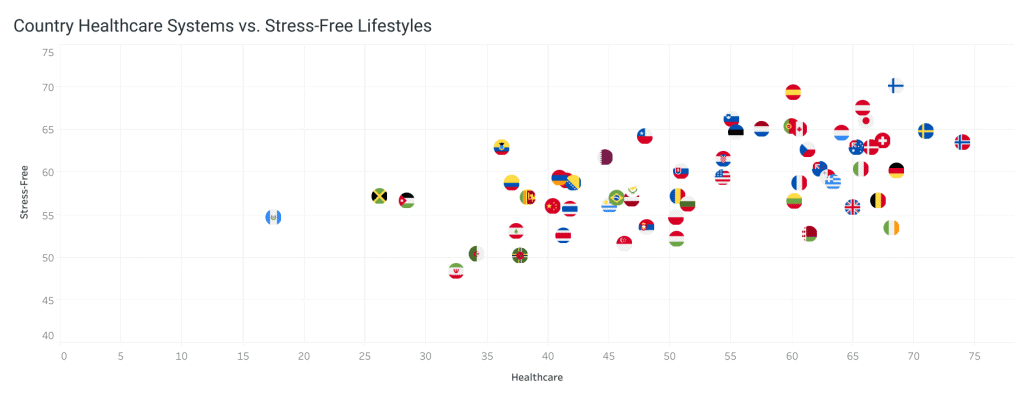
In one of our previous studies, we looked at some of the best countries in the world for enjoying a stress-free retirement. Top of the list was Finland. Sweden also made the top ten in this study, too, as did Austria and Japan (which also score well in this study). This makes these four countries some of the most standout when it comes to choosing a healthy and happy place to retire to. 

Methodology 

Our research began with 189 countries before being reduced to 161 who had a full set of data for us to compare. We then selected 9 categories that analyzed the differences in healthcare systems around the world. These were: 

  • Life Expectancy – Life expectancy at birth indicates the number of years a newborn infant would live if prevailing patterns of mortality at the time of its birth were to stay the same throughout its life.
  • Health Expenditure per Capita – Current expenditures on health per capita in current US dollars. Estimates of current health expenditures include healthcare goods and services consumed during each year.
  • Percentage of Health Expenditure from Public Funds – We used the total amount of healthcare expenditure to come from public funds and compared to the overall health expenditure per capita to create a percentage.
  • Hospital Beds (per 1,000 people) – Hospital beds include inpatient beds available in public, private, general, and specialized hospitals and rehabilitation centers. In most cases, beds for both acute and chronic care are included.
  • Physicians (per 1,000 people) – Physicians include generalists and specialist medical practitioners.
  • Nurses and Midwives (per 1,000 people) – Nurses and midwives include professional nurses, professional midwives, auxiliary nurses, auxiliary midwives, enrolled nurses, enrolled midwives, and other associated personnel, such as dental nurses and primary care nurses.
  • Specialist Surgical Workforce (per 100,000 population) – The specialist surgical workforce is the number of specialist surgical, anesthetic, and obstetric (SAO) providers who are working in each country per 100,000 population.
  • Healthcare Access and Quality Index – 32 causes from which deaths should not occur were selected in the presence of effective care and approximate personal health-care access and quality by location over time. Scored from 0-100.
  • Universal Health Coverage – Each country was researched individually to find out what type of healthcare system it had. Three categories were then generated: Universal and government-funded healthcare (100 points), universal healthcare but not fully government-funded, often with insurance, co-payments, or out-of-pocket payments (50 points), or no universal healthcare (0 points). The latter category has some countries that have not achieved universal health care but do have some free healthcare for residents, we choose to score them as 0 to make universality the key importance in our study. This meant that countries like Jamaica which offer free healthcare to citizens still scored 0 because they have not achieved universal healthcare yet. Similarly, the US scored 0 for not having universal healthcare.

Our scoring system ranked the countries from 0-100 for each category, the highest scores got 100 points and the lowest scores getting zero points. All of the countries in between these two scores received a score on a percentile basis, depending on where they ranked. 

A total score was achieved by averaging each country’s score across the 9 categories. 

Sources – 

https://data.worldbank.org/indicator/SP.DYN.LE00.IN

https://data.worldbank.org/indicator/SH.XPD.CHEX.PC.CD

https://data.worldbank.org/indicator/SH.XPD.PVTD.PC.CD

https://data.worldbank.org/indicator/SH.XPD.GHED.PC.CD

https://data.worldbank.org/indicator/SH.XPD.OOPC.PC.CD

https://data.worldbank.org/indicator/SH.MED.CMHW.P3

https://data.worldbank.org/indicator/SH.MED.BEDS.ZS

https://data.worldbank.org/indicator/SH.MED.PHYS.ZS

https://data.worldbank.org/indicator/SH.MED.NUMW.P3

https://data.worldbank.org/indicator/SH.MED.SAOP.P5

https://www.thelancet.com/journals/lancet/article/PIIS0140-6736(18)30994-2/fulltext#fig4

Read More

Eboni K. Williams’ Black Leather Booties

Eboni K. Williams’ Black Leather Booties With Leah

Real Housewives of New York Season 13 Episode 2 Fashion

While Ramona felt a very “natural bond” upon meeting RHONY newbie Eboni K. Williams, we feel a very natural bond with her black leather booties in this scene. And you feel the same way, well then you should probably scroll on down below so that at least your feet are good-to-go the next time someone pulls a Sonja and checks you up and down. 👀


Fashionably,

Faryn


Eboni K. Williams’ Black Leather Booties

Click Here to Shop Her Rag & Bone Booties

Click Here For Additional Stock

And Here For More Stock

And Here For Even MORE Stock

Originally posted at: Eboni K. Williams’ Black Leather Booties

Read More

Why Perseverance Should Be the Mantra of Dynamic Women Over 60

Dynamic Women Over 60

If I had to define what I see as the mantra of the amazing, inspiring, dynamic 60+ers I so admire, it would be “Stay positive. Put in the effort. Keep on truckin’.” OK, not elegant, hardly haiku material, but so true!

Seniors who thrive, who live a happy, healthy, engaged life, know perfectly well they have an expiration date – but they appear to ignore it. They behave as if they will live forever! And because of that particular combination of attitude and perseverance, they succeed where others might fail.

Take, for example, Diane Friedman who – at 96! – ran the 100-meter dash in 30.18 seconds at the Lake Erie Association USA Track & Field meet, thereby setting the all-time World Record for women in her age group.

Meet an “AMAZING!” with the perfect antidote to boredom: running!
DIANE FRIEDMAN, 96, donned her track shoes and started…

Posted by Meet The Amazings on Thursday, November 16, 2017

She had stopped running some 16 years prior, but found herself dissatisfied with simply sitting, which was what she had been doing once she retired from the work world.

Stay Positive

At 95, she was not going to put up with being bored any longer.

Putting in the Effort

Diane found a local track coach who was willing to work with her. She ran up and down her apartment house hallways as her coach’s way of starting her off. She persisted with her training, as daunting as it no doubt was at times.

Keep on Truckin’?

Diane is still running! Who knows what more she will achieve? She certainly is not shelving her track shoes just because she’s rounding the corner to her 100th birthday.

Science backs up Diane’s results, and many more like hers. Angela Duckworth, PhD, became curious about why students with natural ability weren’t necessarily those who succeeded in their studies.

Her research showed they lacked what she calls ‘grit’ – passion plus perseverance. Natural ability, what might be thought of as ‘talent,’ is nice, but it doesn’t guarantee much of anything.

According to her research, those who succeed magnificently in life have both a passion for something and the perseverance to do what it takes to achieve whatever that is. It doesn’t matter whether you’re 10-years-old or 100. This maxim will hold true.

Grit Does Not Just Apply to Competitive Sports

Lest you think such grit only applies to competitive sports, as exemplified by Diane Friedman, here’s a very different example of grit.

Once upon a time, there were identical twins, Sue Hollinger and Elrose Couric. They each got married, raised their families and were busy with their respective lives, which meant they didn’t have much time for each other.

Meet “AMAZING!” twins who shared the adventure of a lifetime!
SUE HOLLINGER & ELROSE COURIC, 80, identical twins, hiked…

Posted by Meet The Amazings on Thursday, April 13, 2017

When their husbands died within a few years of each other, both women, who were in their mid-60s, found themselves with more time to fulfill what had always been their mutual desire – to spend fun time together. But doing what? Sitting on a porch only satisfies for so long.

The sisters decided to hike the Appalachian Trail, some 2,190 miles long. Considering neither of them were hikers, this was quite an undertaking. The sisters didn’t just plow through the trail in one fell swoop.

It took them 14 years to hike the trail, in bits and pieces, during which time they encountered bears, fell more times than they could count, almost drowned and were attacked by yellow-jackets – none of which stopped Sue or Elrose.

At the age of 80, the sisters had fulfilled their passion – to spend quality time together having fun – and demonstrated their ability to put in the effort and to keep on truckin.’

Grit Matters

Whether your passion is the ultimate soufflé, baked from scratch with your unique recipe, or swimming the English Channel, perseverance is what will see it through.

Keeping your attitude positive throughout – with the support of friends or family, with affirmations, prayer or whatever works for you – and putting in the necessary effort, will reap huge rewards.

You will accomplish not only your cherished goal, but more importantly, in terms of your increased happiness, your increased health and longevity.

Keep on truckin’!

What is your passion? Are you satisfied you’re following your passion or could you do more? Do you have an example of how you showed grit in your life? Please share your story in the comments below.

Read More